

[2025] Salesforce-MuleSoft-Developer-I Exam Dumps, Test Engine Practice Test Questions
Pass Salesforce-MuleSoft-Developer-I exam [Oct 13, 2025] Updated 237 Questions
Salesforce Salesforce-MuleSoft-Developer-I Exam Syllabus Topics:
| Topic | Details |
|---|---|
| Topic 1 |
|
| Topic 2 |
|
| Topic 3 |
|
| Topic 4 |
|
| Topic 5 |
|
| Topic 6 |
|
| Topic 7 |
|
NEW QUESTION # 57
In an application network. If the implementation but not the interface of a product API changes, what needs to be done to the other APIs that consume the product API?
- A. The applications associated with the other APIs must be restarted
- B. Nothing needs to be changed in the other APIs or their associated applications
- C. The applications associated with the other APIs must be recoded
- D. The other APIs must be updated to consume the updated product API
Answer: B
Explanation:
Correct answer is Nothing needs to be changed in the other APIs or their associated applications This is the benefit of having separate interface layer. As there are no changes to interface , no changes are required on the API's which consumes this API in context
NEW QUESTION # 58
What execution model is used by For Each and Batch Job scopes?
- A. Both are multi-threaded
- B. For Each is single-threaded and Batch Job is multi-threaded
- C. Batch Job is single-threaded and For Each Is multi-threaded
- D. Both are single-threaded
Answer: B
NEW QUESTION # 59
Where would you create SLA Tiers for an API?
- A. API Manager
- B. In RAML specifications
- C. Anypoint Studio
- D. Exchange
Answer: A
Explanation:
MuleSoft Doc Ref : https://docs.mulesoft.com/api-manager/2.x/policy-mule3-tutorial-manage-an-api#to-add-the-tier Steps to create SLA Tier are as follows:
1) In API Manager, in API Administration, click a version.
2) Check that the API supports resource-level policies: On the API version details page, in Status, click Configure Endpoint, and check that Type is RAML.
3) Choose the SLA Tiers, and click Add SLA Tier. Set up limit on SLA tier
NEW QUESTION # 60
Refer to the exhibits.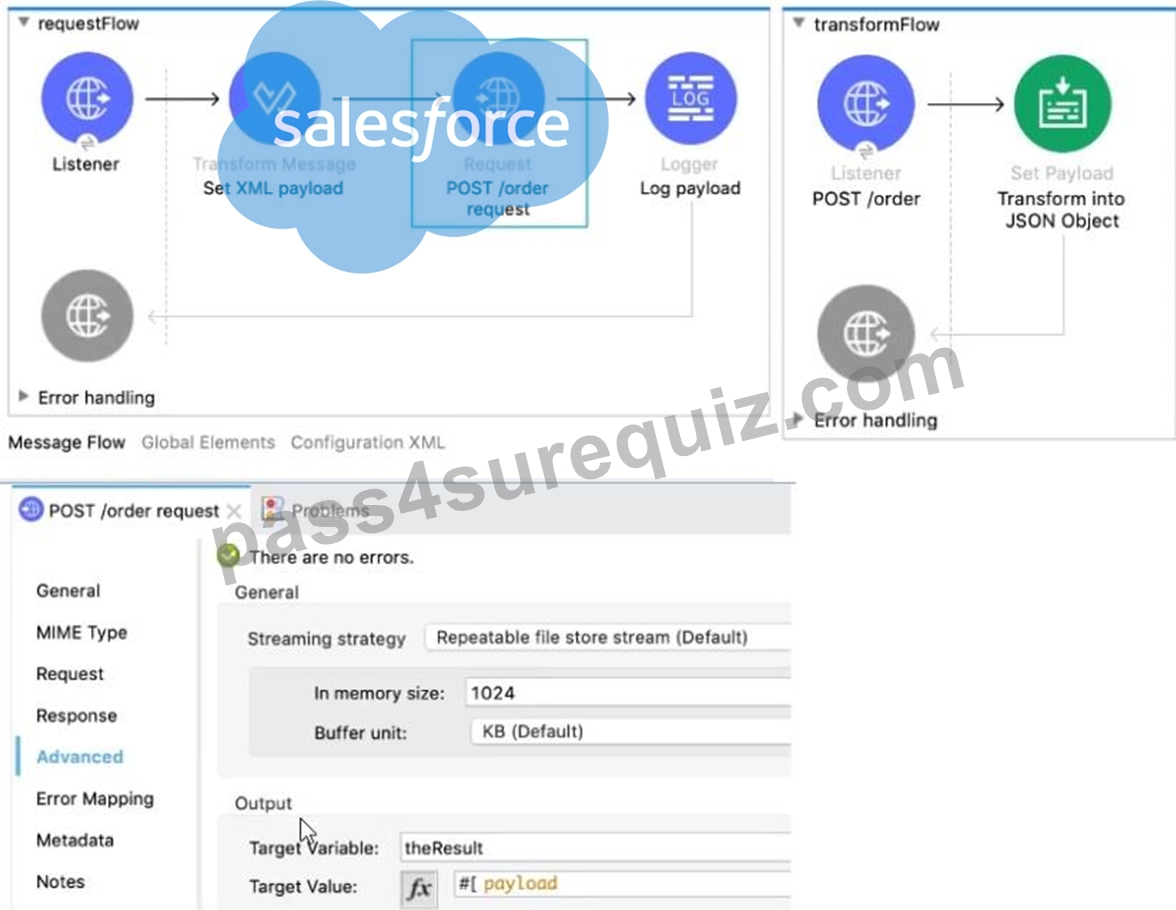
In the requestFlow an HTTP Request operation is configured to send an HTTP request with an XML payload. The request is sent to the HTTP Listener in the transform Flow.
That flow transforms the incoming payload into JSON format and returns the response to the HTTP request. The response of the request is stored in a target variable named the Result.
What is the payload at the Logger component after the HTTP Request?
- A. null
- B. A non-empty Java object
- C. The original XML payload
- D. The returned JSON response
Answer: C
NEW QUESTION # 61
A shopping API contains a method to look up store details by department To get information for a particular store, web clients will submit requests with a query parameter named department and a URI parameter named storeld.
What is a valid RAML snippet that supports requests from web clients to get data for a specific storeld and department name?
- A.
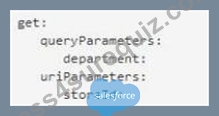
- B.

- C.
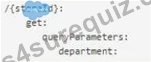
- D.
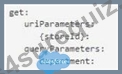
Answer: C
Explanation:
Lets revise few concepts RAML which can help us to find the answer of this question.
URI Parameters
Lets have a look at below example.
/foos:
/{id}:
/name/{name}:
Here, the braces { } around property names define URI parameters. They represent placeholders in each URI and do not reference root-level RAML file properties as we saw above in the baseUri declaration. The added lines represent the resources /foos/{id} and /foos/name/{name}.
Query Parameters
Now we'll define a way to query the foos collection using query parameters. Note that query parameters are defined using the same syntax that we used above for data types:
/foos:
get:
description: List all Foos matching query criteria, if provided;
otherwise list all Foos
queryParameters:
name?: string
ownerName?: string
Based on the above information , below is the only option which defines storeid as uri parameter and department as query parameter.
/{storeId}:
get:
queryParameter:
department:
NEW QUESTION # 62
Refer to the exhibits.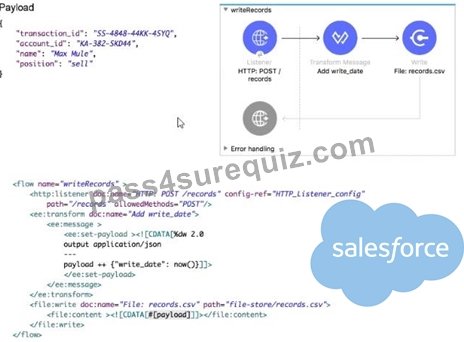
What is written to the records.csv file when the flow executes?
- A. The payload convert to CVS
- B. Nothing
- C. The JSON payload
- D. An error message
Answer: C
Explanation:
Transform Message Add write_date is coverting payload in JSON format and same JSON payload is avaialble to file write processor. However, if the payload is a different format (for example, not CSV) , you can place the transformation inside the Write operation to generate content that will be written without producing a side effect on the message in transit. This is not done in this case. By default, the connector writes whatever is in the message payload. Hence JSON payload will be written to file.
NEW QUESTION # 63
Pick the component with which DataWeave is tightly integrated.
- A. All APIs
- B. Mule runtime
- C. Flow Designer
- D. Exchange
Answer: B
Explanation:
Correct answer is Mule runtime
DataWeave is the MuleSoft expression language for accessing and transforming data that travels through a Mule app. DataWeave is tightly integrated with the Mule runtime engine, which runs the scripts and expressions in your Mule app.
Mule Doc Reference : https://docs.mulesoft.com/mule-runtime/4.3/dataweave
NEW QUESTION # 64
A Mule application's HTTP Listener is configured with the HTTP protocol. The HTTP listeners port attribute is configured with a property placeholder named http.port. The mule application sets the http.port property placeholder's value to 9090 The Mule application is deployed to CloudHub without setting any properties in the Runtime manager Properties tab and a log message reports the status of the HTTP listener after the Mule application deployment completes.
After the mule applications is deployed, what information is reported in the worker logs related to the port on which the Mule application's HTTP Listener listens?
- A. The HTTP Listener failed to bind to the port and is not listening for connections
- B. The HTTP Listener is listening on port 9090
- C. The HTTP Listener is listening on port 8081
- D. The HTTP Listener is listening on port 80
Answer: C
Explanation:
Cloudhub expose services on port 8081 and override value in http.port with this one .
Sample log in Runtime Manager is below
21:15:53.148 08/08/2021 Worker-0 ArtifactDeployer.start.01 INFO
Listening for connections on 'http://0.0.0.0:8081'
NEW QUESTION # 65
Refer to the exhibit.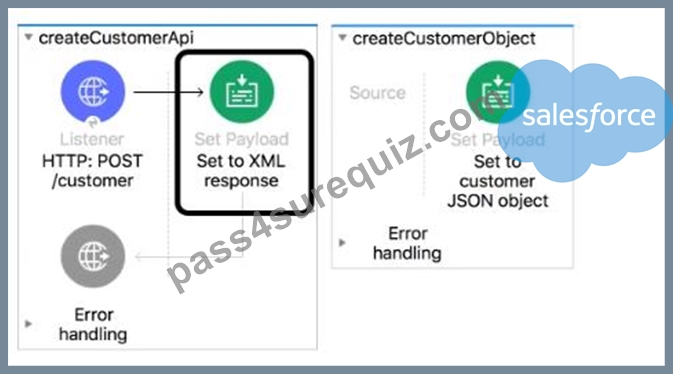
What is the correct DataWeave expression for the Set Payload transformer to call the createCustomerObject flow with values for the first and last names of a new customer?
- A. createCustomerObject( { first: "Alice", last: "Green" > )
- B. createCustomerObject( "Alice", "Green")
- C. lookupf "createCustomerObject", { first: "Alice", last: "Green" > )
- D. lookupC createCustomerObJect( "Alice", "Green- ) )
Answer: C
Explanation:
lookup(String, Any, Number)
This function enables you to execute a flow within a Mule app and retrieve the resulting payload.
It works in Mule apps that are running on Mule Runtime version 4.1.4 and later.
Similar to the Flow Reference component (recommended), the lookup function enables you to execute another flow within your app and to retrieve the resulting payload. It takes the flow's name and an input payload as parameters. For example, lookup("anotherFlow", payload) executes a flow named anotherFlow.
Correct answer is
lookup( "createCustomerObject", {first: "Aice, last: "Green"})
MuleSoft Documentation Reference : https://docs.mulesoft.com/mule-runtime/4.3/dw-mule-functions-lookup
NEW QUESTION # 66
Correct answer is {customerID}.
- A. var toUpper(userName) = upper(userName)
- B. var toUpper(userName) -> upper(userName)
- C. fun toUpper(userName) = upper(userName)
- D. fun toUpper(userName) -> upper(userName)
Answer: C
Explanation:
Reference:
A function named toUpper needs to be defined that accepts a string named userName and returns the string in uppercase.
What is the correct DW code to define the toUpper function?
NEW QUESTION # 67
Refer to the exhibit.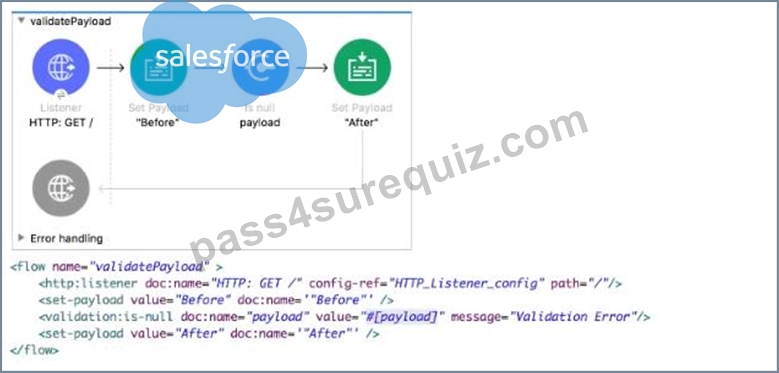
What is the response to a web client request to http://localhost:8081?
- A. before
- B. null
- C. After
- D. Validation Error
Answer: D
Explanation: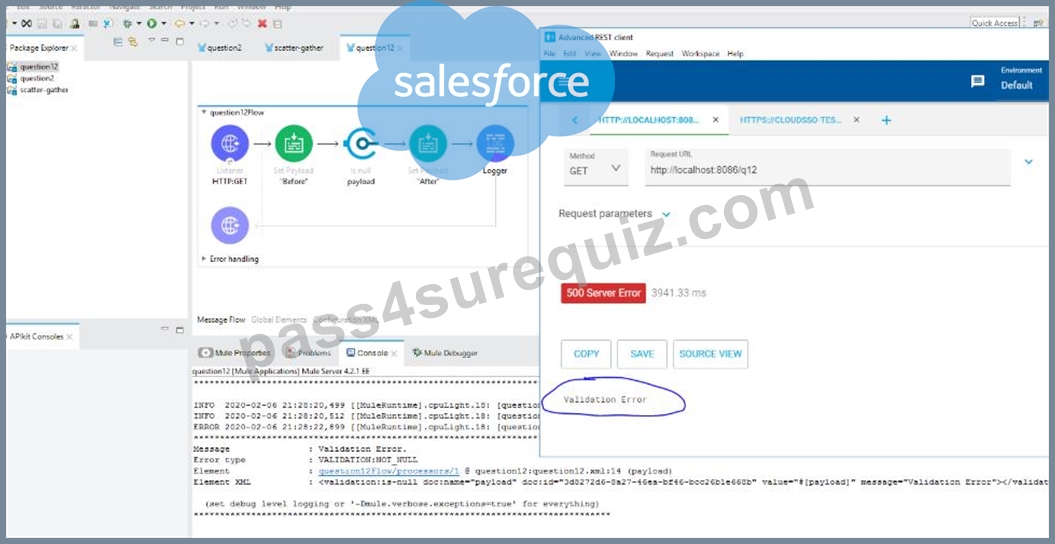
NEW QUESTION # 68
What is the main purpose of flow designer in Design Center?
- A. To design API RAML files in a graphical way
- B. To design and mock Mule application templates that must be implemented using Anypoint Studio
- C. To design and develop fully functional Mule applications in a hosted development environment
- D. To define API lifecycle management in a graphical way
Answer: C
Explanation:
Its primary function is to design and develop fully functional Mule applications in a hosted development environment.
NEW QUESTION # 69
Refer to the exhibits.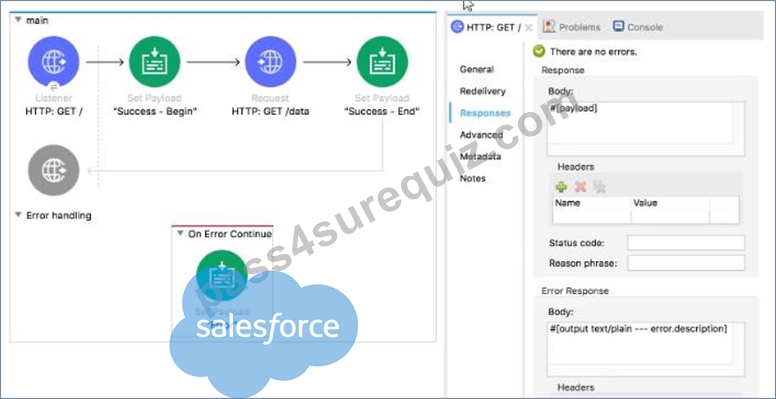
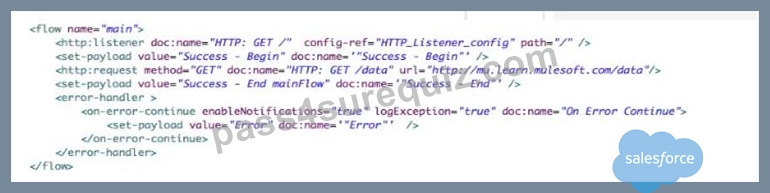
A web client submits a request to the HTTP Listener and the HTTP Request throws an error.
What payload and status code are returned to the web client?
Refer to the exhibits. A web client submits a request to the HTTP Listener and the HTTP Request throws an error.
What payload and status code are returned to the web client?
- A. Response body: "Error" Default response status code: 200
- B. Response body: "Success - Begin* Default response status code: 200
- C. Response body: "Success - End" Default response status code: 200
- D. Error response body: error, description Default error response status code: 500
Answer: A
Explanation:
Correct Answer: Response body: "Error" Default response status code: 200.
-------------------------------------------------------------------------------------------------------------------------------------------------
1) Payload is successfully set to "Success - Started Flow"
2) When HTTP Request throws an error, execution halts
#[error.description] = "ABC"
#[error.errorType] = "XYZ"
3) The On Error Continue scope handles the error. When On Error Continue scope is invoked, all the processors in error block are executed and success response is sent back to the client with payload which is set in error flow. In this case payload is set to "Error" value in error block.
4) "Error" is returned to the requestor in the body of the HTTP request with HTTP Status Code: 200 as On error continue always sends success error code.
Reference Diagram: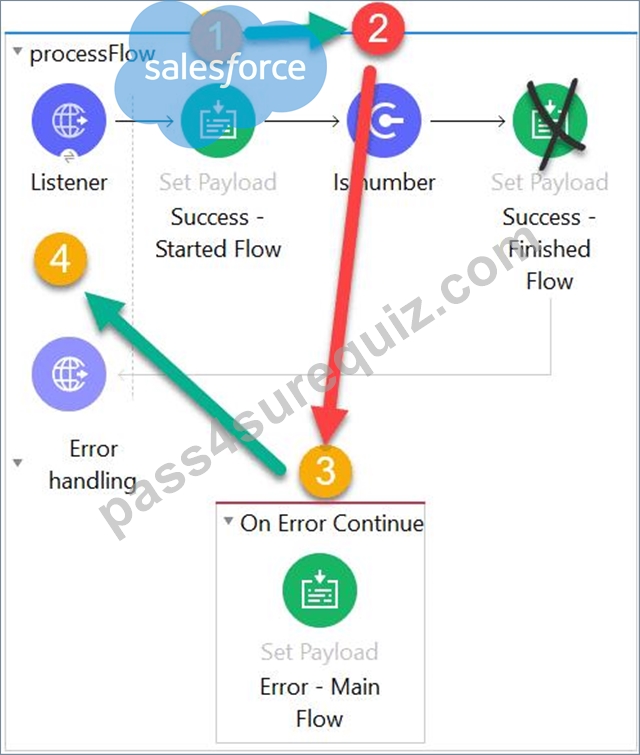
NEW QUESTION # 70
Refer to the exhibit.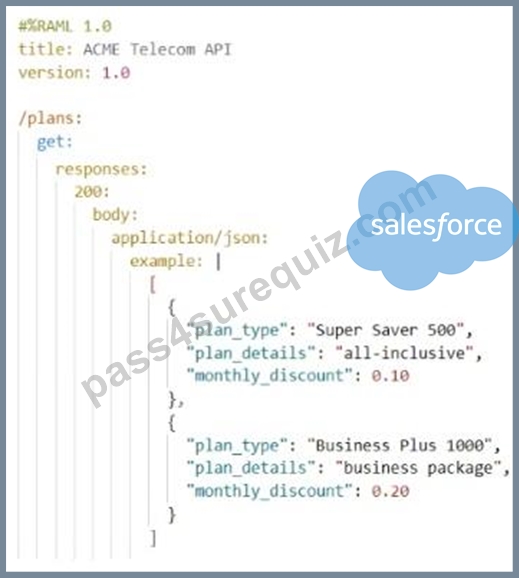
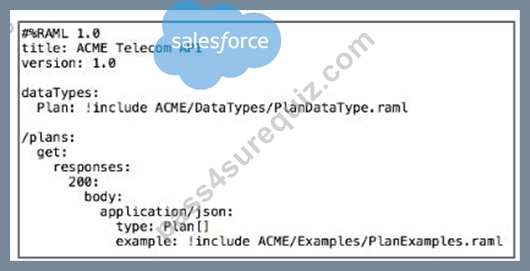
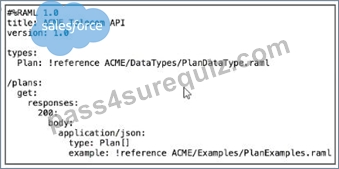
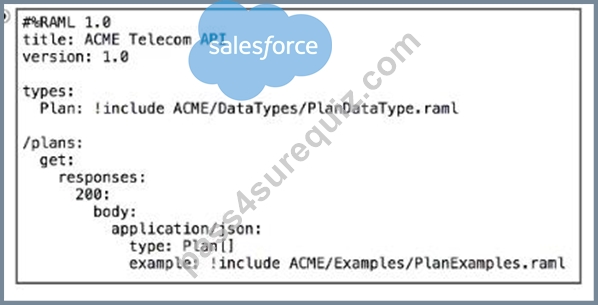
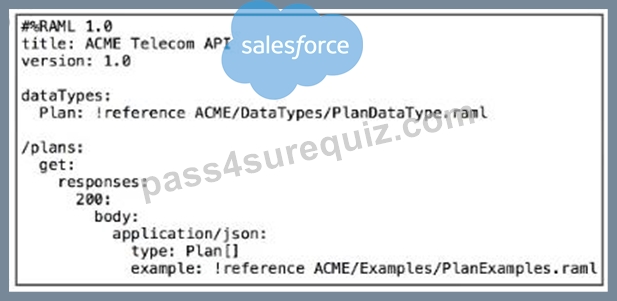
The API needs to be updated using the company-wide standard for the Plan data type. The Object data type has already been published in Anypoint Exchange with the global reference . ACME/DataTypes/PlanDataType.raml.
What is a valid RAML specification that reuses the Plan data type?
- A.
- B.
- C.
- D.
Answer: C
Explanation:
As can be seen in RAML, POST expects input in application/json format which eliminates two of the options as two options are in xml format.
Now out of the two remaining options, one has id field in request which is only mentioned for get response and not for POST request. Hence id field is not expected in POST request.
Hence correct answer is
{
"name": "GoerdiLa Forge",
"address": "1 Westland CA",
"customer_since": "2014-01-04",
"balance": "4829.29",
"bank_agend_id": "12556"
}
NEW QUESTION # 71
Refer to the exhibit.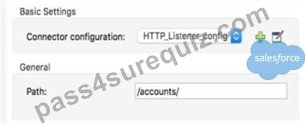
What is the correct syntax to add a customer ID as a URI parameter in an HTTP Listener's path attribute?
- A. #[customerlD]
- B. ${ customerID}
- C. (customerlD)
- D. {customerlD}
Answer: D
NEW QUESTION # 72
What is not the function of API Gateway ?
- A. Specify throttling , security and other policies
- B. Determine which traffic is authorized to pass through the API to backend services
- C. Logs all transactions , collecting and tracking analytics data
- D. Meter the traffic flowing through
Answer: A
Explanation:
Correct answer is Specify throttling , security and other policies
MuleSoft Doc Ref : https://docs.mulesoft.com/api-manager/2.x/api-gateway-capabilities-mule4 API Gateway is responsible for below functions.
1) Determine which traffic is authorized
2) Meter the traffic
3) Logs transaction
4) Apply throttling and other policies (Not specifying. These are specified in API Manager)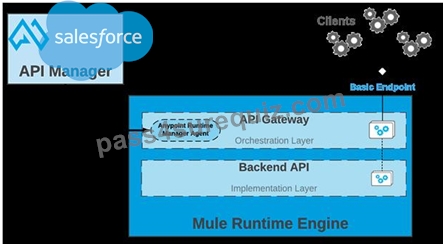
NEW QUESTION # 73
According to Semantic Versioning, which version would you change for incompatible API changes?
- A. MINOR
- B. MAJOR
- C. No change
- D. PATCH
Answer: B
Explanation:
Correct answer is MAJOR
MAJOR version when you make incompatible API changes, MINOR version when you add functionality in a backwards compatible manner, and PATCH version when you make backwards compatible bug fixes.
For details refer to this documentation : https://semver.org/
NEW QUESTION # 74
- A.

- B.
- C.

- D.

- E. Option C
- F. Option B
- G. Option A
- H. Option D
Answer: B,F
NEW QUESTION # 75
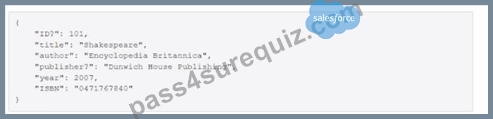
A web client submits a request to http://localhost:8081/books/0471767840. The value "0471767840" is captured by a Set Variable transformer to a variable named booklSBN.
What is the DataWeave expression to access booklSBN later in the flow?
- A. vars. booklSBN
- B. flowVars.booklSBN
- C. attributes.booklSBN
- D. booklSBN
Answer: A
NEW QUESTION # 76
What valid RAML retrieves details on a specific customer by its customerId as a URI parameter?
- A. 1. /customers:
2. get:
3. /{customerId}: - B. 1. /customers:
2. /get:
3. /customerId: - C. 1. /customers:
2. /customerId:
3. get: - D. 1. /customers:
2. /{customerId}:
3. get:
Answer: D
Explanation:
Correct answer is below as it follows the correct syntax.
/customers:
/{customerId}:
get:
NEW QUESTION # 77
......
Salesforce Salesforce-MuleSoft-Developer-I Real 2025 Braindumps Mock Exam Dumps: https://www.pass4surequiz.com/Salesforce-MuleSoft-Developer-I-exam-quiz.html
Salesforce Salesforce-MuleSoft-Developer-I Actual Questions and 100% Cover Real Exam Questions: https://drive.google.com/open?id=1UmMoq-vCgMxwO1NuMVsUmMomuEhg_4Sv