

2025 Valid SAVIGA-C01 FREE EXAM DUMPS QUESTIONS & ANSWERS
Free SAVIGA-C01 Exam Braindumps Saviynt Pratice Exam
NEW QUESTION # 28
Which of the following aspects in EIC is regarded as a unique identity of a person?
- A. User
- B. Endpoint
- C. Account
- D. Employee
Answer: A
Explanation:
In Saviynt, a User represents the unique identity of a person. It's the central object that ties together all the information about an individual, including their accounts, entitlements, roles, and attributes.
Why other options are incorrect:
* Endpoint: Represents a system or application, not a person.
* Employee: While many users might be employees, the term "user" is more general and can include contractors, partners, etc.
* Account: Represents a user's access to a specific system, not their overall identity.
Saviynt IGA References:
* Saviynt Documentation: Throughout the documentation, "User" consistently refers to the individual's identity within the system.
* Saviynt User Interface: The User Management section in Saviynt focuses on managing the lifecycle and access of individual users.
NEW QUESTION # 29
Which of the following options is part of the Saviynt Identity Repository?
- A. Users, User Groups, Workflows, SAV Roles
- B. Users, Accounts, Entitlements, Roles
- C. Users, Accounts, Entitlements, Workflows
- D. Users, Identity Rules, Workflows, Roles
Answer: B
Explanation:
Saviynt's Identity Repository is the central hub for storing and managing all identity-related information. It includes:
* Users: Representing individuals and their attributes.
* Accounts: Representing user access to specific systems or applications.
* Entitlements: Representing permissions and access rights within those systems.
* Roles: Representing collections of entitlements that define job functions or responsibilities.
Why other options are incorrect:
* A, B, and D: These options include elements like Identity Rules, Workflows, and SAV Roles, which are important components of Saviynt but are not core parts of the Identity Repository itself.
Saviynt IGA References:
* Saviynt Documentation: The section on the Identity Repository describes its function and the types of data it stores.
* Saviynt User Interface: The Identity Repository is a key section within the Saviynt interface, where you can view and manage users, accounts, entitlements, and roles.
NEW QUESTION # 30
There is a requirement to have multiple users as Campaign Owners for a User Manager Campaign.
Which of the following configurations would be appropriate to achieve this?
- A. Create a Roles Query and add Roles of various users
- B. Create a user group and choose the user group as the Campaign Owner
- C. Create an Organization Query and add users
- D. Create a user Query and add users
Answer: B
Explanation:
To have multiple users as Campaign Owners for a User Manager Campaign in Saviynt, the appropriate configuration is to B. Create a user group and choose the user group as the Campaign Owner. Here's the explanation:
* Saviynt's User Groups: User groups are collections of users that can be used for various purposes, including assigning roles, permissions, and ownership.
* Campaign Owner as a User Group: Saviynt allows you to specify a user group as the owner of a campaign. This means that all members of the group will have the same campaign ownership permissions.
* Benefits of Using a User Group:
* Simplified Management: It's easier to manage a group of users than to assign individual users as campaign owners.
* Flexibility: You can easily add or remove users from the group to adjust campaign ownership as needed.
* Shared Responsibility: All members of the group share responsibility for managing the campaign.
* Why Other Options Are Less Suitable:
* A. Create a user Query and add users: While you can use queries to select users, directly using a user group is a more standard and manageable approach for assigning multiple campaign owners.
* C. Create a Roles Query and add Roles of various users: Roles are typically used for granting access rights, not for defining campaign ownership.
* D. Create an Organization Query and add users: Organization queries are related to the organizational structure and are not the best way to define a group of campaign owners.
In conclusion: Using a user group as the Campaign Owner in Saviynt provides a flexible and manageable way to assign multiple users as owners, simplifying administration and promoting shared responsibility for campaign management.
NEW QUESTION # 31
Which of the following should be enabled in the User Update Rule when the Rule has to be applied for an existing user?
- A. Trigger when user is updated from import
- B. Action > Rerun All Provisioning Rules
- C. Retrofit rule actions for users
- D. Trigger when user is created from import
Answer: C
Explanation:
To apply a User Update Rule to existing users in Saviynt, you should enable the option B. Retrofit rule actions for users. Here's an explanation:
* Saviynt's User Update Rules - Initial Application: When a User Update Rule is created, it typically applies to users who are newly created or updated after the rule is put in place.
* Retrofit Functionality: The "Retrofit rule actions for users" option allows you to apply the rule retroactively to users who already exist in the system and meet the rule's conditions.
* How it Works: When enabled, Saviynt will evaluate the rule against all existing users. If a user matches the rule's conditions, the defined actions (e.g., assigning roles, updating attributes) will be applied to that user, even if they were created before the rule.
* Use Cases: This is useful when you create a new rule that should have been in place all along, or when you need to make a broad change to existing user configurations based on a new policy.
* Other Options:
* A. Trigger when user is created from import: This applies the rule to new users imported into Saviynt, not existing users.
* C. Trigger when user is updated from import: This applies the rule when existing users are updated via import, but it won't necessarily apply to all existing users who meet the conditions.
* D. Action > Rerun All Provisioning Rules: This action is more general and might not be the most efficient way to apply a specific User Update Rule retroactively.
In summary: The "Retrofit rule actions for users" setting within a Saviynt User Update Rule is crucial for applying the rule's logic and actions to existing users, ensuring consistent configuration across the user base.
NEW QUESTION # 32
Which of the following Rules should always be used in conjunction with the Organization object?
- A. Scan Rule
- B. Request Rule
- C. Technical Rule
- D. User Update Rule
Answer: D
Explanation:
The type of Rule that should always be used in conjunction with the Organization object in Saviynt is the B.
User Update Rule. Here's the explanation:
* Saviynt's Organization Object: The Organization object in Saviynt represents the organizational structure or hierarchy (e.g., departments, locations, cost centers). It's often used to define relationships between users and organizational units.
* User Update Rule: This type of rule is designed to automatically update user attributes based on changes in other user attributes or related objects.
* Using Organization with User Update Rule: The User Update Rule is frequently used with the Organization object to automate user management based on organizational changes.
* Example: You can create a User Update Rule that automatically assigns users to specific roles or groups based on their department (defined in the Organization object). If a user is moved to a different department, the rule will trigger and update their roles or group memberships accordingly.
* Dynamic User Management: This combination enables dynamic user management, ensuring that user attributes and access rights are automatically adjusted as users move within the organization.
* Other Options:
* A. Technical Rule: Technical Rules are more general-purpose and can be used for various tasks, but they are not specifically tied to the Organization object.
* C. Scan Rule: Scan Rules are used for data analysis and identifying potential issues, not for updating user attributes based on organizational structure.
* D. Request Rule: Request Rules are related to access request workflows, not to automatic user updates.
In essence: The User Update Rule, when used in conjunction with the Organization object, provides a powerful way to automate user management in Saviynt, ensuring that user attributes and access rights are dynamically updated based on changes in the organizational structure.
NEW QUESTION # 33
Adam, an Admin, created a rule to provide birthright access; however, the access should be deprovisioned when the condition fails. Which of the following options should be applied for this scenario?
- A. Remove the Access Rule
- B. Remove the birthright Access if the condition fails under the created Rule
- C. Use the Request Rule
- D. Apply a new Technical Rule to remove the Access
Answer: B
Explanation:
To automatically deprovision birthright access when the defining condition fails, the correct option is C.
Remove the birthright Access if the condition fails under the created Rule. Here's a detailed explanation:
* Saviynt's Birthright Access (Automatic Provisioning): Saviynt allows administrators to define rules that automatically grant access (birthright access) based on user attributes or other criteria (e.g., new hires in a specific department automatically get access to certain applications).
* Rule-Based Access Management: These rules are a core part of Saviynt's access management capabilities, allowing for dynamic and automated provisioning.
* "Remove the birthright Access if the condition fails": This option, typically found within the birthright rule configuration itself, is crucial for ensuring that access is revoked when the conditions that granted it are no longer met.
* Example: If a user is granted access to an application because they are in the "Sales" department, and they are later moved to the "Marketing" department, the condition for the birthright rule would fail, and Saviynt would automatically deprovision the access.
* Saviynt's Continuous Monitoring: Saviynt continuously monitors user attributes and rule conditions.
When a change occurs that causes a condition to fail, the deprovisioning action is triggered.
* Other Options:
* A. Remove the Access Rule: This would remove the entire rule, preventing it from granting access to anyone, not just the user whose condition has failed.
* B. Apply a new Technical Rule to remove the Access: While technically possible, it's less efficient and more complex than using the built-in option within the birthright rule.
* D. Use the Request Rule: Request Rules are for access requests, not for automatically provisioning or deprovisioning birthright access.
NEW QUESTION # 34
To help users make informed and quick decisions, Saviynt provides filters for retrieving Certification data in the User Manager Campaign and Service Account Campaign.
Which of the following options cannot be regarded as a Smart Filter?
- A. Out-of-Band Access for Entitlements
- B. Risk Level for Accounts
- C. Access with SoD Violations
- D. User's Assigned Role counts
Answer: D
Explanation:
The option that cannot be regarded as a Smart Filter in Saviynt's User Manager and Service Account Campaigns is A. User's Assigned Role counts. Here's why:
* Saviynt's Smart Filters: Smart Filters are pre-defined filters in Saviynt that help Certifiers quickly focus on specific access patterns or risk indicators during a certification campaign. They are designed to highlight potentially problematic or high-risk access.
* Examples of Smart Filters:
* B. Access with SoD Violations: This is a Smart Filter because it highlights access that violates Segregation of Duties policies, a significant risk indicator.
* C. Out-of-Band Access for Entitlements: This is a Smart Filter as it identifies access that was granted outside of the normal Saviynt processes, potentially indicating a security risk.
* D. Risk Level for Accounts: This is a Smart Filter because it allows Certifiers to focus on accounts with high-risk levels, which might require more scrutiny.
* Why "User's Assigned Role counts" Is Not a Smart Filter:
* Not a Risk Indicator: Simply knowing the number of roles assigned to a user doesn't inherently indicate a risk or a specific access pattern that requires attention. A user might have many roles legitimately, or they might have few roles but with high-risk access.
* Not Actionable: This information alone doesn't provide enough context for a Certifier to make an informed decision about whether to approve or revoke access.
* Alternative: While not a "Smart Filter", the number of roles assigned could be a data point displayed within the campaign, but it wouldn't be considered a pre-defined filter for highlighting risks.
NEW QUESTION # 35
Single Sign-On is enabled in EIC using Azure Identity Provider. In this scenario, can the user log in using Azure and EIC native authentication?
- A. True
- B. False
Answer: B
Explanation:
When Single Sign-On (SSO) is enabled in Saviynt EIC using an external Identity Provider (IdP) like Azure AD, it generally becomes the exclusive authentication method. This means users cannot use Saviynt's native authentication (i.e., logging in with a username/password stored directly within Saviynt).
Reasons for this:
* Security and Centralized Control: SSO with an IdP enhances security by centralizing authentication and enforcing stronger password policies. Allowing native logins would create a potential bypass of these security measures.
* User Experience: SSO provides a seamless login experience, eliminating the need for users to remember multiple credentials. Offering both SSO and native logins could lead to confusion and a less streamlined process.
* Administrative Efficiency: SSO simplifies user management by delegating authentication to the IdP.
Administrators don't need to manage separate user accounts and passwords within Saviynt.
Saviynt IGA References:
* Saviynt Documentation: Saviynt's documentation on SSO configurations emphasizes that enabling SSO typically disables native authentication methods.
* Saviynt Best Practices: Saviynt's best practices for SSO recommend enforcing SSO as the sole authentication method for improved security and user experience.
* Saviynt Implementation Guides: Implementation guides for setting up SSO with various IdPs, including Azure AD, often highlight the exclusive nature of SSO authentication.
NEW QUESTION # 36
Match the keyword of Column I with Column II.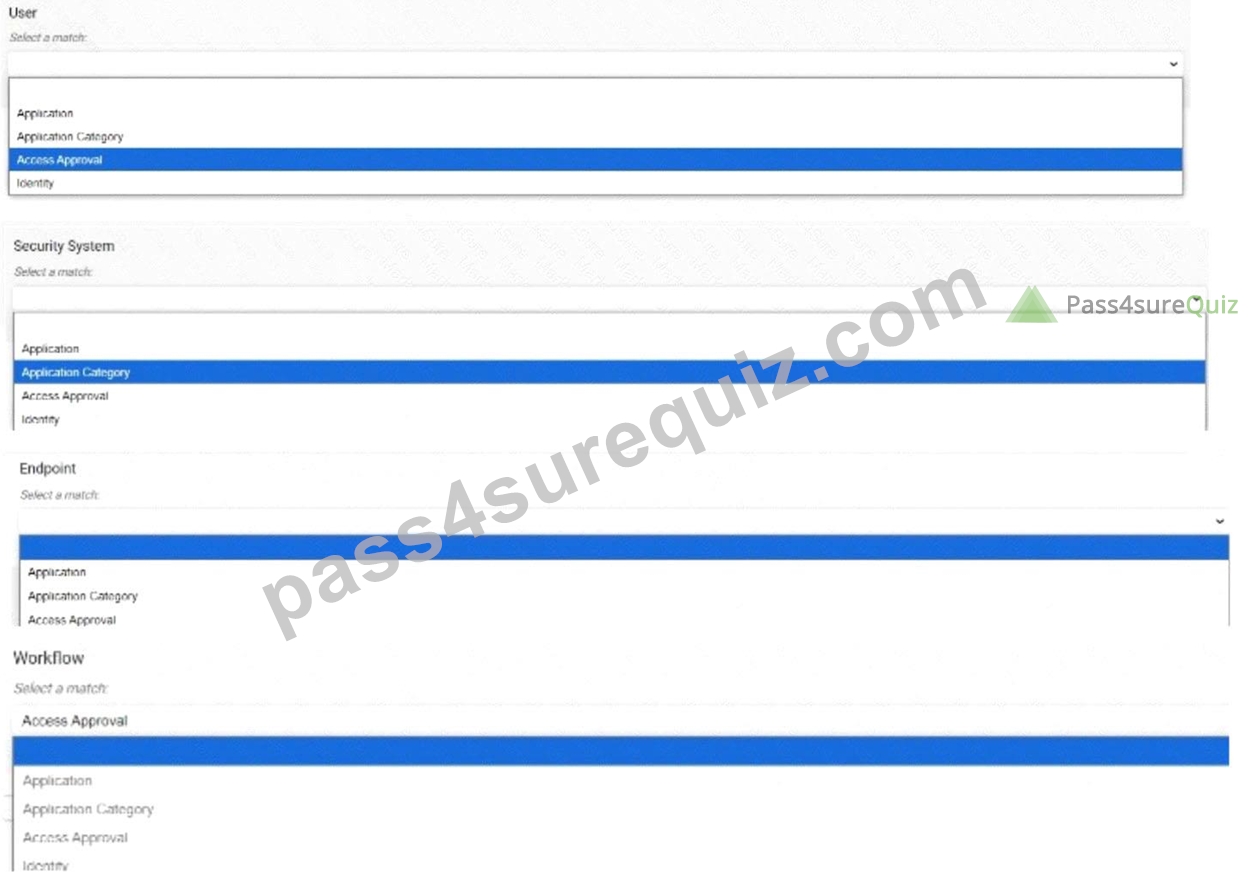
Answer:
Explanation: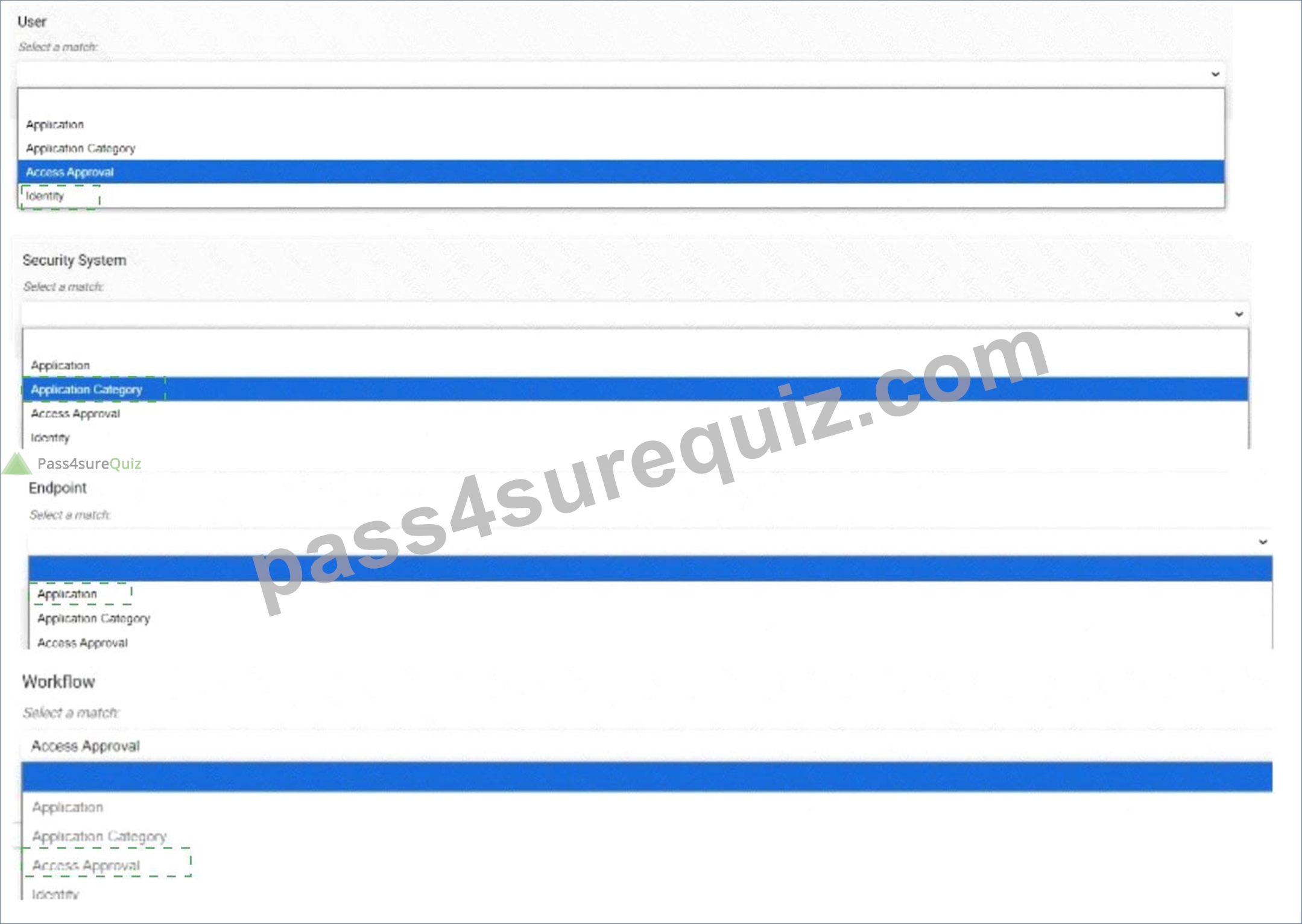
* User matches with Identity
* Security System matches with Application Category
* Endpoint matches with Application
* Workflow matches with Access Approval
* User and Identity: In the context of Identity and Access Management (IAM), "User" often relates to
"Identity" management, which deals with user accounts, profiles, and their associated attributes.
* Security System and Application Category: "Security System" is a broad term. Within the image, it is a category under which applications are managed, making "Application Category" the correct match.
* Endpoint and Application: "Endpoints" in Saviynt refer to the target systems or applications that are being managed or integrated. Therefore "Endpoint" relates to "Application."
* Workflow and Access Approval: "Workflows" are often used to define and automate processes, and in this case, it relates to the "Access Approval" process.
NEW QUESTION # 37
The Max Authentication Session parameter in Single Sign-On settings specifies the maximum duration, in seconds, for which an SSO session will remain valid. The default value is 3600 seconds. If the session logout value defined in IDP is 10,000 seconds and Max Authentication Session in Saviynt SSO is 5000 seconds, how long will the session last?
- A. 10,000 seconds
- B. None of the above
- C. 3600 seconds
- D. 5000 seconds
Answer: D
Explanation:
In Saviynt's SSO setup, the "Max Authentication Session" parameter determines the maximum duration of an SSO session within Saviynt, overriding any longer durations set by the Identity Provider (IdP).
* Session Duration Logic: Saviynt's internal session timeout setting takes precedence over the IdP's session timeout. This ensures that Saviynt can enforce its own security policies regarding session lifetimes.
Why other options are incorrect:
* B. 10,000 seconds: This is the IdP's session logout value, but Saviynt's "Max Authentication Session" setting overrides it.
* C. 3600 seconds: This is the default value, but the question specifies a configured value of 5000 seconds.
Saviynt IGA References:
* Saviynt Documentation: The documentation for configuring SSO settings within Saviynt explains the
"Max Authentication Session" parameter and its impact on session duration.
* Saviynt Best Practices: Saviynt's best practices for SSO often recommend aligning session timeouts between the IdP and Saviynt to avoid confusion and potential security gaps.
NEW QUESTION # 38
Which of the following actions is appropriate if the data displayed in the Campaign Preview mode does not meet the requirement?
- A. Export Campaign
- B. Activate Campaign
- C. Check Summary
- D. Re-configure Campaign
Answer: D
Explanation:
If the data displayed in the Campaign Preview mode does not meet the requirement in Saviynt, the appropriate action is A. Re-configure Campaign. Here's why:
* Saviynt's Campaign Preview Mode: This mode allows administrators to review the data that will be included in a campaign before activating it. It's a crucial step for ensuring that the campaign scope, data, and configuration are correct.
* Purpose of Preview Mode: The primary purpose of the preview is to identify any issues or discrepancies in the campaign setup before it goes live.
* Re-configure Campaign: If the preview reveals problems (e.g., incorrect users or entitlements are included, the wrong Certifiers are assigned, filters are not working as expected), the administrator needs to go back and re-configure the campaign settings. This might involve:
* Adjusting the campaign scope.
* Modifying filters or selection criteria.
* Changing Certifier assignments.
* Updating the campaign schedule or notifications.
* Why Other Options Are Incorrect:
* B. Check Summary: The summary provides a high-level overview of the campaign, but it doesn't allow for detailed data review like the preview mode.
* C. Export Campaign: Exporting the campaign data won't fix the underlying configuration issues.
* D. Activate Campaign: Activating a campaign with incorrect data would lead to inaccurate certification decisions and potential security risks.
NEW QUESTION # 39
If you want an application to be available for requesting access (self or other), which of the following should be configured?
- A. Access Remove Workflow
- B. Emergency Access ID Request Workflow
- C. Access Add Workflow
- D. Proposed Accounts Workflow
Answer: C
Explanation:
To make an application available for access requests (either self-service or requests for others), the Access Add Workflow needs to be configured within Saviynt. This workflow defines the process that governs how access to the application is granted. Here's a breakdown with Saviynt IGA references:
* Saviynt's Access Request System (ARS): This is the module within Saviynt that handles access requests. The ARS relies on defined workflows to manage the approval and provisioning process.
* Access Add Workflow: This specific type of workflow within Saviynt's ARS is triggered when a user requests access to an application or entitlement. It dictates the steps involved, such as:
* Requester Details: Capturing information about who is requesting access.
* Application/Entitlement Selection: The user selects the application (and potentially specific roles or entitlements within that application) for which they are requesting access.
* Approval Routing: Defining the approval chain (e.g., manager approval, application owner approval, etc.). This is configured within the workflow using various approval activities.
* Provisioning: Upon approval, the workflow can trigger automated provisioning of access to the target system (if connected integration is set up).
* Saviynt's Application Onboarding: For an application to be available in the ARS, it needs to be onboarded into Saviynt. During this process, you would typically define the relevant entitlements (access rights) associated with the application.
* Workflow Configuration in Saviynt: Saviynt's admin interface allows administrators to create and customize workflows using a visual designer. This includes setting up conditions, defining approval steps, and configuring actions to be taken at each stage of the workflow.
* Other options:
* Proposed Accounts Workflow: This is less common, often used to suggest potential accounts during the request or account creation process. It's not the primary mechanism for making an application available for access requests.
* Access Remove Workflow: This workflow is used when access needs to be revoked, not granted.
* Emergency Access ID Request Workflow: This workflow is specific to requesting temporary, elevated access in emergency situations. It's not the workflow for general access requests to applications.
NEW QUESTION # 40
What does the following image signify?
Assigning of Enterprise Role based on a dynamic variable city.
- A. Assigning of Enterprise Role based on users' location
- B. Assigning of Enterprise Role based on concatenation of dynamic variable city and Finance
- C. Assigning of Enterprise Role based on users' department
Answer: A
Explanation:
The image signifies B. Assigning of Enterprise Role based on users' location. Here's a breakdown, assuming the image depicts a portion of a Saviynt User Update Rule configuration:
* Dynamic Variable "City": The image highlights the use of a dynamic variable called "city." This strongly suggests that the rule is using the user's location (city) as a key factor in determining role assignment.
* Saviynt's User Update Rules and Dynamic Variables: User Update Rules in Saviynt allow for the use of dynamic variables, which represent user attributes. These variables can be used in conditions and actions within the rule.
* Enterprise Role Assignment: The context of the question implies that the rule is assigning an Enterprise Role based on the value of this "city" variable.
* Example: The rule might be configured to assign an Enterprise Role like "Sydney-Users" to users whose "city" attribute is "Sydney."
* Why Other Options Are Less Likely:
* A. Assigning of Enterprise Role based on users' department: There's no mention of
"department" in the provided information.
* C. Assigning of Enterprise Role based on concatenation of dynamic variable city and Finance: While concatenation is possible in Saviynt, there's no indication that "Finance" is involved here. The focus seems to be solely on the "city" variable.
In conclusion: Based on the information given, the image most likely represents a Saviynt User Update Rule that assigns an Enterprise Role based on the user's location, as indicated by the dynamic variable "city.
NEW QUESTION # 41
Which of the following configurations on Entitlement Type is used to make an Entitlement request time- bound?
- A. Allow update of Access End Date
- B. Config JSON for Request Dates
- C. Ask for Start Date while revoking
- D. Start Date/End Date while raising a Request
Answer: D
Explanation:
To make an Entitlement request time-bound in Saviynt, the configuration used on the Entitlement Type is D.
Start Date/End Date while raising a Request. Here's a breakdown:
* Saviynt's Entitlement Management: Entitlements represent specific access rights within an application. Saviynt allows fine-grained control over how these entitlements are requested and granted.
* Entitlement Type Configuration: Within Saviynt, each Entitlement Type can be configured with various settings that govern its behavior during access requests.
* Time-Bound Access: To enforce time-limited access, Saviynt provides the option to require a Start Date and End Date during the request process.
* "Start Date/End Date while raising a Request": This configuration setting, when enabled on an Entitlement Type, forces the requester to specify a desired start and end date for the access. This ensures that the granted access will only be valid for a specific period.
* Saviynt's Workflow Engine and Provisioning: When a request with a start and end date is approved, Saviynt's workflow engine will typically handle the provisioning and de-provisioning based on these dates. If connected integration is set up, it may schedule the activation and deactivation of the access in the target system accordingly.
* Other Options:
* A. Ask for Start Date while revoking: This setting is related to revoking access, not granting time-bound access.
* B. Allow update of Access End Date: This allows modification of the end date after the access has been granted, but it doesn't enforce a time-bound request from the outset.
* C. Config JSON for Request Dates: While JSON might be used internally for configuration, this is not the specific setting that directly enables time-bound access requests.
In summary: The "Start Date/End Date while raising a Request" configuration on an Entitlement Type in Saviynt is the key to enforcing time-bound access, ensuring that access is granted only for a specific, pre- defined period.
NEW QUESTION # 42
ABC Company intends to implement a workflow that involves Saviynt User Group's approval. Which of the following Workflow blocks is appropriate for this implementation?
- A. TASK Custom Assignment
- B. CONDITION IF Else
- C. TASK Access Approve
- D. Action Prompt
Answer: C
Explanation:
To implement a workflow involving a Saviynt User Group's approval, the appropriate workflow block is B.
TASK Access Approve. Here's an explanation:
* Saviynt's Workflow Engine: Saviynt's workflow engine allows for the creation of complex approval processes using various building blocks or activities.
* TASK Access Approve: This specific activity is designed to handle approval steps within a workflow.
It allows you to define who the approver(s) should be and how the approval should be processed.
* User Group Approval: To implement approval by a Saviynt User Group, you would configure the
"TASK Access Approve" activity as follows:
* Approver Type: You would select "User Group" as the approver type.
* User Group Selection: You would then specify the particular Saviynt User Group that should be responsible for the approval.
* Approval Logic: You can define whether all members of the group must approve, or if a certain number or percentage of approvals is sufficient.
* Saviynt User Groups: User Groups in Saviynt are collections of users, often based on department, role, or other criteria. They are useful for managing access and approvals at a group level.
* Other Options:
* A. CONDITION IF Else: This block is used for branching logic in a workflow, not specifically for assigning approvals to user groups.
* C. Action Prompt: This might be used for displaying information or collecting input, but not for defining an approval step.
* D. TASK Custom Assignment: While you could potentially use custom assignment with scripting to achieve user group approval, the "TASK Access Approve" activity provides a more straightforward and built-in way to do it.
In conclusion: The "TASK Access Approve" workflow block in Saviynt, configured with a User Group as the approver type, is the most appropriate and direct way to implement a workflow that requires approval from a specific Saviynt User Group.
NEW QUESTION # 43
Which of the following Application types can be associated with the Automated Provisioning configuration turned OFF?
- A. Disconnected Application
- B. Hybrid Application
- C. Service Desk Application
- D. Connected Application
Answer: A
Explanation:
Disconnected applications in Saviynt are those that do not have real-time integration with the platform for provisioning and de-provisioning users. Therefore, automated provisioning would be turned OFF for these types of applications.
* Disconnected Applications: These applications typically require manual intervention or custom scripts to manage user access. Saviynt can still manage entitlements and access requests for these applications, but it doesn't directly provision or de-provision accounts.
* Other Application Types:
* Service Desk Application: Usually integrated with Saviynt for automated request fulfillment.
* Hybrid Application: May have some level of automated provisioning, depending on the specific configuration.
* Connected Application: Fully integrated with Saviynt for real-time, automated provisioning.
Saviynt IGA References:
* Saviynt Documentation: The section on Application Onboarding in Saviynt's documentation explains the different application types and their integration capabilities, including the concept of disconnected applications.
NEW QUESTION # 44
In the process of setting up Single Sign-On using SAML 2.0, the "SP Entity ID" acts as a unique identifier for the Saviynt SP. If "SP Entity ID" is set to the value of SaviyntSP, which of the following will be the correct Single Sign-On URL to log in to EIC?
- A. https://myorg.saviyntcloud.com/ECM/saml/SSO/SaviyntSP
- B. https://myorg.saviyntcloud.com/SaviyntSP
- C. https://myorg.saviyntcloud.com/ECM/saml/SSO/alias/SaviyntSP
Answer: C
Explanation:
In Saviynt's SAML 2.0 based Single Sign-On (SSO) configuration, the "SP Entity ID" uniquely identifies Saviynt as the Service Provider (SP) to the Identity Provider (IdP). The correct SSO URL structure incorporates this "SP Entity ID" within a specific path.
* Saviynt's URL Structure: Saviynt's SSO URLs follow a pattern to ensure proper routing and authentication. The /ECM/saml/SSO/alias/ portion is crucial for directing SAML-based login attempts.
Why the other options are incorrect:
* A. https://myorg.saviyntcloud.com/ECM/saml/SSO/SaviyntSP: This URL is missing the crucial " alias" segment in the path, making it invalid for SAML SSO.
* B. https://myorg.saviyntcloud.com/SaviyntSP: This URL doesn't include the necessary components for SAML-based authentication within Saviynt.
Saviynt IGA References:
* Saviynt Documentation: Saviynt's official documentation on configuring SAML SSO provides details on the correct URL structure and the significance of the "SP Entity ID."
* Saviynt Support: Saviynt's support resources and knowledge base articles often address issues related to SSO configuration, reinforcing the correct URL format
NEW QUESTION # 45
As part of a recent organizational change, John, a Security Consultant, was moved from Department A to B.
To follow the Least Privilege Principle, there is a requirement to certify all existing entitlements of John by relevant stakeholders. Now, you have configured a User Update Rule to launch a certification when the department changes. Which of the following actions will you configure to support this scenario?
- A. Launch Organization Owner Campaign
- B. Launch Manager Campaign
- C. Launch Service Account Campaign
- D. Launch Entitlement Owner Campaign
Answer: D
Explanation:
To certify all existing entitlements of John by relevant stakeholders after he moves from Department A to B, and you have a User Update Rule to trigger a certification, the action you should configure is C. Launch Entitlement Owner Campaign. Here's why:
* Saviynt's Certification Campaigns: Saviynt supports various types of certification campaigns to review and validate user access.
* Entitlement Owner Campaign: This specific campaign type is designed to have the owners of entitlements (typically application or business owners) review and certify the users who have access to those entitlements.
* User Update Rule Trigger: The User Update Rule, triggered by the department change, can initiate the certification process.
* Least Privilege Principle: This approach aligns with the principle of least privilege by ensuring that access is regularly reviewed and validated, especially after significant changes like a department transfer.
* Why Other Options Are Less Suitable:
* A. Launch Manager Campaign: While manager campaigns are useful, they might not be the most appropriate in this case. Entitlement owners are generally more knowledgeable about who should have access to specific entitlements.
* B. Launch Service Account Campaign: This is for certifying service accounts, not user entitlements.
* D. Launch Organization Owner Campaign: This is not a standard campaign type in Saviynt and might not be relevant to certifying user entitlements.
In conclusion: Launching an Entitlement Owner Campaign from a User Update Rule triggered by a department change is the most effective way to ensure that John's existing entitlements are reviewed and certified by the appropriate stakeholders, adhering to the principle of least privilege.
NEW QUESTION # 46
ABC Company has set up a one-level workflow for an application, where the lone approver is the manager of the beneficiary. Margaret, who is Edward's manager, raised an access request on behalf of Edward. Which of the following statements would be true/applicable?
- A. Manager's approval is auto-approved
- B. None of the above
- C. Manager must manually approve/reject the request
- D. Manager's approval is auto-rejected
Answer: A
Explanation:
In the given scenario, where ABC Company has a one-level workflow with the manager as the sole approver, and Margaret (Edward's manager) raises a request on behalf of Edward, the statement that would be true
/applicable is A. Manager's approval is auto-approved. Here's why:
* Saviynt's Workflow Configuration: Saviynt allows for the configuration of various workflow scenarios, including auto-approval based on certain conditions.
* Self-Approval Prevention/Auto-Approval: A common security best practice is to prevent users from approving their own access requests. However, when a manager requests on behalf of a subordinate, this is considered a delegated request and many organizations find it acceptable to auto-approve since the approval should be implicit in the act of requesting.
* Manager Requesting on Behalf: When a manager initiates a request for a subordinate, it's often considered an implicit approval. The manager is essentially saying, "I approve this access for my team member."
* Saviynt's Default Behavior (Typically): By default, or through common configuration practices, Saviynt is often set up to recognize this scenario and auto-approve the manager's approval step in the workflow. This streamlines the process and avoids unnecessary delays.
* Configuration Options: While auto-approval is common, Saviynt's workflow engine is flexible. It's possible to configure it differently, for instance, to still require explicit manager approval even in this scenario. However, this is less typical.
* Other Options:
* B. Manager's approval is auto-rejected: This is highly unlikely and would defeat the purpose of having a manager initiate the request.
* C. Manager must manually approve/reject the request: While possible through configuration, it's not the typical or default behavior in this scenario.
* D. None of the above: Option A is the most likely and common outcome.
In summary: In a one-level workflow where the manager is the approver, and the manager requests access on behalf of a subordinate, Saviynt is typically configured to auto-approve the manager's approval step, streamlining the process and reflecting the implicit approval inherent in the manager's action.
NEW QUESTION # 47
________ refers to any type of access that is associated with a managed system or application, such as groups, roles, permissions, or responsibilities.
- A. Workflows
- B. Accounts
- C. Entitlements
- D. Endpoints
Answer: C
Explanation:
In Saviynt, "Entitlements" refers to any type of access granted to users within a managed system or application. This broad term encompasses various forms of access controls, including:
* Groups: Collections of users with shared access permissions.
* Roles: Sets of permissions that define a user's job function or responsibilities.
* Permissions: Specific access rights to resources or functionalities.
* Responsibilities: Duties or tasks associated with a particular role.
Why other options are incorrect:
* Endpoints: Refer to network devices or systems, not access rights.
* Workflows: Are automated processes for tasks like approvals, not access itself.
* Accounts: Represent user identities, not the specific access they have.
Saviynt IGA References:
* Saviynt Documentation: Saviynt's documentation consistently uses the term "Entitlements" to describe the various types of access it manages.
* Saviynt User Interface: The Saviynt interface uses "Entitlements" throughout its menus and features related to access management.
NEW QUESTION # 48
John, who recently joined an organization as a full-time employee, is required to work from the Sydney office. He was assigned birthright entitlements as part of the new joiner provisioning. Which of the following Enterprise Roles will be assigned to John from the Birthright Rule?
- A. Birthright - All
- B. Birthright - Employee
- C. Birthright - Permanent - Full-time
- D. Birthright - Sydney
Answer: D
Explanation:
In this scenario, where John is a new full-time employee required to work from the Sydney office, the most specific and appropriate Enterprise Role assigned from the Birthright Rule would likely be A. Birthright - Sydney. Here's the reasoning:
* Saviynt's Birthright Roles and Rules: Birthright roles are designed to automatically provision access based on specific criteria like location, job role, or employment type. Birthright rules define the conditions for assigning these roles.
* Specificity of Role Assignment: The goal is to assign the most relevant and granular role based on the available information. In this case, John's location (Sydney) is the most specific criterion mentioned.
* Why Other Options Are Less Likely:
* B. Birthright - Permanent - Full-time: While John is a full-time employee, this role might be too broad if there are other location-specific roles.
* C. Birthright - All: This role is likely too generic and would grant excessive access. It's generally not good practice to have an "all-encompassing" birthright role.
* D. Birthright - Employee: Similar to the "Full-time" role, this might be too broad if location- specific roles are available.
* Best Practices: It's a best practice in identity governance to use the most specific criteria possible when assigning birthright access. This helps enforce the principle of least privilege.
In summary: The "Birthright - Sydney" role is the most appropriate choice because it aligns with John's specific work location, ensuring he receives the necessary access for his role while adhering to the principle of least privilege.
NEW QUESTION # 49
Given that an Admin launched a Role Ownership Campaign for you, which of the following options can you not certify?
- A. Role Ownership
- B. Delete Role
- C. Associated Entitlements
- D. User membership of the Role
Answer: A
Explanation:
Given that an Admin launched a Role Ownership Campaign for you in Saviynt, the option you can not certify is A. Role Ownership. Here's why:
* Saviynt's Role Ownership Campaign: This type of campaign is specifically designed for reviewing and certifying the ownership of roles, not the other aspects of a role.
* Your Role as Certifier: In this scenario, you are the designated reviewer for role ownership. This means you are responsible for confirming who should be the owner of specific roles.
* What You Can Certify in a Role Ownership Campaign:
* Confirm or Change Role Owner: You can confirm that the current role owner is correct or assign a new owner.
* What You Cannot Certify in This Campaign:
* A. Role Ownership: You are the one certifying role ownership, so you cannot certify your own action of assigning an owner. It would be a circular process.
* B. User membership of the Role: This is typically reviewed in a User Access Campaign or a Role Membership Campaign.
* C. Delete Role: Role deletion is an administrative action, not typically part of a Role Ownership Campaign.
* D. Associated Entitlements: Entitlement certification is usually handled in an Entitlement Owner Campaign or as part of a broader User Access Campaign.
In essence: A Role Ownership Campaign focuses solely on validating and assigning role owners. Other aspects of role management, such as user membership or associated entitlements, are handled in different campaign types or through separate administrative actions. As the certifier in this specific campaign, you cannot certify the very action you are performing, which is assigning role ownership.
NEW QUESTION # 50
Where can an Admin get the details of a successfully executed Rule?
- A. Archived Rule Trail
- B. Action Trail
- C. Current Rule Trail
- D. Archived Application Logs
Answer: C
Explanation:
To get the details of a successfully executed Rule in Saviynt, an Admin should look in the C. Current Rule Trail. Here's why:
* Saviynt's Rule Engine and Logging: Saviynt's rule engine executes various types of rules (e.g., birthright rules, user update rules, technical rules). It maintains logs to track rule execution and outcomes.
* Current Rule Trail: This log specifically captures the details of recently executed rules, including:
* Rule Name: The name of the rule that was executed.
* Execution Time: The timestamp of when the rule was executed.
* Status: Whether the rule execution was successful or not.
* Details: Specific information about the rule's execution, such as the conditions that were evaluated and the actions that were taken.
* Troubleshooting and Auditing: The Current Rule Trail is invaluable for troubleshooting rule behavior and for auditing purposes, providing a clear record of what rules were executed and their results.
* Other Options:
* A. Archived Rule Trail: This log stores details of older rule executions that have been archived.
It's useful for historical analysis but not for recent executions.
* B. Archived Application Logs: These logs are related to application activity, not rule execution.
* D. Action Trail: The Action Trail captures general user and administrative actions within Saviynt, but it might not provide the detailed information about rule execution that the Current Rule Trail does.
NEW QUESTION # 51
Multiple indices can be selected while creating Analytics using the Elasticsearch Query.
- A. False
- B. True
Answer: B
Explanation:
It is True that multiple indices can be selected while creating Analytics using the Elasticsearch Query in Saviynt. Here's why:
* Saviynt's Analytics and Elasticsearch: Saviynt's analytics capabilities are often built on top of Elasticsearch, a powerful search and analytics engine.
* Indices in Elasticsearch: In Elasticsearch, an index is like a database table. It's a collection of documents with similar characteristics. Saviynt uses indices to store various types of data, such as user data, account data, entitlement data, and event logs.
* Multi-Index Queries: Elasticsearch allows you to query across multiple indices simultaneously. This is a fundamental feature of the search engine.
* Saviynt's Interface: When creating analytics in Saviynt using Elasticsearch queries, the interface typically allows you to select multiple indices as the data source for your analysis.
* Use Cases: This capability is essential for creating comprehensive analytics that span different data domains. For example, you might want to analyze user access patterns (from one index) in conjunction with application usage data (from another index).
In conclusion: The ability to select multiple indices is a core feature of Elasticsearch and is supported within Saviynt's analytics interface,
NEW QUESTION # 52
Which of the following Role types should be selected for a Role containing Entitlements that span across multiple applications?
- A. Transactional Role
- B. Enabler Role
- C. Enterprise Role
- D. Application Role
Answer: C
Explanation:
In Saviynt, Enterprise Roles are specifically designed to encompass entitlements that span multiple applications. This is in contrast to Application Roles, which are limited to entitlements within a single application.
* Enterprise Roles: Provide a way to group entitlements across different applications, reflecting a user's overall job function or responsibilities within the organization. This is essential for managing access for users who need permissions in various systems to perform their duties.
* Other Role Types:
* Application Role: Grants permissions specific to a single application.
* Transactional Role: Focuses on granting permissions for specific tasks or transactions within an application.
* Enabler Role: Provides supplementary permissions that enhance or support other roles.
Saviynt IGA References:
* Saviynt Documentation: The section on Role Management within Saviynt's documentation clearly defines the different role types and their purposes.
* Saviynt Training Materials: Saviynt's training courses emphasize the importance of Enterprise Roles in managing cross-application access.
NEW QUESTION # 53
......
Saviynt SAVIGA-C01 Exam Syllabus Topics:
| Topic | Details |
|---|---|
| Topic 1 |
|
| Topic 2 |
|
| Topic 3 |
|
| Topic 4 |
|
| Topic 5 |
|
| Topic 6 |
|
| Topic 7 |
|
| Topic 8 |
|
| Topic 9 |
|
Prepare For Realistic SAVIGA-C01 Dumps PDF - 100% Passing Guarantee: https://www.pass4surequiz.com/SAVIGA-C01-exam-quiz.html
Practice Test for SAVIGA-C01 Certification Real 2025 Mock Exam: https://drive.google.com/open?id=1PTNMXBljEQyutZkZejm63TAHhdU6hAAH