

Assume Salesforce Identity-and-Access-Management-Architect Dumps PDF Are going to be The Best Score
Identity and Access Management Designer Identity-and-Access-Management-Architect Exam and Certification Test Engine
Salesforce Certified Identity and Access Management Architect certification is an essential certification for architects who want to demonstrate their expertise in designing and implementing IAM solutions using Salesforce. Salesforce Certified Identity and Access Management Architect certification validates an individual's knowledge of core IAM concepts and their ability to configure and use Salesforce's IAM tools effectively. If you are an experienced architect looking to advance your career in IAM, then the Salesforce Certified Identity and Access Management Architect certification is the right choice for you.
NEW QUESTION # 73
Universal containers (UC) is setting up their customer Community self-registration process. They are uncomfortable with the idea of assigning new users to a default account record. What will happen when customers self-register in the community?
- A. The self-registration page will create a new account record.
- B. The self-registration process will create a person Account record.
- C. The self-registration page will ask user to select an account.
- D. The self-registration process will produce an error to the user.
Answer: B
Explanation:
Explanation
When customers self-register in the community, the self-registration process will create a person account record. A person account is a special type of account that combines both account and contact information in one record. This allows customers to have their own individual accounts without being associated with a default account. Option A is not a good choice because the self-registration process will not produce an error to the user, unless there is some configuration or validation issue. Option B is not a good choice because the self-registration page will not ask user to select an account, unless it is customized to do so. Option D is not a good choice because the self-registration page will not create a new account record, unless it is customized to do so.
References: [How to Provision Salesforce Communities Users], [Salesforce Licensing]
NEW QUESTION # 74
Universal Containers (UC) is planning to deploy a custom mobile app that will allow users to get e-signatures from its customers on their mobile devices. The mobile app connects to Salesforce to upload the e-signature as a file attachment and uses OAuth protocol for both authentication and authorization. What is the most recommended and secure OAuth scope setting that an Architect should recommend?
- A. Web
- B. Custom_permissions
- C. Api
- D. Id
Answer: B
Explanation:
The most recommended and secure OAuth scope setting for UC's custom mobile app is custom_permissions.
Custom_permissions are settings that can be used in Apex code or validationrules to check whether a user has access to a custom feature or functionality. Custom_permissions can also be used as OAuth scopes to limit the access of an external application, such as UC's mobile app, to certain custom features or functionalities in Salesforce. By configuring custom_permissions as OAuth scopes in the connectedapp settings, UC can restrict the mobile app access to only the e-signature feature and protect against unauthorized or excessive access.
The other options are not recommended or secure OAuth scope settings for UC's custom mobile app. Id is an OAuth scopethat allows the mobile app to access basic information about the user and their org, such as name, email, profile picture, and instance URL. This scope does not provide any access to Salesforce data or features, such as uploading e-signatures. Web is an OAuth scope that allows the mobile app to access Salesforce data and features through a browser or web-view. This scope provides full access to Salesforce data and features, which could expose sensitive information or allow unwanted actions. Api is an OAuthscope that allows the mobile app to make REST or SOAP API calls to Salesforce using the access token. This scope also provides full access to Salesforce data and features, which could compromise security and compliance.
References: [OAuth Scopes], [Connected Apps], [Custom Permissions]
NEW QUESTION # 75
Universal Containers (UC) has Active Directory (AD) as their enterprise identity store and would like to use it for Salesforce user authentication. UC expects to synchronize user data between Salesforce and AD and Assign the appropriate Profile and Permission Sets based on AD group membership. What would be the optimal way to implement SSO?
- A. Use Salesforce Identity Connect as the Identity Provider.
- B. Use Active Directory Federation Service (ADFS) as the Identity Provider.
- C. Use Active Directory with Reverse Proxy as the Identity Provider.
- D. Use Microsoft Access control Service as the Authentication provider.
Answer: A
Explanation:
Explanation
The optimal way to implement SSO with Active Directory as the enterprise identity store is to use Salesforce Identity Connect as the identity provider. Salesforce Identity Connect is a software that integrates Microsoft Active Directory with Salesforce and enables single sign-on (SSO) using SAML. It also allows user data synchronization between Active Directory and Salesforce and profile and permission set assignment based on Active Directory group membership. Option A is not a good choice because using Active Directory with reverse proxy as the identity provider may not be supported by Salesforce or may require additional configuration and customization. Option B is not a good choice because using Microsoft Access Control Service as the authentication provider may not be available, as Microsoft has retired this service in 2018.
Option C is not a good choice because using Active Directory Federation Service (ADFS) as the identity provider may not allow user data synchronization or profile and permission set assignment based on Active Directory group membership, unless it is combined with another tool such as Salesforce Identity Connect.
References: Salesforce Identity Connect Implementation Guide, Single Sign-On Implementation Guide
NEW QUESTION # 76
Containers (UC) uses a legacy Employee portal for their employees to collaborate. Employees access the portal from their company's internal website via SSO. It is set up to work with SiteMinder and Active Directory. The Employee portal has features to support posing ideas. UC decides to use Salesforce Ideas for voting and better tracking purposes. To avoid provisioning users on Salesforce, UC decides to integrate Employee portal ideas with Salesforce idea through the API. What is the role of Salesforce in the context of SSO, based on this scenario?
- A. Identity Provider, because the API calls are authenticated by Salesforce.
- B. An independent system, because Salesforce is not part of the SSO setup.
- C. Service Provider, because Salesforce is the application for managing ideas.
- D. Connected App, because Salesforce is connected with Employee portal via API.
Answer: B
NEW QUESTION # 77
An Architect has configured a SAML-based SSO integration between Salesforce and an external Identity provider and is ready to test it. When the Architect attempts to log in toSalesforce using SSO, the Architect receives a SAML error. Which two optimal actions should the Architect take to troubleshoot the issue?
- A. Paste the SAML Assertion Validator in Salesforce.
- B. Ensure the Callback URL is correctly set in the Connected Apps settings.
- C. Use the browser's Development tools to view the Salesforce page's markup.
- D. Use a browser that hasan add-on/extension that can inspect SAML.
Answer: A,D
Explanation:
these are the optimal actions to troubleshoot a SAML error. According to the Salesforce documentation1, you can use the following methods to debug a SAML error:
* Use a browser that has an add-on/extension that can inspect SAML. This will allow you to see the SAML request and response messages and identify any issues with the SAML assertion or the SAML response2.
* Paste the SAML Assertion Validator in Salesforce. This is a tool that helps you validate the last SAML operation on your organization and shows you any errors or warnings with the SAML assertion or the SAML response1.
Option A is incorrect because the Callback URL is not related to SAML SSO. The Callback URL is used for OAuth SSO, which is a different protocol3. Option D is incorrect because using the browser's Development tools to view the Salesforce page's markup will not help you debug a SAML error. The page's markup doesnot contain any information about the SAML request or response4.
References: 1: SAML Login Errors - Salesforce 2: How to Troubleshoota Single Sign-On Error | Salesforce Ben 3: Identity Providers and Service Providers - Salesforce 4: Single Sign-On - Salesforce
NEW QUESTION # 78 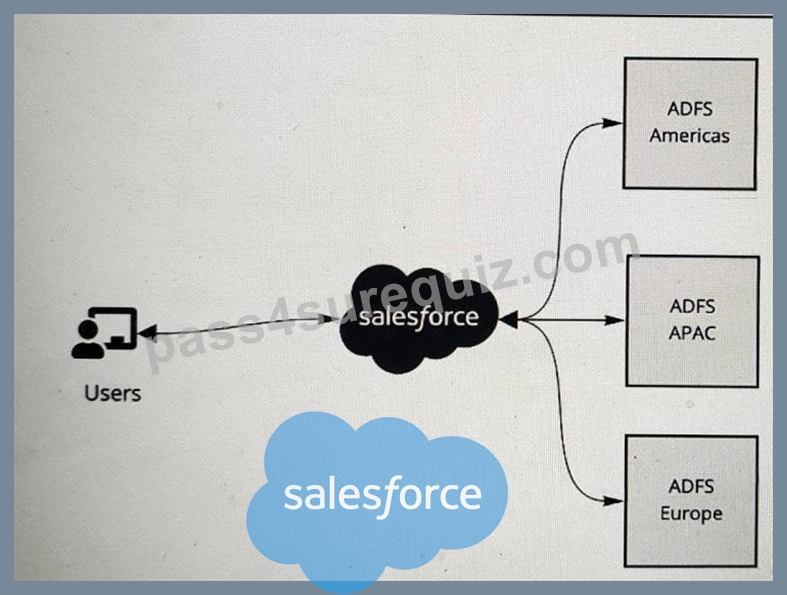
A multinational company is looking to rollout Salesforce globally. The company has a Microsoft Active Directory Federation Services (ADFS) implementation for the Americas, Europe and APAC. The company plans to have a single org and they would like to have all of its users access Salesforce using the ADFS . The company would like to limit its investments and prefer not to procure additional applications to satisfy the requirements.
What is recommended to ensure these requirements are met ?
- A. Configure Each ADFS system under single sign-on settings and allow users to choose the system to authenticate during sign on to Salesforce-
- B. Use connected apps for each ADFS implementation and implement Salesforce site to authenticate users across the ADFS system applicable to their geo.
- C. Implement Identity Connect to provide single sign-on to Salesforce and federated across multiple ADFS systems.
- D. Add a central identity system that federates between the ADFS systems and integrate with Salesforce for single sign-on.
Answer: C
NEW QUESTION # 79
Universal Containers (UC) would like its community users to be able to register and log in with Linkedin or Facebook Credentials. UC wants users to clearly see Facebook &Linkedin Icons when they register and login.
What are the two recommended actions UC can take to achieve this Functionality? Choose 2 answers
- A. Create custom buttons for Facebook and inkedin using JAVAscript/CSS on a custom Visualforce page.
- B. Store the Linkedin or Facebook user IDs in the Federation ID field on the Salesforce User record.
- C. Enable Facebook and Linkedin as Login options in the login section of the Community configuration.
- D. Create custom Registration Handlers to link Linkedin and facebook accounts to user records.
Answer: C,D
Explanation:
The two recommended actions UC can take to achieve the functionality of allowing community users to register and log in with LinkedIn or Facebook credentials are:
* Enable Facebook and LinkedIn as login options in the login section of the community configuration.
This action allows UC to configure Facebook and LinkedIn as authorization providers in Salesforce, which are external services that authenticate users and provide information about their identity and attributes. Byenabling these login options in the community configuration, UC can display Facebook and LinkedIn icons on the community login page and allow users to log in with their existing credentials from these services.
* Create custom registration handlers to linkLinkedIn and Facebook accounts to user records. This action allows UC to create Apex classes that implement the Auth.RegistrationHandler interface and define the logic for creating or updating user accounts in Salesforce when users log in with LinkedIn orFacebook.
By creating custom registration handlers, UC can map the information from the authorization providers to the user fields in Salesforce, such as name, email, profile, or contact.
The other options are not recommended actions for this scenario. Storing the LinkedIn or Facebook user IDs in the Federation ID field on the Salesforce user record is not necessary or sufficient for enabling SSO with these services, as the Federation ID is used for SAML-based SSO, not OAuth-based SSO. Creating custom buttons for Facebook and LinkedIn using JavaScript/CSS on a custom Visualforce page is not advisable, as it would require custom code and UI development, which could increase complexity and maintenance efforts.
Moreover, it would not leverage the built-in functionality of authorization providers and registration handlers that Salesforce provides. References: [Authorization Providers], [Enable Social Sign-On for Your Community], [Create a Registration Handler Class], [Auth.RegistrationHandler Interface], [Federation ID]
NEW QUESTION # 80
Which three different attributes can be used to identify the user in a SAML 65> assertion when Salesforce is acting as a Service Provider? Choose 3 answers
- A. Salesforce User ID
- B. User Full Name
- C. Salesforce Username
- D. User Email Address
- E. Federation ID
Answer: C,D,E
Explanation:
Explanation
The three different attributes that can be used to identify the user in a SAML assertion when Salesforce is acting as a Service Provider are Federation ID, User Email Address, and Salesforce Username. According to the Salesforce documentation, "Salesforce supports three attributes for identifying users in a SAML assertion:
Federation ID, User Email Address, and Salesforce Username." Therefore, option A, D, and E are the correct answers.
References: [SAML Assertion Attributes]
NEW QUESTION # 81
Universal Containers is creating a mobile application that will be secured by Salesforce Identity using the OAuth 2.0 user-agent flow (this flow uses the OAuth 2.0 implicit grant type).
Which three OAuth concepts apply to this flow?
Choose 3 answers
- A. Client ID
- B. Scopes
- C. Refresh Token
- D. Verification Code
- E. Authorization Code
Answer: A,B
Explanation:
The OAuth 2.0 user-agent flow uses the OAuth 2.0 implicit grant type, which does not require an authorization code or a refresh token. The client ID and scopes are required to identify the connected app and request the appropriate permissions from the user. References: OAuth Authorization Flows, OAuth with Salesforce Demystified
NEW QUESTION # 82
Universal containers (UC) wants to implement a partner community. As part of their implementation, UC would like to modify both the Forgot password and change password experience with custom branding for their partner community users. Which 2 actions should an architect recommend to UC? Choose 2 answers
- A. Build acustom visualforce page for both the change password and Forgot password experiences.
- B. Build a custom visualforce page for the change password experience and a community builder page for the Forgot password experience.
- C. Build a community builder page for the change password experience and Custom Visualforce page for the Forgot password experience.
- D. Build a community builder page for both the change password and Forgot password experiences.
Answer: A,B
Explanation:
The two actions that an architect should recommend to UC are to build a custom Visualforce page for both the change password and forgot password experiences and to build a custom Visualforce page for the change password experience and a community builder page for the forgot password experience. A custom Visualforce page is a page that uses Visualforce markup and Apex code to create a custom user interface. A community builder page isa page that uses the Community Builder tool to create a custom user interface with drag-and-drop components. Both types of pages can be used to modify the look and feel of the password management features for partner community users. However, using a custom Visualforce page for both features requires more coding and customization, while using a community builder page for the forgot password feature allows more flexibility and configuration options.
References: [Visualforce Pages], [Community Builder Pages], [Customize Password Management Features]
NEW QUESTION # 83
An identity architect has been asked to recommend a solution that allows administrators to configure personalized alert messages to users before they land on the Experience Cloud site (formerly known as Community) homepage.
What is recommended to fulfill this requirement with the least amount of customization?
- A. Use Login Flows to add a screen that shows personalized alerts.
- B. Customize the registration handler Apex class to create a routing logic navigating to different home pages based on the user profile.
- C. Build a Lightning web Component (LWC) for a homepage that shows custom alerts.
- D. Create custom metadata that stores user alerts and use a LWC to display alerts.
Answer: A
Explanation:
Explanation
Login Flows are custom post-authentication processes that can be used to add additional screens or logic after a user logs in to Salesforce. Login Flows can be used to show personalized alert messages to users based on their profile or other criteria before they land on the Experience Cloud site homepage. Login Flows require minimal customization and can be configured using Visual Workflow or Apex. References: Login Flows, Customizing User Authentication with Login Flows
NEW QUESTION # 84
Universal Containers (UC) has an existing Salesforce org configured for SP-Initiated SAML SSO with their Idp. A second Salesforce org is being introduced into the environment and the IT team would like to ensure they can use the same Idp for new org. What action should the IT team take while implementing the second org?
- A. Use a different Entity ID than the first org.
- B. Use the same SAML Identity location as the first org.
- C. Use the same request bindings as the first org.
- D. Use the Salesforce Username as the SAML Identity Type.
Answer: A
Explanation:
Explanation
The Entity ID is a unique identifier for a service provider or an identity provider in SAML SSO. It is used to differentiate between different service providers or identity providers that may share the same issuer or login URL. In Salesforce, the Entity ID is automatically generated based on the organization ID and can be viewed in the Single Sign-On Settings page1. If you have a custom domain set up, you can use https://
[customDomain].my.salesforce.com as the Entity ID2. If you want to use the same IdP for two Salesforce orgs, you need to use different Entity IDs for each org, otherwise the IdP will not be able to distinguish them and may send incorrect assertions. You can also use different certificates, issuers, or login URLs for each org, but using different Entity IDs is the simplest and recommended way3.
NEW QUESTION # 85
Universal containers (UC) has implemented SAML -based single Sign-on for their salesforce application. UC is using PingFederate as the Identity provider. To access salesforce, Users usually navigate to a bookmarked link to my domain URL. What type of single Sign-on is this?
- A. Web server flow.
- B. IDP-initiated with deep linking
- C. IDP-initiated
- D. Sp-Initiated
Answer: D
Explanation:
The type of single sign-on that UC is using is SP-initiated, which means that the service provider (Salesforce) initiates the SSO process by sending a SAML request to the identity provider (PingFederate) when the user navigates to the My Domain URL3. Therefore, option A is the correct answer. References: SAML SSO with Salesforce as the Service Provider
NEW QUESTION # 86
Universal Containers (UC) employees have Salesforce access from restricted IP ranges only, to protect against unauthorized access. UC wants to roll out the Salesforce1 mobile app and make it accessible from any location. Which two options should an Architect recommend? Choose 2 answers
- A. Relax the IP restriction with a second factor in the Connect App settings for Salesforce1 mobile app.
- B. Use Login Flow to bypass IP range restriction for the mobile app.
- C. Relax the IP restrictions in the Connect App settings for the Salesforce1 mobile app.
- D. Remove existing restrictions on IP ranges for all types of user access.
Answer: A,C
Explanation:
The two options that an architect should recommend for UC to roll out the Salesforce1 mobile app and make it accessible from any location are:
* Relax the IP restriction with a second factor in the Connected App settings for Salesforce1 mobile app.
This option allows UC to enable two-factor authentication (2FA) for the Salesforce1 mobile app, which requires users to verify their identity with a second factor, such asa verification code or a mobile app, after entering their username and password. By enabling 2FA in the Connected App settings, UC can relax the IP restriction for the Salesforce1 mobile app, as users can access it from any location as long as they providethe second factor.
* Relax the IP restrictions in the Connected App settings for the Salesforce1 mobile app. This option allows UC to disable or modify the IP restriction for the Salesforce1 mobile app in the Connected App settings, which control how userscan access a connected app, such as Salesforce1. By relaxing the IP restrictions, UC can allow users to access the Salesforce1 mobile app from any location without requiring 2FA.
The other options are not recommended for this scenario. Removing existing restrictions on IP ranges for all types of user access would compromise security and compliance, as it would expose Salesforce to unauthorized access from any location. Using Login Flow to bypass IP range restriction for the mobile app would require custom code and logic, which could introduce complexity and errors. References: [Connected Apps], [Two-Factor Authentication], [Require a Second Factor of Authentication for Connected Apps], [IP Restrictions for Connected Apps], [Login Flows]
NEW QUESTION # 87
An architect needs to advise the team that manages the identity provider how to differentiate salesforce from other service providers. What SAML SSO setting in salesforce provides this capability?
- A. SAML identity location
- B. Entity id
- C. Issuer
- D. Identity provider login URL
Answer: B
NEW QUESTION # 88
Under which scenario Web Server flow will be used?
- A. Used for mobile applications and testing legacy Integrations.
- B. Used for web applications when server-side code needs to interact with APIS.
- C. Used for server-side components when page needs to be rendered.
- D. Used for verifying Access protected resources.
Answer: B
Explanation:
Theweb server flow is used for web applications when server-side code needs to interact with APIs. This flow implements the OAuth 2.0 authorization code grant type, which allows the web app to obtain an access token and a refresh token from Salesforce after theuser grants permission1. The web app can then use the access token to call the Salesforce APIs and use the refresh token to obtain a new access token when the previous one expires2. The other options are not valid scenarios for using the web server flow. The webserver flow is not used for server-side components when page needs to be rendered, as this does not involve API calls. The web server flow is not used for mobile applications and testing legacy integrations, as these scenarios are better suited for other OAuthflows, such as theuser-agent flow or the password flow3. The web server flow is not used for verifying access protected resources, as this is a general purpose of OAuth, not a specific scenario for the web server flow. References: OAuth 2.0 Web Server Flow for Web AppIntegration, Mastering Salesforce Canvas Apps, OAuth Authorization Flows
NEW QUESTION # 89
IT security at Unversal Containers (UC) us concerned about recent phishing scams targeting its users and wants to add additional layers of login protection. What should an Architect recommend to address the issue?
- A. Increase Password complexity requirements in Salesforce.
- B. Lock sessions to the IP address from which they originated.
- C. Use the Salesforce Authenticator mobile app with two-step verification
- D. Implement Single Sign-on using a corporate Identity store.
Answer: C
Explanation:
Explanation
The Salesforce Authenticator mobile app adds an extra layer of security for online accounts with two-factor authentication. It allows users to respond to push notifications or use location services to verify their logins and other account activity1. This can help prevent phishing scams and unauthorized access.
References: Salesforce Authenticator, Salesforce Authenticator: Mobile App Security Features, Salesforce Authenticator
NEW QUESTION # 90
Universal containers (UC) have a custom, internal-only, mobile billing application for users who are commonly out of the office. The app is configured as a connected App in salesforce. Due to the nature of this app, UC would like to take the appropriate measures to properly secure access to the app. Which two are recommendations to make the UC? Choose 2 answers
- A. Set login IP ranges to the internal network for all of the app users profiles.
- B. Use Google Authenticator as an additional part of the logical processes.
- C. Disallow the use of single Sign-on for any users of the mobile app.
- D. Require high assurance sessions in order to use the connected App
Answer: B,D
Explanation:
Explanation
High assurance sessions are sessions that require a stronger level of identity verification, such as two-factor authentication or SAML assertions1. Google Authenticator is an app that generates verification codes on your mobile device that you can use as a second factor of authentication2. These measures can help prevent unauthorized access to the connected app by ensuring that the user is who they claim to be and that they have access to their mobile device. Disallowing the use of single sign-on (SSO) for the mobile app is not a recommendation because SSO can provide a seamless and secure user experience across multiple applications3. Setting login IP ranges to the internal network for the app users profiles is not a recommendation because it can limit the mobility and flexibility of the users who are commonly out of the office. References: 1: Session Security Levels 2: Google Authenticator 3: Connected Apps : [Restrict Login Access by IP Address]
NEW QUESTION # 91
......
Salesforce Identity-and-Access-Management-Architect certification is a prestigious certification for professionals looking to demonstrate their expertise in the field of identity and access management. Salesforce Certified Identity and Access Management Architect certification validates the skills and knowledge required to design, implement, and manage a secure identity and access management solution using Salesforce's platform. Salesforce Certified Identity and Access Management Architect certification exam is designed to test the candidate's knowledge of various identity and access management components, including authentication, authorization, user management, and data security.
Use Identity-and-Access-Management-Architect Exam Dumps (2026 PDF Dumps) To Have Reliable Identity-and-Access-Management-Architect Test Engine: https://www.pass4surequiz.com/Identity-and-Access-Management-Architect-exam-quiz.html
Identity-and-Access-Management-Architect PDF Recently Updated Questions Dumps to Improve Exam Score: https://drive.google.com/open?id=192Zwe8v_J_9un3sEwBX7kM4yiPVOQIwu