

[Mar-2026] Verified 3V0-25.25 dumps Q&As - 3V0-25.25 dumps with Correct Answers
The Best Professional Level Exams Study Guide for the 3V0-25.25 Exam
NEW QUESTION # 35
Which two statements describe the recommended strategy for configuring and synchronizing security policies across Federated NSX sites? (Choose two.)
- A. Security policies should be defined locally on each LM and only synchronized manually by an administrator to prevent accidental conflicts.
- B. Local Managers (LMs) can define local policies, but any global policies defined on the GM always take precedence over the local ones.
- C. Consistency is achieved by ensuring all security groups have the exact same name on every Federated site's Local Manager (LM).
- D. The Global Manager only synchronizes networking (L2/L3) configurations. Security rules must be configured separately on each site.
- E. Security policies, such as Distributed Firewall rules and security groups, must be defined as global policies on the Global Manager (GM).
Answer: B,E
Explanation:
Comprehensive and Detailed 250 to 350 words of Explanation From VMware Cloud Foundation (VCF) documents:
NSX Federationis the cornerstone of multi-siteVMware Cloud Foundation (VCF)security, enabling administrators to maintain a consistent security posture across geographically dispersed data centers. The management of security in a Federated environment relies on a hierarchical relationship between theGlobal Manager (GM)andLocal Managers (LMs).
According to VMware documentation, the recommended strategy is to defineGlobal Security Policieson the Global Manager (Option B). When a security group or a Distributed Firewall (DFW) rule is created on the GM, it is automatically synchronized to all registered Local Managers. This ensures that a "Finance App" security policy is identical in AZ1 and AZ2. These global objects are identified by a specific tag in the local NSX Manager UI, indicating they are managed globally and cannot be modified locally.
Furthermore, NSX handles the coexistence of global and local rules through a specific evaluation order (Option D). In the NSX DFW category structure,Global Categories(managed by the GM) are evaluated beforeLocal Categories(managed by the LM). This ensures that corporate-wide security mandates (like
"Block All SSH to Management") defined at the GM level are enforced first and cannot be bypassed by localized site-level rules.
Option A is incorrect because manual naming consistency is prone to error and does not provide actual synchronization. Option C and E are incorrect as they contradict the fundamental purpose of Federation, which is to centralize management and automate synchronization to prevent configuration drift and security gaps. Therefore, defining policies on the GM and utilizing the inherent precedence of global rules is the verified design best practice for VCF Federation.
NEW QUESTION # 36
An administrator is enabling IPv6-to-IPv4 communication for workloads hosted in an NSX environment. The workloads use IPv6-only addressing, but the external systems they must reach are IPv4-only. To provide this translation service, the administrator decides to configure NAT64. Which two following characteristics about NAT64 are true? (Choose two.)
- A. NAT64 is stateless and requires gateways to be deployed in active-standby mode.
- B. NAT64 requires the Tier-1 gateway to be configured in active-active mode.
- C. NAT64 is supported on Tier-0 and Tier-1 gateways.
- D. NAT64 is supported on Tier-1 gateways only.
- E. NAT64 requires the Tier-1 gateway to be configured in active-standby mode.
Answer: C,E
Explanation:
Comprehensive and Detailed 250 to 350 words of Explanation From VMware Cloud Foundation (VCF) documents:
As organizations modernize their infrastructure withVCF 5.x and 9.0, IPv6 adoption becomes more prevalent.
NAT64is a critical transition technology that allows IPv6-only hosts to communicate with IPv4-only resources by translating the packet headers.
In NSX, NAT64 is astateful service. Stateful services in the NSX architecture require a centralized point of processing to maintain the session state table. Because of this requirement, any gateway (Tier-0 or Tier-1) providing NAT64 servicesmust be configured in Active-Standby high availability mode. In Active-Active mode, asymmetric return traffic could hit a different Edge node that does not have the session information, causing the translation to fail. This is a fundamental design constraint for stateful NAT in NSX.
Furthermore, VMware NSX documentation specifies that NAT64 is a flexible service that can be implemented at multiple tiers of the logical routing hierarchy. It issupported on both Tier-0 and Tier-1 gateways. The choice of where to place the NAT64 service depends on the design requirements: placing it on the Tier-1 gateway allows for tenant-specific translation and offloads the Tier-0, while placing it on the Tier-0 provides a centralized translation point for all connected segments.
Option A is incorrect because NAT64 in NSX is stateful, not stateless. Option C is incorrect because it is not limited to Tier-1. Option E is incorrect because Active-Active mode does not support the stateful nature of the NAT64 engine. Consequently, the correct architecture requires anActive-Standbyconfiguration on either a Tier-0 or Tier-1gateway to properly facilitate the translation between the IPv6 workloads and the IPv4 external world.
NEW QUESTION # 37
A sovereign cloud provider has a VMware Cloud Foundation (VCF) stretched Workload Domain across two data centers (AZ1 and AZ2), where site connectivity via Layer 3 is provided by the underlay. The following NSX details are included in the design:
* Each site must host its own local NSX Edge Cluster for availability zones.
* Tier-0 gateways must be configured in active/active mode with BGP ECMP to local top-of-rack switches.
* Inter-site Edge TEP traffic must not cross the inter-DC link.
* SDDC Manager is used to automate NSX deployment.
During deployment of the Edge Cluster for AZ2, the SDDC Manager workflow fails because the Edge transport nodes' TEP IPs are not reachable from the ESXi transport nodes. Which step ensures correct Edge Cluster deployment in multi-site stretched domains?
- A. Configure BGP neighbors before deploying the Edge Cluster.
- B. Create an AZ2-specific Edge TEP IP pool and map it to the AZ2 uplink profile before deploying the Edge Cluster.
- C. Disable the liveness check during Edge deployment in SDDC Manager.
- D. Reuse the TEP IP pool from AZ1.
Answer: B
Explanation:
Comprehensive and Detailed 250 to 350 words of Explanation From VMware Cloud Foundation (VCF) documents:
In aVMware Cloud Foundation (VCF)stretched cluster or Multi-Availability Zone (Multi-AZ) architecture, the networking design must account for the fact that AZ1 and AZ2 typically reside in different Layer 3 subnets. While the NSX Overlay provides Layer 2 adjacency for virtual machines across sites, the underlying Tunnel Endpoints (TEPs)must be able to communicate over the physical Layer 3 network.
According to the VCF Design Guide for Multi-AZ deployments, when stretching a workload domain, each availability zone should have its own dedicatedTEP IP Pool. This is because TEP traffic is encapsulated (Geneve) and routed via the physical underlay. If the Edge nodes in AZ2 were to use the same IP pool as AZ1 (Option C), the physical routers would likely encounter routing conflicts or reachability issues, as the subnet for AZ1 would not be natively routable or "local" to the AZ2 Top-of-Rack (ToR) switches.
The failure during the SDDC Manager workflow occurs because the automated "Liveness Check" or "Pre- validation" step attempts to verify that the newly assigned TEP IPs in AZ2 can reach the existing TEPs in the environment. To resolve this and ensure a successful deployment, the administrator must define a uniqueAZ2- specific IP Poolin NSX. Furthermore, this pool must be associated with anUplink Profile(or a Sub-Transport Node Profile in VCF 5.x/9.0) that uses the specific VLAN tagged for TEP traffic in the second data center.
This ensures that the Edge Nodes in AZ2 are assigned IPs that are valid and routable within the AZ2 underlay, allowing Geneve tunnels to establish correctly to the ESXi hosts in both sites without requiring a stretched Layer 2 physical network for the TEP infrastructure.
NEW QUESTION # 38
An administrator has a standalone vSphere 8.0 Update 1a deployment that is running with VMware NSX
4.1.0.2 and has to converge the deployment into a new VMware Cloud Foundation (VCF) instance. How can the administrator accomplish this task?
- A. Manually upgrade vSphere to version 9. Then use the VCF Installer to converge the vSphere 9 environment into a new VCF management domain. Then use the VCF lifecycle management tools to upgrade NSX to version 9.
- B. Manually upgrade both vSphere and NSX to version 9 prior to converging. Then use the VCF Installer to converge the vSphere 9 and NSX 9 instances into a new VCF management domain.
- C. Manually upgrade vSphere to version 9 and uninstall NSX 4. Then use the VCF Installer to converge the vSphere 9.0 environment into a new VCF management domain at which time NSX 9 will be reinstalled.
- D. Use the VCF Installer to converge the existing vSphere 8 and NSX 4 environment into a new VCF management domain. Then use the VCF lifecycle management tools to upgrade to 9.
Answer: D
Explanation:
Comprehensive and Detailed 250 to 350 words of Explanation From VMware Cloud Foundation (VCF) documents:
The process of bringing existing infrastructure under VCF management is known as"VCF Import"or
"Convergence."This is a common path for organizations transitioning from siloed management to the full SDDC stack provided by Cloud Foundation.
According to the VCF 5.x and 9.0 documentation, theVCF Installer(specifically the Cloud Foundation Builder and the Import Tool) is designed to ingest existing environments. The verified best practice is to converge the environment at its current, supported version, provided it meets the minimum baseline requirements for the VCF version you are deploying.
In this scenario, vSphere 8.0 U1 and NSX 4.1 are compatible versions that can be imported into a VCF management framework. By using theVCF Installerto converge the existing environment first (Option C), the SDDC Manager takes ownership of the existing vCenter and NSX Manager. Once the environment is
"VCF-aware," the administrator gains the benefit ofSDDC Manager's Lifecycle Management (LCM).
The SDDC Manager then handles the orchestrated, multi-step upgrade to version 9.0. This ensures that the automated "Bill of Materials" (BOM) is strictly followed, ensuring compatibility between vCenter, ESXi, and NSX components. Attempting to manually upgrade components to version 9beforeconvergence (Options A and B) or uninstalling NSX (Option D) creates a "Frankenstein" environment that may not align with the VCF BOM, making the automated convergence process fail or resulting in an unsupported configuration. The principle of VCF is tobring the environment in first, then let VCF manage the upgrades.
NEW QUESTION # 39
An administrator needs to prevent the datacenter from advertising any internal prefixes toward a new VPC, while still ensuring the VPC receives a default route learned from the datacenter's upstream network. Where should the routing policy be applied?
- A. On the provider Tier-0 neighbor.
- B. On the VPC transit gateway.
- C. On each segment default gateway.
- D. On the Tier-1 gateway.
Answer: B
Explanation:
Comprehensive and Detailed 250 to 350 words of Explanation From VMware Cloud Foundation (VCF) documents:
In theVMware Cloud Foundation (VCF) 9.0andNSX VPCarchitecture, theTransit Gateway (TGW)is the central routing element that interconnects VPCs to each other and to the provider's infrastructure (Tier-0 or VRF gateways). It acts as the "Project-level" gateway that aggregates North-South traffic.
To control the visibility of routes within a specific VPC, the administrator must utilizeRoute Filteringat the VPC's boundary. When a VPC is attached to a Transit Gateway, a logical interface is created. To prevent the data center's internal prefixes (such as management networks or other tenant subnets) from being seen by the VPC while still providing a path to the internet, a prefix list or route map should be applied to theVPC Transit Gateway. This policy will explicitly "Deny" specific internal CIDR ranges while "Permitting" the
$0.0.0.0/0$ default route advertisement from the provider.
Applying the policy at theTier-1 gateway(Option B) is technically similar but in the VPC model, the "Tier-1" is often an obscured or automated component of the VPC itself; the Transit Gateway is the designed administrative point for inter-project and North-South policy enforcement. Applying it at theprovider Tier-0 neighbor(Option D) would be too global, affecting all VPCs or projects connected to that Tier-0, rather than the "new VPC" specifically. Therefore, the Transit Gateway provides the necessary granular control for multi- tenant isolation and routing optimization as per the VCF 9.0 networking model.
NEW QUESTION # 40
An administrator has observed an NSX Local Manager (LM) outage at the secondary Site. However, the NSX Global Manager (GM) in secondary Site remains operational. What happens to data plane operations and policy enforcement at the secondary site?
- A. All traffic is blocked until secondary site LM recovers.
- B. Only local policies work; global policies cease to apply on the secondary site.
- C. Secondary site must failover all workloads to Primary site.
- D. The data plane operates normally until LM recovery and reconnection.
Answer: D
Explanation:
Comprehensive and Detailed 250 to 350 words of Explanation From VMware Cloud Foundation (VCF) documents:
The architecture ofNSX Federationwithin a VCF Multi-Site design is built upon a separation of theControl Planeand theData Plane. This "decoupled" architecture ensures high availability and resiliency even when management components become unavailable.
In NSX Federation, theGlobal Manager (GM)handles the configuration of objects that span multiple locations, while theLocal Manager (LM)is responsible for pushing those configurations down to the local Transport Nodes (ESXi hosts and Edges) within its specific site. When a configuration is pushed, the Local Manager communicates with theCentral Control Plane (CCP)and subsequently theLocal Control Plane (LCP)on the hosts.
If an NSX Local Manager goes offline, the "Management Plane" for that site is lost. This means no new segments, routers, or firewall rules can be created or modified at that site. However, the existing configuration is already programmed into theData Plane(the kernels of the ESXi hosts and the DPDK process of the Edge nodes).
According to VMware's "NSX Multi-Location Design Guide," the data plane remains fully operational during a Management Plane outage. Existing VMs will continue to communicate, BGP sessions on the Edges will remain established, and Distributed Firewall (DFW) rules will continue to be enforced based on the last known good configuration state cached on the hosts. The data plane does not require constant heartbeats from the Local Manager to forward traffic. Therefore, operations continue normally "headless" until the LM is restored and can resume synchronization with the Global Manager and local hosts. Failover to a primary site (Option D) is only necessary if the actual data plane (hosts/storage) fails, not just the management components.
NEW QUESTION # 41
An administrator has deployed a new VMware Cloud Foundation (VCF) management domain. To be compliant with company policy, backups must be configured to occur anytime a change is made to the NSX configuration. How can the administrator ensure that complete configuration backups are captured every time a change occurs?
- A. Configure a cron job on the NSX Manager to automatically perform an incremental backup of the NSX configuration every hour.
- B. Create a recurring backup schedule and explicitly indicate that backups should be captured anytime the configuration changes.
- C. No action is required as by default NSX will automatically perform a complete backup every time a change is made to the configuration.
- D. Configure an alarm to detect configuration changes and automatically trigger a complete configuration backup.
Answer: B
Explanation:
Comprehensive and Detailed 250 to 350 words of Explanation From VMware Cloud Foundation (VCF) documents:
InVMware Cloud Foundation (VCF), the protection of theNSX Managerconfiguration is paramount, as it contains the state of the entire software-defined network, including firewall rules, logical switches, and routing topologies. To meet strict compliance requirements for real-time or change-based protection, NSX offers specific automated backup triggers.
Within theNSX Manager UI(under System > Lifecycle > Backup & Restore), an administrator can configure the backup behavior. While a time-based schedule (e.g., daily at 2:00 AM) is common, it does not satisfy the requirement for backups "anytime a change is made." To accomplish this, the administrator must enable the
"Backup on Configuration Change"toggle within the backup scheduling configuration.
When this feature is enabled, the NSX Manager monitors its own management database (DS) for write operations. Once a configuration change is detected (such as adding a segment or modifying a DFW rule), the system initiates an automated backup process. This ensures that the backup repository always contains a near- instantaneous reflection of the current network state, minimizing data loss in the event of a cluster failure.
Option B is incorrect because this feature is not enabled by default; it requires an external SFTP/FTP server to be configured first. Option C (Cron jobs) is an unsupported manual workaround that bypasses the SDDC- native management tools. Option A is redundant as the functionality is built directly into the NSX backup engine. Consequently, the verified method for compliance is to use thenative recurring backup schedule with the "Detect Configuration Change" option enabled.
NEW QUESTION # 42
An administrator is tasked to create a development environment with a Tier-1 gateway to host overlay segments for only East/West workload communication. North/South communication is also required. The solution will not include the following services: NAT, DHCP, VPN. Which step must the administrator take when creating the Tier-1 gateway?
- A. Configure a Service Interface on the Tier-1 gateway to connect each overlay segment to provide the East
/West communication. - B. Keep route advertisement disabled and leave the Tier-1 gateway disconnected from any Tier-0 gateway.
- C. Enable route advertisement and connect the Tier-1 gateway to the Tier-0 gateway.
- D. Assign the Tier-1 gateway to an Edge Cluster before any segments are created.
Answer: C
Explanation:
Comprehensive and Detailed 250 to 350 words of Explanation From VMware Cloud Foundation (VCF) documents:
In anNSX-based VCFenvironment, theTier-1 Gatewayis designed to provide localized routing for a specific tenant, department, or environment (like "Development"). Even if the requirements exclude stateful services like NAT or VPN, the gateway must still be logically connected to the higher-tier routing fabric to facilitate North/Southcommunication.
East-West communication-traffic between VMs on the same or different overlay segments attached to the same Tier-1-is handled by theDistributed Router (DR)component of the Tier-1 gateway. This happens automatically as soon as segments are attached to the gateway. However, for a VM on one of these segments to reach an "external" destination (such as a shared service in the Management Domain or the public internet), the Tier-1 must have a path to theTier-0 Gateway.
To satisfy the North/South requirement, the administrator mustconnect the Tier-1 gateway to a Tier-0 gatewayand, crucially,enable Route Advertisement. Without route advertisement, the Tier-0 gateway will not know that the subnets (prefixes) behind the Tier-1 gateway even exist. Consequently, while the Tier-1 might have a default route pointing up to the Tier-0, the physical network will have no return path to the VMs, breaking external connectivity.
Option C is incorrect because a Tier-1 gateway onlyrequiresan Edge Cluster if it needs to provide stateful services (NAT, LB, VPN). Since this design explicitly excludes them, the Tier-1 can remain a purely Distributed Router, which is more efficient and does not consume Edge node resources. Option D would isolate the environment, preventing the required North/South communication. Therefore, the logical link and the enabling ofAll Connected Segmentsin the advertisement settings are the verified steps to ensure full connectivity.
NEW QUESTION # 43
An administrator has noticed an issue in a freshly deployed VMware Cloud Foundation (VCF) environment where the BGP neighborship between the Tier-0 gateway and a physical router remains in the Idle state. Pings between the uplink IPs are successful. What is the issue?
- A. Geneve tunnel down.
- B. Overlay MTU too low.
- C. Autonomous System number mismatch.
- D. Distributed Firewall blocking traffic.
Answer: C
Explanation:
Comprehensive and Detailed 250 to 350 words of Explanation From VMware Cloud Foundation (VCF) documents:
In the context ofVMware Cloud Foundation (VCF), particularly versions 5.x and the architectural advancements inVCF 9.0, the establishment of North-South routing via theNSX Tier-0 Gatewayis a critical post-deployment or bring-up task. The Tier-0 gateway usesBorder Gateway Protocol (BGP)to peer with physical Top-of-Rack (ToR) switches to exchange reachability information for the overlay networks.
When a BGP session is reported in the"Idle"state, it indicates that the BGP Finite State Machine (FSM) is at its first stage and is not yet attempting a TCP connection, or it has encountered an error that forced it back to this state. According to VMware VCF documentation and NSX troubleshooting guides, if the administrator can successfully ping between the Tier-0 uplink IP and the physical router interface,Layer 3 reachability is confirmed. This eliminates issues related to physical cabling, VLAN tagging on the trunk ports, or basic IP interface configuration.
The primary reason a BGP session remainsIdledespite successful ICMP reachability is a configuration mismatch. Specifically, anAutonomous System (AS) number mismatchis the most frequent culprit. BGP requires that the "Remote AS" configured on the Tier-0 gateway matches the "Local AS" of the physical peer.
If the SDDC Manager automated workflow or the manual configuration in NSX Manager contains a typo in these values, the protocol handshake will fail immediately.
While aDistributed Firewall (DFW)could technically block port 179, it is not common in a "freshly deployed" environment for the default rules to block the Edge Node's control plane traffic.Geneve tunnelsand MTU issues(Option C and D) typically affect the data plane-causing packet loss for encapsulated guest VM traffic-but they do not prevent the BGP control plane (running over standard TCP) from moving beyond the Idle state. Therefore, verifying the AS numbers in the VCF Planning and Preparation Workbook against the physical switch configuration is the verified resolution path.
NEW QUESTION # 44
An administrator is troubleshooting BGP flapping in a VMware Cloud Foundation (VCF) 9 environment. A Tier-0 Gateway is running in Active/Active mode with two Edge nodes. BFD is enabled on the eBGP sessions to the upstream routers. Each Edge node uses its own uplink IP for BGP. After some network maintenance, one BGP session starts flapping every few minutes. The other BGP sessions stay stable. On the affected Edge node, the command get bfd-sessions shows:
* State: Down
* Diag: Detect Time Expired
Symptoms:
* The upstream router also shows the BFD session as Down with control Detection Time Expired.
* There are no interface errors, no packet loss for normal traffic, and clearing the BFD session temporarily brings it back up - but it flaps again after few minutes.
What is the root cause?
- A. The MTU does not match on the end-to-end between Tier-0 Gateway and upstream routers.
- B. BFD timers are mismatched between Tier-0 Gateway and the upstream routers.
- C. BFD is configured in echo mode on the upstream routers.
- D. The Edge nodes are undersized and are experiencing high contention on CPU and drops BFD packets.
Answer: A
Explanation:
Comprehensive and Detailed 250 to 350 words of Explanation From VMware Cloud Foundation (VCF) documents:
In aVMware Cloud Foundation (VCF)environment, particularly with the high-performance requirements of North-South routing,BGPandBFD (Bidirectional Forwarding Detection)are used in tandem to ensure rapid failure detection. A common but subtle issue in fresh or modified environments is anMTU (Maximum Transmission Unit) mismatchon the physical or virtual uplinks.
When BGP establishes a neighborship, it initially exchanges small keepalive packets. These small packets easily pass through interfaces even if there is an MTU mismatch (e.g., the Edge is set to 9000 bytes but a physical switch in the path is limited to 1500 bytes). However, once the BGP state reaches "Established," the routers begin exchanging full routing tables. TheseBGP Updatepackets are often large and will be fragmented or dropped if they exceed the MTU of any hop in the path.
The symptom described-where the session is stable for a few minutes (during the initial handshake) and then flaps-is the hallmark of an MTU issue. The "Detect Time Expired" diagnostic in BFD occurs because the BGP hold timer expires when it fails to receive the large update packets, or the BFD packets themselves are delayed/lost due to the congestion caused by retrying large, failed transmissions. According to VMware NSX troubleshooting documentation, if pings (small packets) succeed but the BGP session fails specifically when traffic load or route counts increase, the MTU should be the first setting verified.
VCF 9.0 and 5.x designs mandate consistent MTU settings (typically9000 MTUfor the overlay and at least
1500+for the uplinks) across the entire path, including the virtual switch (VDS), the Edge VM vNICs, and the physical ToR switches. A mismatch here prevents the completion of the BGP state machine's full synchronization, leading to the cyclic "flapping" observed by the administrator.
NEW QUESTION # 45
An administrator is creating NSX segments in an environment. The NSX segment on an ESX Host is not realized. To troubleshoot the issue, the administrator needs to track the communication of components in the environment.
Drag and drop the component to the appropriate location in the diagram to track the path from desired state to completed state.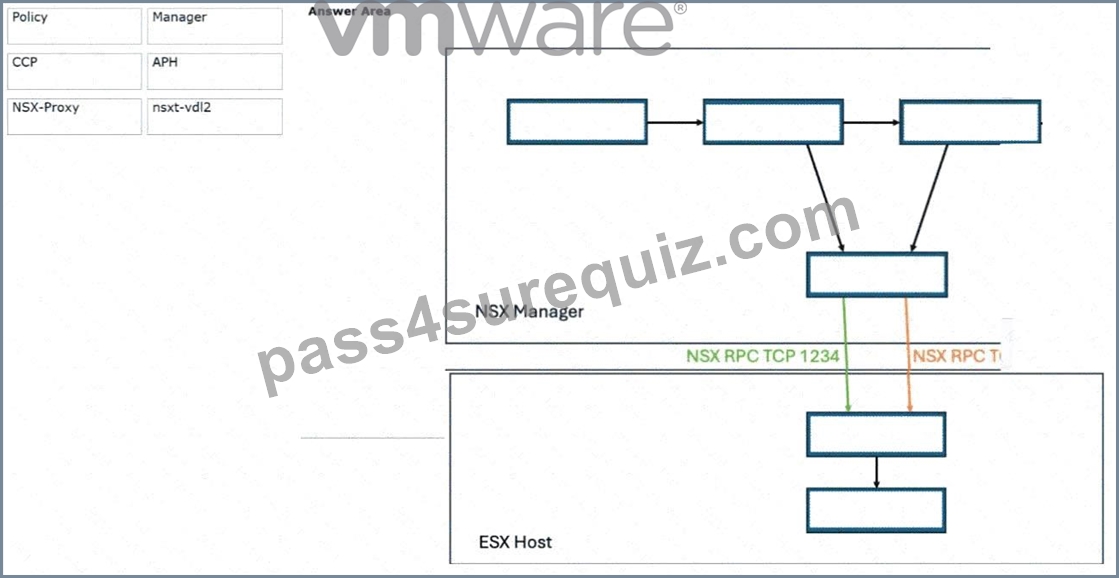
Answer:
Explanation: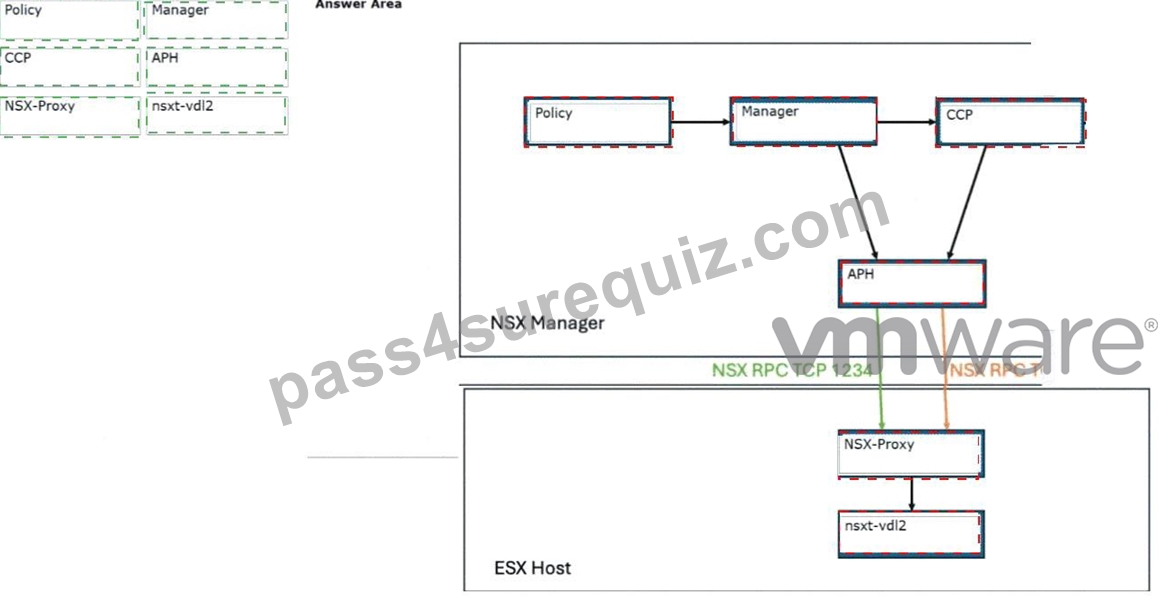
Explanation:
Answer Area Placement:
* NSX Manager Top-Left Box:Policy
* NSX Manager Top-Middle Box:Manager
* NSX Manager Top-Right Box:CCP (Central Control Plane)
* NSX Manager Bottom Box:APH (Asynchronous Proxy Handler)
* ESXi Host Top Box:NSX-Proxy
* ESXi Host Bottom Box:nsxt-vdl2
InVMware Cloud Foundation (VCF)and NSX architectures, the realization of a logical object (like a segment) involves a multi-step communication flow across different management and control plane layers.
The Management Plane (NSX Manager)
* Policy:The entry point where the "Desired State" is defined by the user or automation.
* Manager:Receives the policy, validates it, and stores it in the management database.
* CCP (Central Control Plane):Processes the logical configuration and computes the actual instructions needed for the data plane.
* APH (Asynchronous Proxy Handler):Acts as a broker on the NSX Manager, responsible for pushing these instructions down to the transport nodes viaNSX RPC TCP 1234(Management) andNSX RPC TCP 1235(Control).
The Local Control Plane (ESXi Host)
* NSX-Proxy:A local agent on the ESXi host that maintains a persistent connection to the APH. It receives the instructions and ensures the "Local Control Plane" state matches the "Central Control Plane" intent.
* nsxt-vdl2:The final component in the chain. It interacts directly with the ESXi kernel modules to program the Virtual Distributed Switch (VDS) and realize the segment on the host. Once this step is finished, the segment moves to the"Completed State"and is ready for use.
NEW QUESTION # 46
An administrator is tasked to enable users to configure an individual VPC, but not create subnets. What three NSX roles would the administrator assign to allow access without the ability to create subnets? (Choose three.)
- A. Security Operator
- B. VPC Admin
- C. Network Operator
- D. Security Admin
- E. Network Admin
Answer: A,B,C
Explanation:
Comprehensive and Detailed 250 to 350 words of Explanation From VMware Cloud Foundation (VCF) documents:
With the introduction of theVirtual Private Cloud (VPC)consumption model inVCF 9.0and late 5.x releases, Role-Based Access Control (RBAC) has become more granular to support true multi-tenancy. A VPC is designed to be a self-contained "container" for a department's or user's networking resources.
To meet the specific requirement where a user can configure aspects of an individual VPC but is restricted from creating new subnets (which involves modifying the underlying network CIDR blocks and IPAM), a combination of specific roles is required.
* VPC Admin:This is the primary role for the user within their assigned VPC. It allows the user to manage the overall VPC environment, including high-level settings and monitoring. However, the VPC Admin's power is often limited by the specific quotas and policies set by the Enterprise Admin.
* Security Operator:This role allows the user to view security configurations and policies without having the permission to modify the network fabric or create new infrastructure components like subnets. It provides the "read-only" visibility into the security posture of the VPC.
* Network Operator:Similar to the Security Operator, the Network Operator role provides visibility into the networking state-such as routing tables, segment status, and connectivity-without granting the
"Write" permissions required to provision new subnets or alter the network topology.
AssigningNetwork Admin(Option B) orSecurity Admin(Option A) would grant too much privilege, as these roles typically include the ability to create, delete, and modify subnets and firewall policies at a structural level. By combining theVPC Adminrole withOperator-level roles, the administrator ensures the user has the necessary context to manage their assigned resources while strictly adhering to the restriction against creating new network subnets.
NEW QUESTION # 47
An administrator must provide North/South connectivity for a VPC. The fabric exposes a distributed external VLAN across all ESX hosts. But, the only BGP peer to the core is on a VLAN only accessible on the Edge Cluster. Which design is required?
- A. Deploy a Provider Tier-1 with BGP and connect the VPC Transit Gateway via route leaking.
- B. Centralized Transit Gateway on the Edge Cluster.
- C. Distributed Transit Gateway with an EVPN route reflector on the transport nodes.
- D. Use a VPC Tier-0 Gateway in active/active mode with distributed eBGP peering.
Answer: B
Explanation:
Comprehensive and Detailed 250 to 350 words of Explanation From VMware Cloud Foundation (VCF) documents:
In aVMware Cloud Foundation (VCF)environment utilizing theVirtual Private Cloud (VPC)model, North
/South connectivity is managed by theTransit Gateway (TGW). The TGW acts as the bridge between the VPC-internal networks and the provider-level physical network.
The scenario presents a specific constraint: while an external VLAN exists across all hosts, the actual BGP peering point (the interface to the physical core routers) is restricted to theNSX Edge Cluster. In NSX terminology, when a gateway or service must be anchored to specific Edge Nodes to access physical network services-such as BGP peering, NAT, or stateful firewalls-it must be configured as aCentralizedcomponent.
ACentralized Transit Gateway(Option C) is instantiated on the Edge nodes. This allows the TGW to participate in the BGP session with the core routers on the VLAN that is only accessible to those Edges. The TGW then handles the routing for the VPC's internal segments. Traffic from the ESXi transport nodes (East- West) travels via the Geneve overlay to the Edge nodes, where it is then routed North-South by the Centralized TGW using the physical BGP peer.
Option A is incorrect because "distributed eBGP peering" would require every ESXi host to have peering capabilities, which contradicts the constraint. Option B involves EVPN, which is a significantly more complex and different architecture than what is required for standard VPC North/South access. Option D is an unnecessarily complex routing design that is not the standard VCF/VPC implementation pattern. Thus, the use of a Centralized Transit Gateway on the Edge cluster is the verified design requirement to bridge the gap between the overlay VPC and the localized BGP peering point.
NEW QUESTION # 48
An administrator has been tasked with providing a networking solution including a Source and Destination NAT for a single Tenant. The tenant is using Centralized Connectivity with a Tier-0 Gateway named Ten-A- Tier-0 supported by an Edge cluster in Active-Active mode. The NAT solution must be available for multiple subnets within the Tenant space. The administrator chooses to deploy a Tier-1 Gateway to implement the NAT solution. How would the administrator complete the task?
- A. Create a Tier-1 Gateway in Distributed Routing mode only and do not attach it to Ten-A-Tier-0.
- B. Change Ten-A-Tier-0 to Active-Standby to support the stateful NAT.
- C. Create a new Tier-0 Gateway in Active-Standby mode and attach another Tier-1 Gateway.
- D. Create a new Tier-1 Gateway in Active-Standby mode and attach it to Ten-A-Tier-0.
Answer: D
Explanation:
Comprehensive and Detailed 250 to 350 words of Explanation From VMware Cloud Foundation (VCF) documents:
In aVMware Cloud Foundation (VCF)environment, the implementation of stateful services-such as Source NAT (SNAT) and Destination NAT (DNAT)-requires a specific architectural configuration within theNSXcomponent. This is because stateful services need a centralized point of processing (a Service Router or SR) to maintain the session state tables and ensure that return traffic is processed by the same node that initiated the session.
The scenario describes a provider-levelTier-0 Gatewayrunning inActive-Activemode. While Active-Active provides high-performance North-South throughput via ECMP (Equal Cost Multi-Pathing), it does not support stateful NAT services because asymmetric traffic flows would break the session tracking. Rather than changing the Tier-0 to Active-Standby (which would reduce overall throughput for the entire environment), the architecturally sound approach is to offload the stateful services to aTier-1 Gateway.
According to VCF design guides, when a Tier-1 Gateway is required to perform NAT for multiple subnets, it must be configured as aStateful Tier-1. This involves associating the Tier-1 with anEdge Clusterand setting its high-availability mode toActive-Standby. Once the Tier-1 is created in this mode, it creates a Service Router (SR) component on the selected Edge Nodes. By attaching this Active-Standby Tier-1 to the existing Active-Active Tier-0 (Ten-A-Tier-0), the tenant's subnets can enjoy the benefits of localized stateful NAT while the environment maintains high-performance, non-stateful routing at the Tier-0 layer.
Option A is inefficient as it impacts the entire Tier-0. Option B is redundant. Option C is incorrect because a
"Distributed Routing only" Tier-1 (one without an Edge Cluster association) cannot perform stateful NAT.
Therefore, creating anActive-Standby Tier-1and linking it to the provider Tier-0 is the verified VCF multi- tenant design pattern.
NEW QUESTION # 49
A large multinational corporation is seeking proposals for the modernization of a Private Cloud environment.
The proposed solution must meet the following requirements:
* Support multiple data centers located in different geographic regions.
* Provide a secure and scalable solution that ensures seamless connectivity between data centers and different departments.
Which three NSX features or capabilities must be included in the proposed solution? (Choose three.)
- A. Centralized Network Connectivity
- B. vDefend
- C. AVI Load Balancer
- D. NSX Edge
- E. NSX L2 Bridging
- F. Virtual Private Cloud (VPC)
Answer: B,D,F
Explanation:
Comprehensive and Detailed 250 to 350 words of Explanation From VMware Cloud Foundation (VCF) documents:
In a modern VMware Cloud Foundation (VCF) architecture, particularly when addressing the needs of a multinational corporation with geographically dispersed data centers, the solution must prioritize multi- tenancy, security, and consistent delivery. The integration ofNSXwithin VCF provides these core pillars.
First, theNSX Edgeis a foundational requirement for any multi-site or modern cloud environment. It serves as the bridge between the virtual overlay network and the physical world. In a multi-region deployment, NSX Edges facilitate North-South traffic and are essential for supporting features like Global Server Load Balancing (GSLB) or site-to-site connectivity. Without the Edge, the software-defined data center (SDDC) cannot communicate with external networks or peer via BGP with physical routers.
Second,vDefend(formerly known as NSX Security) provides the advanced security framework required for a
"secure and scalable" environment. This includes Distributed Firewalling (DFW), Distributed IDS/IPS, and Malware Prevention. For a corporation with different departments, vDefend allows for micro-segmentation, ensuring that a security breach in one department's segment cannot move laterally to another. This is critical for meeting compliance and isolation requirements across global regions.
Third, theVirtual Private Cloud (VPC)model is the cornerstone of the latest VCF 9.0 and 5.x architectures.
It enables the "scalable solution" for different departments by providing a self-service consumption model.
Each department can manage its own isolated network space, including subnets and security policies, without needing deep networking expertise or constant tickets for the central IT team. This abstraction simplifies management across multiple data centers and allows for consistent application of policies regardless of the physical location.
While AVI Load Balancer and Centralized Network Connectivity are valuable, they are often considered add- ons or outcomes rather than the core architectural features that define the multi-tenant, secure, and geographically distributed nature of a modern VCF private cloud modernization project.
NEW QUESTION # 50
An administrator has been tasked with enabling OSPF as the routing protocol for a Tier-0 Gateway. Which two items must be configured to enable OSPF for a Tier-0 Gateway?
Mark two answers by clicking the two correct locations on the image. (Choose two.)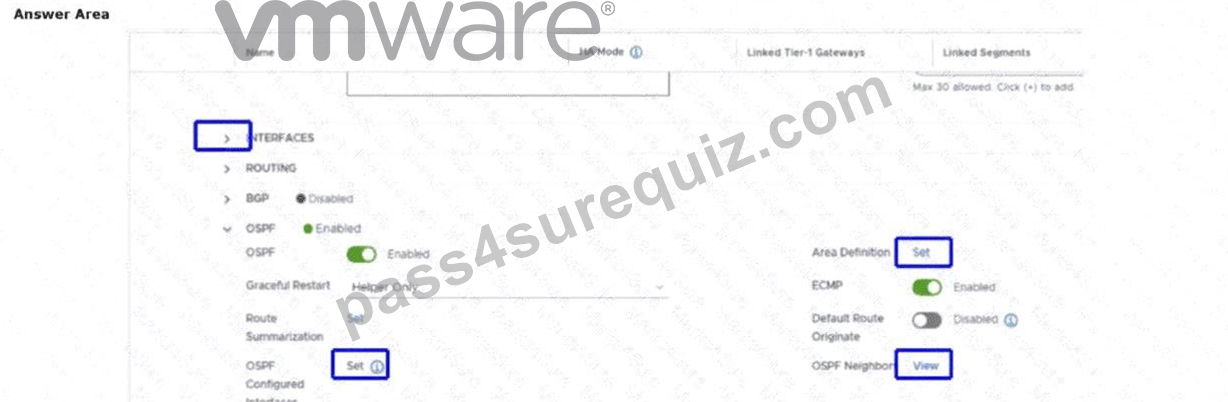
Answer:
Explanation: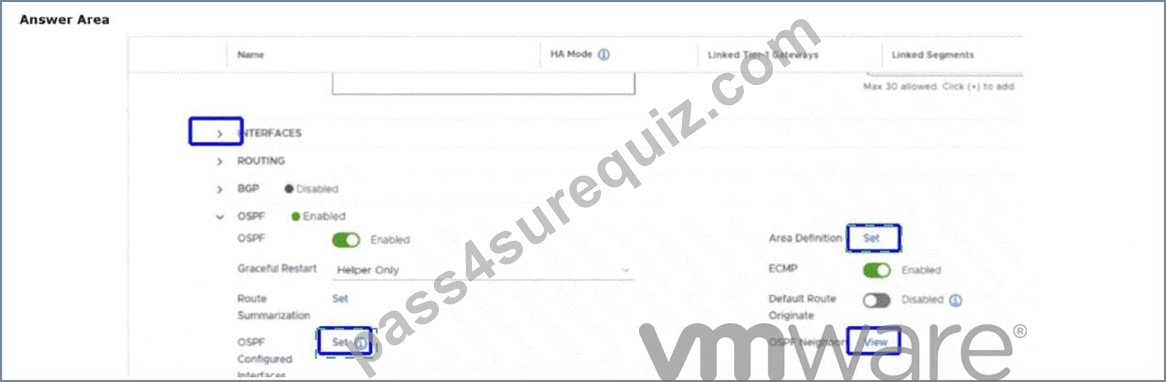
Explanation:
To enable OSPF on a Tier-0 Gateway within a VMware Cloud Foundation (VCF) or NSX environment, an administrator must define the areas where the gateway will participate and the specific interfaces it will use for peering.
Based on the NSX Manager configuration interface, the two required items to be configured are:
* Area Definition: This is necessary to define the OSPF area (e.g., Area 0) the Tier-0 gateway will participate in.
* OSPF Configured Interfaces: OSPF must be explicitly configured on the relevant uplink interfaces to establish neighbor relationships and exchange routing information with physical routers.
NEW QUESTION # 51
An administrator has noticed that both the active and standby Global Managers have gone offline.
What is the correct sequence of events to restore the Global Managers?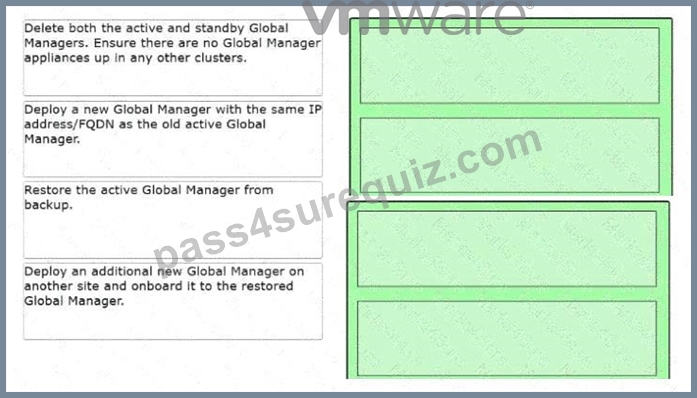
Answer:
Explanation: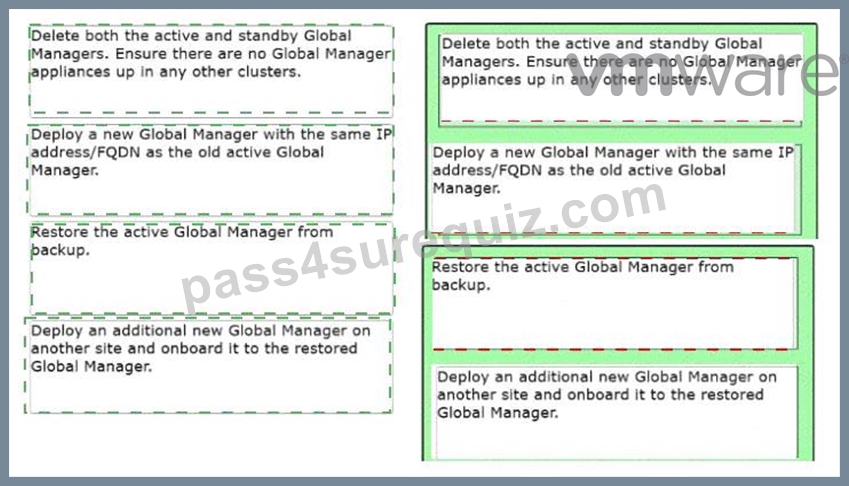
Explanation:
* Step 1: Delete both the active and standby Global Managers. Ensure there are no Global Manager appliances up in any other clusters.
* Step 2: Deploy a new Global Manager with the same IP address/FQDN as the old active Global Manager.
* Step 3: Restore the active Global Manager from backup.
* Step 4: Deploy an additional new Global Manager on another site and onboard it to the restored Global Manager.
In aVMware Cloud Foundationmulti-site deployment usingNSX Federation, the Global Manager (GM) manages the global networking configuration across multiple sites. If the entire GM cluster (Active and Standby) fails, the following architectural principles apply:
* Cleanup (Step 1):Before initiating a restore, the environment must be "cleaned." If old, failed VMs remain in the inventory or on the hosts, they can cause IP address conflicts or UUID mismatches during the deployment of the new appliance. You must ensure the management plane is clear of the original failed nodes.
* Identity Consistency (Step 2):When restoring an NSX appliance (Local or Global) from backup, the new appliancemustbe deployed with the exact sameIP address and FQDNas the original active node.
This is critical because the existing Local Managers (LMs) at each site already have established thumbprints and communication channels tied to that specific identity.
* The Restore Operation (Step 3):Once the "seed" appliance is deployed, the restore process is triggered through the NSX Manager UI/API. This process re-populates the database with the global segments, firewall rules, and Tier-0/Tier-1 configurations.
* Restoring Redundancy (Step 4):The backup only contains the configuration of the cluster. It does not
"restore" the standby VM itself. High Availability (HA) must be manually re-established by deploying a second GM appliance at the secondary site and joining it to the newly restored Global Manager cluster to act as the standby.
NEW QUESTION # 52
An administrator is responsible for managing a VMware Cloud Foundation (VCF) Private Cloud consisting of a single VCF Fleet with a single Workload Domain.
The administrator has been tasked with configuring NSX to support the new Virtual Desktop Infrastructure (VDI) solution that allows users to securely access a mainframe- based application located on the physical network. The VDI solution will use a dedicate DHCP solution for each of the the desktop pool segments and static addresses for all VDI management components.
The administrator completes the following steps towards configuring DHCP:
1. Creates a new tier-1 gateway (vdi-tier-1) and links it to the tier-0 gateway (gw-tier-0).
2. Creates one new segment for vdi management (vdi-seg-01) and connects it to vdi-tier-1.
3. Creates two new segments for virtual desktops (vdi-seg-02 and vdi-seg-03) and connects them to vdi-tier-1.
Drag and drop the six steps from the list of Possible Steps on the left and place them in order in to the Solution Steps. (Choose six.)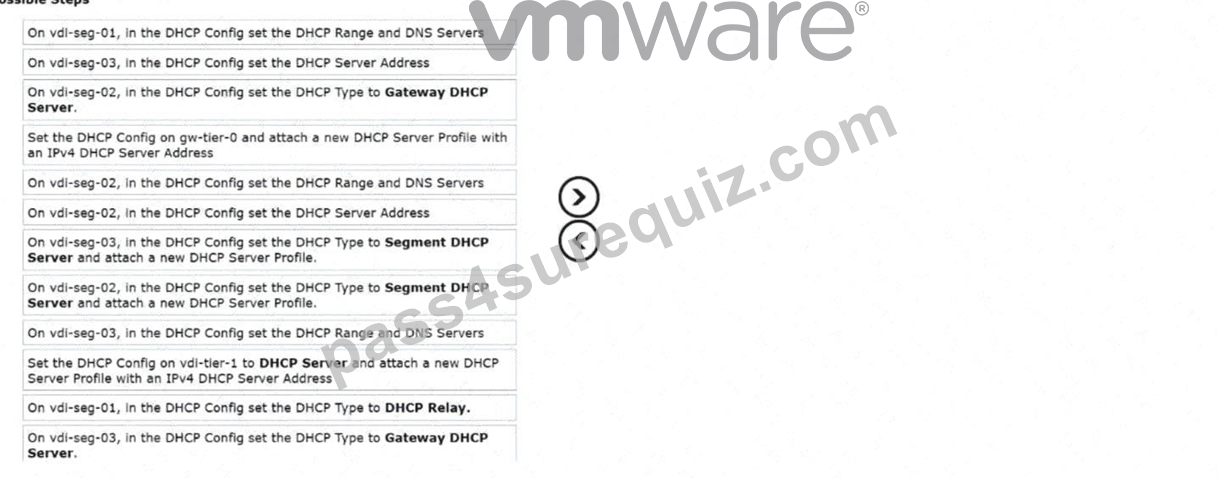
Answer:
Explanation: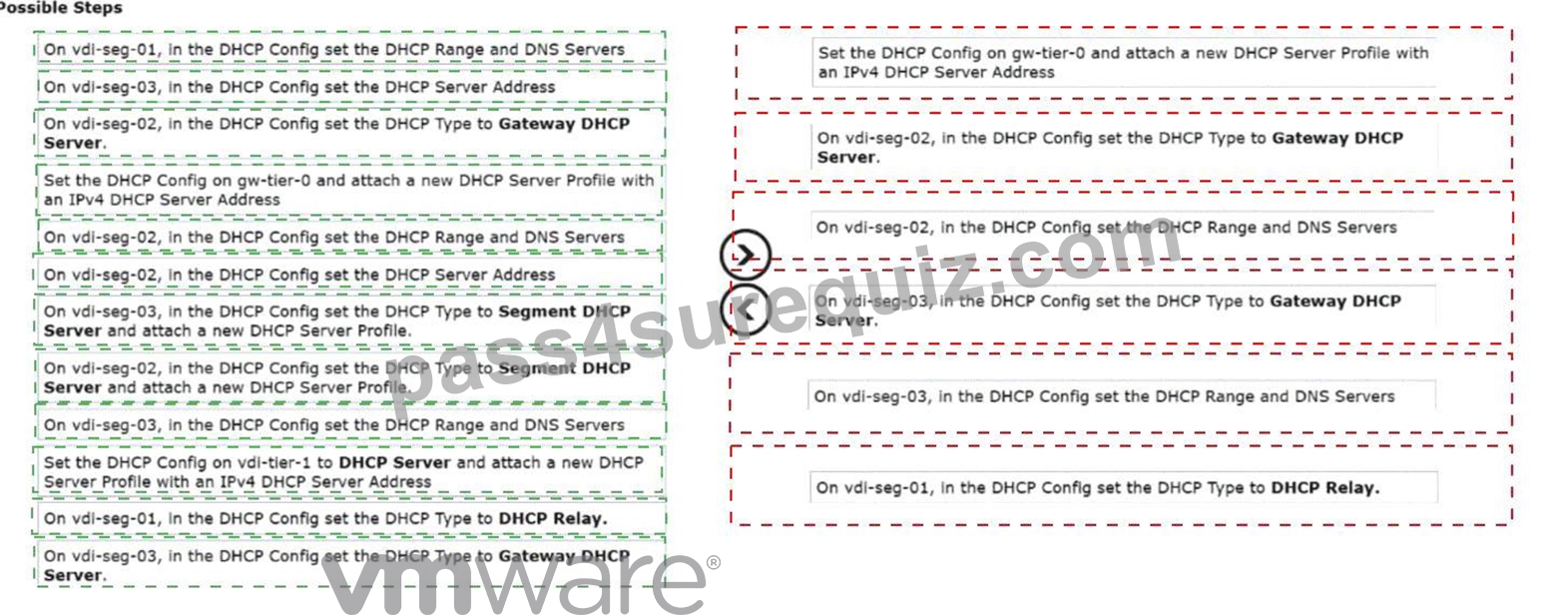
Explanation:
For the VDI solution requiring dedicated DHCP for desktop pool segments and static addresses for management components, the correct sequence of steps to configure DHCP is as follows:
* Set the DHCP Config on vdi-tier-1 to DHCP Server and attach a new DHCP Server Profile with an IPv4 DHCP Server Address.This establishes the Tier-1 gateway as the local DHCP service provider for its attached segments.
* On vdi-seg-02, in the DHCP Config set the DHCP Type to Gateway DHCP Server.This instructs the segment to use the DHCP server service configured on its parent Tier-1 gateway.
* On vdi-seg-02, in the DHCP Config set the DHCP Range and DNS Servers.Defines the specific IP pool and network settings for the first desktop pool.
* On vdi-seg-03, in the DHCP Config set the DHCP Type to Gateway DHCP Server.Instructs the second desktop segment to also leverage the Tier-1 DHCP service.
* On vdi-seg-03, in the DHCP Config set the DHCP Range and DNS Servers.Defines the IP pool for the second desktop pool.
* On vdi-seg-01, in the DHCP Config set the DHCP Type to DHCP Relay.Since management components use static addresses provided by an external mainframe-based solution or dedicated physical infrastructure, a relay is used rather than a local server to ensure proper network isolation and policy enforcement for the physical mainframe application.
NEW QUESTION # 53
When attempting to deploy or expand an edge cluster from an administrator encounters a failure: "Failed to validate the BGP Route Distribution". Prior to calling support, the administrator attempts to troubleshoot the issue. How should the administrator troubleshoot this issue?
- A. Log into the Tier-1 router to verify that route distribution is being enabled.
- B. Log into the NSX manager and examine the nsxapi.log for errors.
- C. Log into the vCenter and verify there are no errors or warnings from the NSX manager.
- D. Log into the edge node of the Tier-0 being deployed and check the routes being learnt.
Answer: D
Explanation:
Comprehensive and Detailed 250 to 350 words of Explanation From VMware Cloud Foundation (VCF) documents:
InVMware Cloud Foundation (VCF), theSDDC Managerautomates the deployment and expansion ofNSX Edge Clusters. As part of the automated workflow, particularly in VCF 4.x, 5.x, and 9.0, a "Verify BGP Route Distribution" task is executed. This task is a validation check designed to ensure that the newly deployed or expanded Edge nodes are successfully peering with the physical Top-of-Rack (ToR) switches and, more importantly, are actually receiving routes.
According to VMware/Broadcom technical documentation (specificallyKB 388351), the workflow expects to see at least one route (often the default route or specific physical prefixes) learned via BGP from the northbound peer. If the Edge nodes establish a BGP session but the physical switches are not advertising any routes (or are only advertising routes that the Edge ignores due to filters), the SDDC Manager validation fails with the error "Failed to validate the BGP Route Distribution".
The verified troubleshooting step is tolog into the CLI of the Edge nodeidentified in the failure. Using the command get route bgp from within the Tier-0 Service Router (SR) VRF context allows the administrator to see the current Routing Information Base (RIB). If the table is empty or only contains internal "ISR" (Inter- SR) routes, it confirms that the physical network is not providing the expected advertisements. This allows the administrator to correct the BGP advertisement settings on the physical ToR switches-such as enabling default-originate-and then simply "Resume" the task in SDDC Manager without needing to redeploy the entire cluster.
NEW QUESTION # 54
An administrator has a vSphere 8 Update 1a with NSX 4.1.0.2 environment. What option can the administrator use to converge this vSphere with NSX environment into a VMware Cloud Foundation (VCF) Workload Domain?
- A. Upgrade the environment and use VCF Operations to converge the vSphere environment into a new VCF Workload Domain.
- B. Upgrade the environment version and use the VCF installer to converge the vSphere environment into a new VCF Workload Domain.
- C. Upgrade NSX to version 9 into the vSphere 8 environment and use the VCF installer to converge the vSphere 8 with NSX environment into a new VCF Workload Domain.
- D. Use the VCF installer to automatically converge the vSphere with NSX environment into a new VCF Workload Domain.
Answer: D
Explanation:
Comprehensive and Detailed 250 to 350 words of Explanation From VMware Cloud Foundation (VCF) documents:
The process of transforming an existing, "brownfield" environment into a VCF-managed infrastructure is known asConvergence. In VCF 5.x and the advancements found in VCF 9.0, VMware provides theVCF Import Tool(often bundled or utilized alongside the VCF Installer/Cloud Builder) specifically for this purpose.
An environment runningvSphere 8 Update 1aandNSX 4.1.0.2is within the supported compatibility matrix for VCF 5.x convergence. The most direct and verified method (Option A) is to use theVCF Installerto "ingest" the existing vCenter and NSX Manager. During this process, the installer validates the current configuration, ensures the hosts are compatible, and then brings them under the management of a newly deployedSDDC Manager.
One of the significant advantages of this approach is that it avoids the need for a "rip and replace" of the existing networking. The VCF Installer identifies the existing NSX Manager and the logical networking constructs. Once the convergence is successful, the environment is treated as a standardVCF Workload Domain.
Options B and C are incorrect because VCF's design principle is to perform the convergence at a known stable and compatible versionbeforeusing the SDDC Manager'sLifecycle Management (LCM)to perform upgrades. Manually upgrading to version 9 prior to convergence can introduce configuration drifts that the VCF Installer may not be able to reconcile. Option D is incorrect asVCF Operations(formerly vRealize Operations) is a monitoring and optimization tool; it does not have the administrative capability to perform the structural convergence of the SDDC stack. Therefore, the automated convergence via the VCF Installer is the correct architectural path.
NEW QUESTION # 55
An administrator created a new Tier-1 Gateway and is attempting to change the connected gateway for a deployed segment to use the new gateway. In the UI, when the administrator clicks the Connected Gateway dropdown, the new Tier-1 gateway is not shown as an available gateway. What would prevent the new Tier-1 gateway from showing in the list of available gateways?
- A. The Tier-1 Gateway and NSX Segment are connected to different Tier-0 Gateways.
- B. The Tier-1 Gateway and NSX Segment are in different transport zones.
- C. The Tier-1 Gateway is not connected to an NSX Edge Cluster.
- D. The Tier-1 Gateway connectivity policy is set to "None".
Answer: B
Explanation:
Comprehensive and Detailed 250 to 350 words of Explanation From VMware Cloud Foundation (VCF) documents:
InVMware Cloud Foundationnetworking, the relationship between segments and gateways is governed by the underlyingTransport Zone (TZ)configuration. A Transport Zone defines the potential span of a virtual network-specifically, which hosts and edges can participate in that network.
When an administrator creates anNSX Segment, they must associate it with a specific Transport Zone (either Overlay or VLAN). Similarly, when aTier-1 Gatewayis created, its reach is determined by the Transport Zones available on the Transport Nodes (Edges and ESXi hosts) where it is instantiated. For a Segment to be attached to a Tier-1 Gateway, both objectsmust reside within the same Transport Zone.
If the Segment was created in "Overlay-TZ-01" but the new Tier-1 Gateway is only associated with "Overlay- TZ-02" (or if one is in a VLAN TZ and the other in an Overlay TZ), the NSX Manager UI will filter out the incompatible gateway to prevent an invalid configuration. The logical switch (Segment) cannot bind to a gateway if they do not share a common broadcast or encapsulation domain defined by the Transport Zone.
Option A is incorrect because a Tier-1 Gateway does not strictlyrequirean Edge Cluster unless it is providing stateful services (like NAT, LB, or Firewall). It can exist purely as a distributed component on the hypervisors. Option B (Connectivity Policy) determines if the T1 advertises routes to the T0, but it doesn't prevent a segment from connecting to it. Option D is also incorrect, as a Tier-1 Gateway can be moved between Tier-0s, or even exist without a Tier-0 connection initially. Therefore, theTransport Zone mismatch is the fundamental architectural barrier preventing the gateway from appearing in the selection list.
NEW QUESTION # 56
The administrator must configure Border Gateway Protocol (BGP) on the Tier-0 Gateway to establish neighbor relationships with upstream routers. Which two statements describe the Border Gateway Routing Protocol (BGP) configuration on a Tier-0 Gateway? (Choose two.)
- A. Can be used as an Exterior Gateway Protocol.
- B. EIGRP is configured by default.
- C. It supports a 4-byte autonomous system number.
- D. The network is divided into areas that are logical groups.
Answer: A,C
Explanation:
Comprehensive and Detailed 250 to 350 words of Explanation From VMware Cloud Foundation (VCF) documents:
In the architecture ofVMware Cloud Foundation (VCF)and its networking component, NSX, theTier-0 Gatewayserves as the critical demarcation point between the virtualized overlay network and the physical infrastructure. To facilitate this communication, BGP is the industry-standard protocol utilized.
BGP is fundamentally designed as anExterior Gateway Protocol (EGP). While it can be used internally (iBGP), its primary role in a VCF deployment is to exchange routing information between the SDDC and the physical Top-of-Rack (ToR) switches or core routers (eBGP). This allows the physical network to learn about the virtual subnets (overlay segments) and allows the virtual environment to receive a default route or specific external prefixes. This confirms that BGP is utilized as an EGP in these designs.
Furthermore, as global IP networking has evolved, the traditional 2-byte Autonomous System (AS) numbers (ranging from 1 to 65,535) were found to be insufficient for the number of organizations requiring them.
Modern NSX versions integrated into VCF 5.x and 9.0 fully support4-byte Autonomous System numbers (ranging from 1 to 4,294,967,295). This support is essential for service providers and large enterprises that have been assigned 4-byte ASNs by regional internet registries.
Option A is incorrect because EIGRP is a proprietary Cisco protocol and is not used by NSX. Option C describes OSPF (Open Shortest Path First), which uses "Areas," whereas BGP uses "Autonomous Systems." Therefore, the ability to act as an EGP and support for 4-byte ASNs are the verified characteristics of BGP within the VCF networking stack.
NEW QUESTION # 57
An administrator implements route leaking between the Tier-0 gateways to enhance east/west communication because the physical L3 devices are oversubscribed.
Where should route-maps be configured based on the architecture observed in the diagram?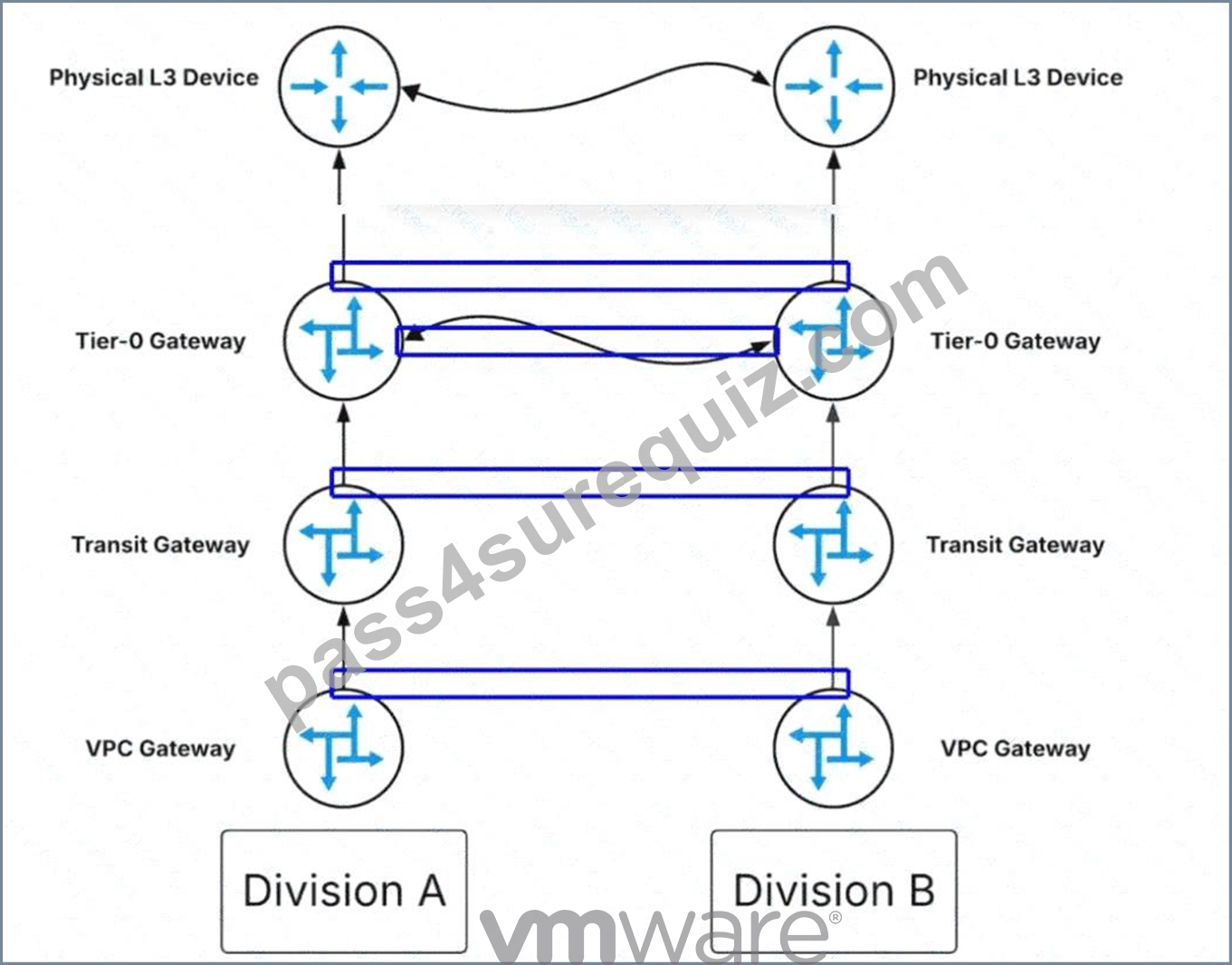
Answer:
Explanation: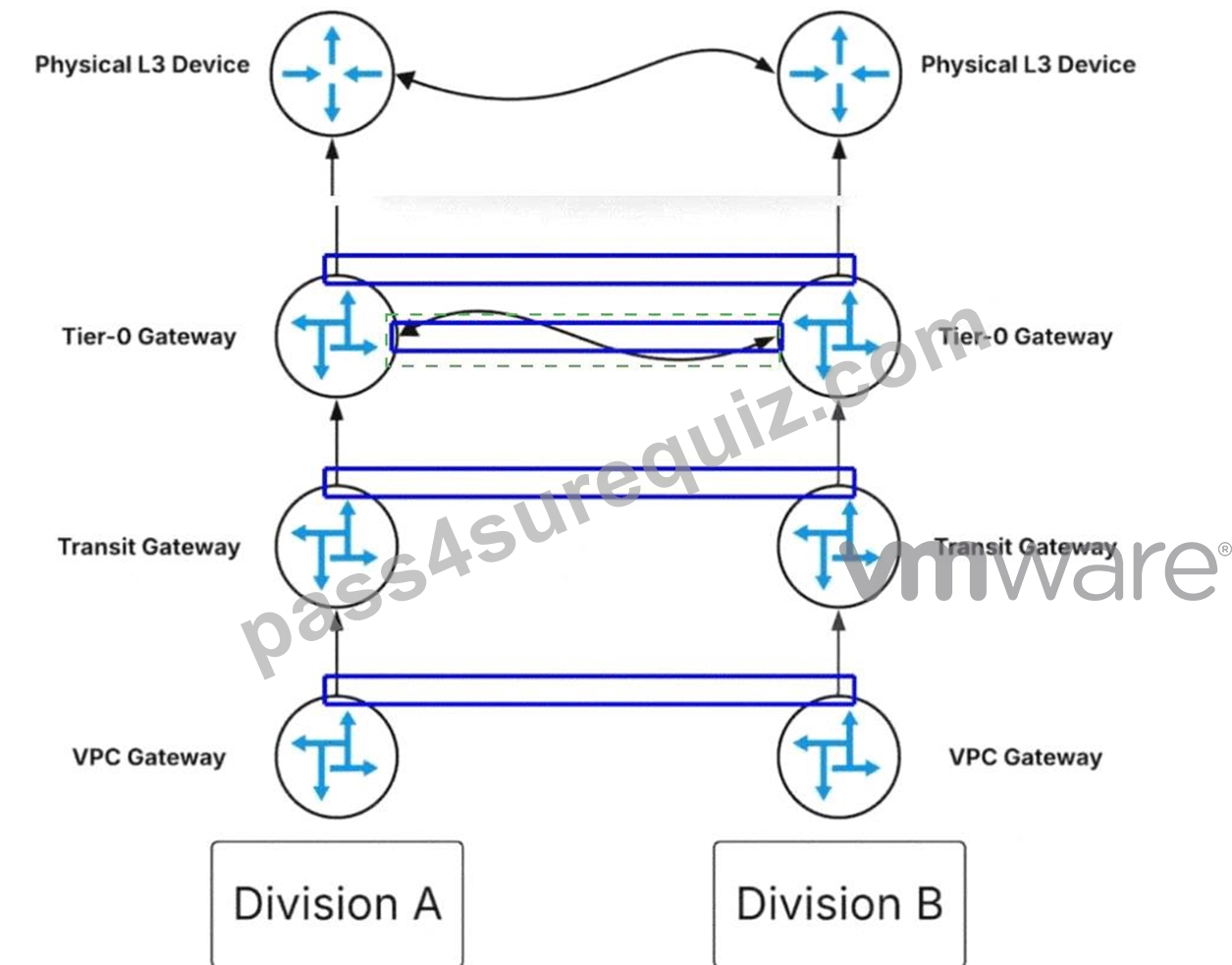
Explanation:
The administrator should click on theblue box representing the logical link between the two Tier-0 Gateways.
In the multi-tenant architecture ofVMware Cloud Foundation (VCF) 9.0, networking is structured hierarchically with VPC Gateways, Transit Gateways, and Tier-0 Gateways. Under normal conditions, traffic between isolated divisions (such as Division A and Division B) that need to communicate might be routed
"North" all the way to thePhysical L3 Devices(the physical core routers) before being routed back down.
However, if these physical devices are oversubscribed or reaching their throughput limits, this creates a performance bottleneck.
To optimize this flow, NSX allows forRoute Leakingat the Tier-0 layer. By establishing a logical peering or connection directly between twoTier-0 Gatewayswithin the virtual fabric, administrators can exchange routing information (prefixes) between the two environments without the traffic ever leaving the SDDC.
To control exactly which networks are shared and to prevent routing loops or unauthorized access,Route- Mapsmust be applied at this inter-gateway connection point. These route-maps define the "Permit" or "Deny" statements for specific IP prefixes being "leaked" from one routing table to another. By clicking the highlighted link between the Tier-0 Gateways, the administrator is targeting the specific control plane interface where these prefix exchanges occur. This configuration ensures that East-West traffic between Division A and Division B is handled locally by theNSX Edge Nodes, effectively bypassing the oversubscribed physical L3 devices and significantly reducing latency and physical network congestion.
NEW QUESTION # 58
......
VMware 3V0-25.25 Exam Syllabus Topics:
| Topic | Details |
|---|---|
| Topic 1 |
|
| Topic 2 |
|
| Topic 3 |
|
| Topic 4 |
|
| Topic 5 |
|
3V0-25.25 certification guide Q&A from Training Expert Pass4SureQuiz: https://www.pass4surequiz.com/3V0-25.25-exam-quiz.html
3V0-25.25 Certification Overview Latest 3V0-25.25 PDF Dumps: https://drive.google.com/open?id=1dgJxXw_6djD5u_R8n0Oe2waifPLf6iCC