

NCP-US-6.5 Exam Dumps - Try Best NCP-US-6.5 Exam Questions from Training Expert Pass4SureQuiz
Practice Examples and Dumps & Tips for 2026 Latest NCP-US-6.5 Valid Tests Dumps
Nutanix NCP-US-6.5 Exam Syllabus Topics:
| Topic | Details |
|---|---|
| Topic 1 |
|
| Topic 2 |
|
| Topic 3 |
|
| Topic 4 |
|
| Topic 5 |
|
| Topic 6 |
|
| Topic 7 |
|
| Topic 8 |
|
NEW QUESTION # 23
An administrator has been asked to confirm the ability of a physical windows Server 2019 host to boot from storage on a Nutanix AOS cluster.
Which statement is true regarding this confirmation by the administrator?
- A. Physical servers may boot from a volume group from the data services IP and MPIO is not required.
- B. Physical servers may boot from a volume group from the data services IP and MPIO is
- C. Physical servers may boot from an object bucket from the data services IP and MPIO is required.
- D. Physical servers may boot from an object bucket from the data services IP address and MPIO is not required.
Answer: B
Explanation:
Nutanix Volumes allows physical servers to boot from a volume group that is exposed as an iSCSI target from the data services IP. To ensure high availability and load balancing, multipath I/O (MPIO) is required on the physical server. Object buckets cannot be used for booting physical servers1. Reference: Nutanix Volumes Administration Guide1
NEW QUESTION # 24
What best describes the data protection illustrated in the exhibit?
- A. Availability Zones
- B. Metro Availability
- C. NearSync
- D. Smart DR
Answer: D
Explanation:
The data protection illustrated in the exhibit is Smart DR. Smart DR is a feature that allows share-level replication between active file server instances for disaster recovery. Smart DR can replicate shares from a primary FSI to one or more recovery FSIs on different clusters or sites. Smart DR can also perform failover and failback operations in case of a disaster or planned maintenance. The exhibit shows a Smart DR configuration with one primary FSI and two recovery FSIs. Reference: Nutanix Files Administration Guide, page 79; Nutanix Files Solution Guide, page 9
NEW QUESTION # 25
Which tool allows a report on file sizes to be automatically generated on a weekly basis?
- A. Data Lens
- B. File Analytics
- C. Files Console via Prism Element
- D. Files view in Prism Central
Answer: A
Explanation:
Data Lens is a feature that provides insights into the data stored in Files, such as file types, sizes, owners, permissions, and access patterns. Data Lens allows administrators to create reports on various aspects of their data and schedule them to run automatically on a weekly basis. Reference: Nutanix Data Lens Administration Guide
NEW QUESTION # 26
A company is currently using Objects 3.2 with a single Object Store and a single S3 bucket that was created as a repository for their data protection (backup) application. In the near future, additional S3 buckets will be created as this was requested by their DevOps team. After facing several issues when writing backup images to the S3 bucket, the vendor of the data protection solution found the issue to be a compatibility issue with the S3 protocol. The proposed solution is to use an NFS repository instead of the S3 bucket as backup is a critical service, and this issue was unknown to the backup software vendor with no foreseeable date to solve this compatibility issue. What is the fastest solution that requires the least consumption of compute capacity (CPU and memory) of their Nutanix infrastructure?
- A. Redeploy Objects using the latest version, create a new bucket, and enable NFS v3 access.
- B. Upgrade Objects to the latest version, create a new bucket, and enable NFS v3 access.
- C. Deploy Files and create a new Share with multi-protocol access enabled.
- D. Delete the existing bucket, create a new bucket, and enable NFS v3 access.
Answer: C
Explanation:
The company is using Nutanix Objects 3.2, a component of Nutanix Unified Storage (NUS), which provides S3-compatible object storage. Due to an S3 protocol compatibility issue with their backup application, they need to switch to an NFS repository. The solution must be the fastest and consume the least compute capacity (CPU and memory) on their Nutanix infrastructure.
Analysis of Options:
* Option A (Delete the existing bucket, create a new bucket, and enable NFS v3 access): Incorrect.
Nutanix Objects does support NFS access for buckets starting with version 3.5 (as per Nutanix documentation), but Objects 3.2 does not have this capability. Since the company is using Objects 3.2, this option is not feasible without upgrading or redeploying Objects, which is not mentioned in this option. Even if NFS were supported, deleting and recreating buckets does not address the compatibility issue directly and may still consume compute resources for bucket operations.
* Option B (Deploy Files and create a new Share with multi-protocol access enabled): Correct.
Nutanix Files, another component of NUS, supports NFS natively and can be deployed to create an NFS share quickly. Multi-protocol access (e.g., NFS and SMB) can be enabled on a Files share, allowing the backup application to use NFS as a repository. Deploying a Files instance with a minimal configuration (e.g., 3 FSVMs) consumes relatively low compute resources compared to redeploying or upgrading Objects, and it is the fastest way to provide an NFS repository without modifying the existing Objects deployment.
* Option C (Redeploy Objects using the latest version, create a new bucket, and enable NFS v3 access): Incorrect. Redeploying Objects with the latest version (e.g., 4.0 or later) would allow NFS v3 access, as this feature was introduced in Objects 3.5. However, redeployment is a time-consuming process that involves uninstalling the existing Object Store, redeploying a new instance, and reconfiguring buckets. This also consumes significant compute resources during the redeployment process, making it neither the fastest nor the least resource-intensive solution.
* Option D (Upgrade Objects to the latest version, create a new bucket, and enable NFS v3 access):
Incorrect. Upgrading Objects from 3.2 to a version that supports NFS (e.g., 3.5 or later) is a viable solution, as it would allow enabling NFS v3 access on a new bucket. However, upgrading Objects involves downtime, validation, and potential resource overhead during the upgrade process, which does not align with the requirement for the fastest solution with minimal compute capacity usage.
Why Option B is the Fastest and Least Resource-Intensive:
* Nutanix Files Deployment: Deploying a new Nutanix Files instance is a straightforward process that can be completed in minutes via Prism Central or the Files Console. A minimal Files deployment (e.g.,
3 FSVMs) requires 4 vCPUs and 12 GiB of RAM per FSVM (as noted in Question 2), totaling 12 vCPUs and 36 GiB of RAM. This is a relatively low resource footprint compared to redeploying or upgrading an Objects instance, which may require more compute resources during the process.
* NFS Support: Nutanix Files natively supports NFS, and enabling multi-protocol access (NFS and SMB) on a share is a simple configuration step that does not require modifying the existing Objects deployment.
* Speed: Deploying Files and creating a share can be done without downtime to the existing Objects setup, making it faster than upgrading or redeploying Objects.
Exact Extract from Nutanix Documentation:
From the Nutanix Files Deployment Guide (available on the Nutanix Portal):
"Nutanix Files supports multi-protocol access, allowing shares to be accessed via both NFS and SMB protocols. To enable NFS access, deploy a Files instance and create a share with multi-protocol access enabled. A minimal Files deployment requires 3 FSVMs, each with 4 vCPUs and 12 GiB of RAM, ensuring efficient resource usage." From the Nutanix Objects Administration Guide (available on the Nutanix Portal):
"Starting with Objects 3.5, NFS v3 access is supported for buckets, allowing them to be mounted as NFS file systems. This feature is not available in earlier versions, such as Objects 3.2."
:
Nutanix Files Deployment Guide, Version 4.0, Section: "Deploying Nutanix Files and Configuring Shares" (Nutanix Portal).
Nutanix Objects Administration Guide, Version 4.0, Section: "NFS Access for Buckets" (Nutanix Portal).
Nutanix Certified Professional - Unified Storage (NCP-US) Study Guide, Section: "Nutanix Files and Objects Comparison".
NEW QUESTION # 27
An administrator has performed an upgrade to Files. After upgrading, the file server cannot reach the given domain name with the specified DNS server list.
Which two steps should the administrator perform to resolve the connectivity issues with the domain controller servers? (Choose two.)
- A. DNS server addresses of the domain controllers.
- B. Verify the DNS settings in Prism Central.
- C. Verify the DNS settings in Prism Element.
- D. DNS entries for the given domain name.
Answer: C,D
Explanation:
The two steps that the administrator should perform to resolve the connectivity issues with the domain controller servers are:
Verify the DNS settings in Prism Element: DNS (Domain Name System) is a system that translates domain names into IP addresses. DNS settings are configurations that specify which DNS servers to use for resolving domain names. Verifying the DNS settings in Prism Element is a step that the administrator should perform, because it can help identify and correct any incorrect or outdated DNS server addresses or domain names that may cause connectivity issues with the domain controller servers.
Verify the DNS entries for the given domain name: DNS entries are records that map domain names to IP addresses or other information. Verifying the DNS entries for the given domain name is another step that the administrator should perform, because it can help check and update any incorrect or outdated IP addresses or other information that may cause connectivity issues with the domain controller servers. Reference: Nutanix Files Administration Guide, page 32; Nutanix Files Troubleshooting Guide
NEW QUESTION # 28
What tool can be used to report on a specific user's activity within a Files environment?
- A. Prism Element Alerts menu
- B. Data Lens Audit Trails
- C. Files Console Usage
- D. Prism Central Activity menu
Answer: B
Explanation:
The tool that can be used to report on a specific user's activity within a Files environment is Data Lens Audit Trails. Data Lens Audit Trails is a feature that provides detailed logs of all file operations performed by users on Files shares and exports, such as create, read, write, delete, rename, move, copy, etc. Data Lens Audit Trails can help administrators track and audit user actions and identify any unauthorized or malicious activities. The administrator can use Data Lens Audit Trails to filter and search for a specific user's activity based on various criteria, such as file name, file type, file size, file path, file share, file server, operation type, operation time, operation status, and so on. References: Nutanix Files Administration Guide, page 98; Nutanix Data Lens User Guide Nutanix Files, part of Nutanix Unified Storage (NUS), supports monitoring and reporting on user activities to track file access, modifications, and other operations. To report on a specific user's activity, a tool that provides detailed audit trails at the file level is required.
Analysis of Options:
* Option A (Prism Element Alerts menu): Incorrect. The Alerts menu in Prism Element provides cluster-level alerts (e.g., hardware failures, storage issues), but it does not offer detailed user activity reports for Files shares.
* Option B (Files Console Usage): Incorrect. The Files Console provides usage statistics for shares (e.g., storage consumption, share-level metrics), but it does not provide granular user activity reports or audit trails for specific users.
* Option C (Data Lens Audit Trails): Correct. Nutanix Data Lens, a service integrated with Nutanix Files, provides audit trails that track user activities at the file level. This includes details such as file access, modifications, deletions, and permission changes, allowing administrators to report on a specific user's actions within the Files environment.
* Option D (Prism Central Activity menu): Incorrect. The Activity menu in Prism Central provides high-level activity logs for cluster operations (e.g., VM creation, policy updates), but it does not provide detailed file-level user activity reports for Nutanix Files.
Why Data Lens Audit Trails?
Nutanix Data Lens is designed for data governance and security, offering features like audit trails, anomaly detection, and ransomware protection. The Audit Trails feature specifically allows administrators to filter and report on user activities, such as which files a user accessed, modified, or deleted, making it the ideal tool for this task.
Exact Extract from Nutanix Documentation:
From the Nutanix Data Lens Administration Guide (available on the Nutanix Portal):
"Data Lens Audit Trails provide detailed tracking of user activities within Nutanix Files shares.
Administrators can view and filter audit logs to report on specific user actions, including file access, modifications, deletions, and permission changes. This feature is accessible via the Data Lens dashboard."
:
Nutanix Data Lens Administration Guide, Version 4.0, Section: "Using Audit Trails for User Activity Monitoring" (Nutanix Portal).
Nutanix Certified Professional - Unified Storage (NCP-US) Study Guide, Section: "Nutanix Data Lens Features".
NEW QUESTION # 29
What is the binary image extension of File Analytics?
- A. VMDK
- B. ISO
- C. JSON
- D. QCOW2
Answer: D
Explanation:
File Analytics is a feature that provides insights into the data stored in Files, such as file types, sizes, owners, permissions, and access patterns. File Analytics is deployed as a VM on an AHV cluster using a QCOW2 binary image file that contains the File Analytics software and configuration3. Reference: Nutanix File Analytics Administration Guide3
NEW QUESTION # 30
An administrator is having difficulty enabling Data Lens for a file server. What is the most likely cause of this issue?
- A. The file server has been cloned.
- B. The file server is in a Protection Domain.
- C. The file server has blacklisted file types.
- D. SSR is enabled on the file server.
Answer: A
Explanation:
Nutanix Data Lens, a service integrated with Nutanix Unified Storage (NUS), provides data governance, analytics, and ransomware protection for Nutanix Files. Enabling Data Lens for a file server involves configuring the service to monitor the file server's shares. If the administrator is unable to enable Data Lens, there may be a configuration or compatibility issue with the file server.
Analysis of Options:
* Option A (The file server has been cloned): Correct. Cloning a file server (e.g., creating a duplicate file server instance via cloning in Nutanix) is not a supported configuration for Data Lens. Data Lens relies on a unique file server identity to manage its metadata and analytics. If the file server has been cloned, Data Lens may fail to enable due to conflicts in identity or metadata, as the cloned file server may not be properly registered or recognized by Data Lens.
* Option B (SSR is enabled on the file server): Incorrect. Self-Service Restore (SSR) is a feature in Nutanix Files that allows users to recover previous versions of files in SMB shares. Enabling SSR does not affect the ability to enable Data Lens, as the two features are independent and can coexist on a file server.
* Option C (The file server is in a Protection Domain): Incorrect. A Protection Domain in Nutanix is used for disaster recovery (DR) of VMs or Volume Groups, not file servers directly. Nutanix Files uses replication policies (e.g., NearSync) for DR, not Protection Domains. Even if the file server is part of a replication setup, this does not prevent Data Lens from being enabled.
* Option D (The file server has blacklisted file types): Incorrect. Blacklisting file types in Nutanix Files prevents certain file extensions from being stored on shares (e.g., for security reasons). However, this feature does not affect the ability to enable Data Lens, which operates at a higher level to analyze file metadata and user activity, regardless of file types.
Why Option A?
Cloning a file server creates a duplicate instance that may not be properly registered with Data Lens, leading to conflicts in identity, metadata, or configuration. Nutanix documentation specifies that Data Lens requires a uniquely deployed file server, and cloning can cause issues when enabling the service, making this the most likely cause of the administrator's difficulty.
Exact Extract from Nutanix Documentation:
From the Nutanix Data Lens Administration Guide (available on the Nutanix Portal):
"Data Lens requires a uniquely deployed file server to enable its services. Cloning a file server is not supported, as it may result in conflicts with Data Lens metadata and configuration. If a file server has been cloned, Data Lens may fail to enable, and the file server must be redeployed or re-registered to resolve the issue."
:
Nutanix Data Lens Administration Guide, Version 4.0, Section: "Troubleshooting Data Lens Enablement" (Nutanix Portal).
Nutanix Certified Professional - Unified Storage (NCP-US) Study Guide, Section: "Nutanix Data Lens Configuration".
NEW QUESTION # 31
What is a prerequisite for deploying Smart DR?
- A. Open TCP port 7515 on all client network IPs uni-directionally on the source and recovery file servers.
- B. The primary and recovery file servers must have the same domain name.
- C. The Files Manager must have at least three file servers.
- D. Requires one-to-many shares.
Answer: B
Explanation:
Smart DR in Nutanix Files, part of Nutanix Unified Storage (NUS), simplifies disaster recovery (DR) by automating replication policies between file servers (e.g., using NearSync, as seen in Question 24). Deploying Smart DR has specific prerequisites to ensure compatibility and successful replication between the primary and recovery file servers.
Analysis of Options:
* Option A (Open TCP port 7515 on all client network IPs uni-directionally on the source and recovery file servers): Incorrect. Port 7515 is not a standard port for Nutanix Files or Smart DR communication. Smart DR replication typically uses ports like 2009 and 2020 for data transfer between FSVMs, and port 9440 for communication with Prism Central (as noted in Question 45). The client network IPs (used for SMB/NFS traffic) are not involved in Smart DR replication traffic, and uni- directional port opening is not a requirement.
* Option B (The primary and recovery file servers must have the same domain name): Correct.
Smart DR requires that the primary and recovery file servers are joined to the same Active Directory (AD) domain (i.e., same domain name) to ensure consistent user authentication and permissions during failover. This is a critical prerequisite, as mismatched domains can cause access issues when the recovery site takes over, especially for SMB shares relying on AD authentication.
* Option C (Requires one-to-many shares): Incorrect. Smart DR does not require one-to-many shares (i.
e., a single share replicated to multiple recovery sites). Nutanix Files supports one-to-one replication for shares (e.g., primary to recovery site, as seen in the exhibit for Question 24), and one-to-many replication is not a prerequisite-it's an optional configuration not supported by Smart DR.
* Option D (The Files Manager must have at least three file servers): Incorrect. "Files Manager" is not a standard Nutanix term, but assuming it refers to the Files instance or deployment, there is no requirement for three file servers. Smart DR can be deployed with a single file server on each site (primary and recovery), though three FSVMs per file server are recommended for high availability (not file servers). This option misinterprets the requirement.
Why Option B?
Smart DR ensures seamless failover between primary and recovery file servers, which requires consistent user authentication. Both file servers must be joined to the same AD domain (same domain name) to maintain user permissions and access during failover, especially for SMB shares. This is a documented prerequisite for Smart DR deployment to avoid authentication issues.
Exact Extract from Nutanix Documentation:
From the Nutanix Files Administration Guide (available on the Nutanix Portal):
"A prerequisite for deploying Smart DR is that the primary and recovery file servers must be joined to the same Active Directory domain (same domain name). This ensures consistent user authentication and permissions during failover, preventing access issues for clients."
:
Nutanix Files Administration Guide, Version 4.0, Section: "Smart DR Prerequisites" (Nutanix Portal).
Nutanix Certified Professional - Unified Storage (NCP-US) Study Guide, Section: "Nutanix Files Disaster Recovery Setup".
NEW QUESTION # 32
An administrator is tasked with performing an upgrade to the latest Objects version.
What should the administrator do prior to upgrade Objects Manager?
- A. Upgrade Objects service
- B. Upgrade Lifecycle Manager
- C. Upgrade MSP
- D. Upgrade AOS
Answer: D
Explanation:
Before upgrading Objects Manager, the administrator must upgrade AOS to the latest version. AOS is the core operating system that runs on each node in a Nutanix cluster and provides the foundation for Objects Manager and Objects service. Upgrading AOS will ensure compatibility and stability for Objects components. Reference: Nutanix Objects Administration Guide, Acropolis Operating System Upgrade Guide
NEW QUESTION # 33
A team of developers are working on a new processing application and requires a solution where they can upload the ... code for testing API calls. Older iterations should be retained as newer code is developer and tested.
- A. Create a bucket in Objects with Versioning enabled.
- B. Provision a Volume Group and connect via iSCSI with MPIO.
- C. Create an SMB Share with Files and enable Previous Version
- D. Create an NFS Share, mounted on a Linux Server with Files.
Answer: A
Explanation:
Nutanix Objects supports versioning, which is a feature that allows multiple versions of an object to be preserved in the same bucket. Versioning can be useful for developers who need to upload their code for testing API calls and retain older iterations as newer code is developed and tested. Versioning can also provide protection against accidental deletion or overwrite of objects. References: Nutanix Objects Administration Guide The development team needs a solution to upload code via API calls while retaining older versions of the code as newer versions are developed. This use case aligns with versioned object storage, which supports API- based uploads (e.g., S3 APIs) and automatic versioning.
Analysis of Options:
* Option A (Create a bucket in Objects with Versioning enabled): Correct. Nutanix Objects, part of Nutanix Unified Storage (NUS), provides S3-compatible object storage. It supports versioning, which allows multiple versions of an object to be retained when new versions are uploaded. The S3 API is ideal for programmatic uploads via API calls, meeting the developers' requirement to upload code for testing while retaining older iterations.
* Option B (Create an SMB Share with Files and enable Previous Versions): Incorrect. Nutanix Files supports SMB shares with the Previous Versions feature (via Self-Service Restore), which allows users to access earlier versions of files. However, SMB is not typically accessed via API calls-it's designed for file sharing over a network (e.g., Windows clients). This does not align with the requirement for API-based uploads.
* Option C (Provision a Volume Group and connect via iSCSI with MPIO): Incorrect. Nutanix Volumes provides block storage via iSCSI, which is suitable for applications requiring low-level storage access (e.g., databases). However, iSCSI does not support API-based uploads or versioning, making it unsuitable for the developers' needs.
* Option D (Create an NFS Share mounted on a Linux Server with Files): Incorrect. An NFS share in Nutanix Files allows file access over the NFS protocol, which can be mounted on a Linux server. While NFS supports file storage, it does not natively provide versioning, and NFS is not typically accessed via API calls for programmatic uploads.
Why Option A is the Best Solution:
* Nutanix Objects with Versioning: Objects supports S3 APIs, which are widely used for programmatic uploads in development workflows. Enabling versioning ensures that older versions of the code are retained automatically when new versions are uploaded, meeting the requirement to retain older iterations.
* API Support: The S3 API is a standard for API-based uploads, making it ideal for the developers' workflow.
* Scalability: Objects is designed for scalable object storage, suitable for development and testing environments.
Exact Extract from Nutanix Documentation:
From the Nutanix Objects Administration Guide (available on the Nutanix Portal):
"Nutanix Objects supports versioning for buckets, allowing multiple versions of an object to be retained.
When versioning is enabled, uploading a new version of an object preserves the previous versions, which can be accessed or restored via S3 API calls. This feature is ideal for development workflows where older iterations of files need to be retained."
:
Nutanix Objects Administration Guide, Version 4.0, Section: "Bucket Versioning" (Nutanix Portal).
Nutanix Certified Professional - Unified Storage (NCP-US) Study Guide, Section: "Nutanix Objects Features".
NEW QUESTION # 34
An administrator needs to configure Files to forward logs to a syslog server. How could the administrator complete this task?
- A. Configure the syslog in Prism Element.
- B. Use the CLI in an FSVM.
- C. Use the CLI in a CVM.
- D. Configure the syslog in Files Console.
Answer: B
Explanation:
Nutanix Files, part of Nutanix Unified Storage (NUS), generates logs for file service operations, which can be forwarded to a syslog server for centralized logging and monitoring. The process to configure syslog forwarding for Nutanix Files involves interacting with the File Server Virtual Machines (FSVMs), as they handle the file services and generate the relevant logs.
Analysis of Options:
* Option A (Configure the syslog in Prism Element): Incorrect. Prism Element manages cluster-level settings, such as storage and VM configurations, but it does not provide a direct interface to configure syslog forwarding for Nutanix Files. Syslog configuration for Files is specific to the FSVMs.
* Option B (Configure the syslog in Files Console): Incorrect. The Files Console (accessible via Prism Central) is used for managing Files shares, FSVMs, and policies, but it does not have a built-in option to configure syslog forwarding. Syslog configuration requires direct interaction with the FSVMs.
* Option C (Use the CLI in an FSVM): Correct. Nutanix Files logs are managed at the FSVM level, and syslog forwarding can be configured by logging into an FSVM and using the command-line interface (CLI) to set up the syslog server details. This is the standard method documented by Nutanix for enabling syslog forwarding for Files.
* Option D (Use the CLI in a CVM): Incorrect. The Controller VM (CVM) manages the Nutanix cluster's storage and services, but it does not handle Files-specific logging. Syslog configuration for Files must be done on the FSVMs, not the CVMs.
Configuration Process:
To configure syslog forwarding, the administrator would:
* SSH into one of the FSVMs in the Files deployment.
* Use the nutanix user account to access the FSVM CLI.
* Run commands to configure the syslog server (e.g., modify the /etc/syslog.conf file or use Nutanix- specific commands to set the syslog server IP and port).
* Restart the syslog service on the FSVM to apply the changes.This process ensures that Files logs are forwarded to the specified syslog server.
Exact Extract from Nutanix Documentation:
From the Nutanix Files Administration Guide (available on the Nutanix Portal):
"To forward Nutanix Files logs to a syslog server, you must configure syslog settings on each FSVM. Log in to an FSVM using SSH and the 'nutanix' user account. Use the CLI to update the syslog configuration by specifying the syslog server's IP address and port. After configuration, restart the syslog service to apply the changes."
:
Nutanix Files Administration Guide, Version 4.0, Section: "Configuring Syslog for Nutanix Files" (Nutanix Portal).
Nutanix Certified Professional - Unified Storage (NCP-US) Study Guide, Section: "Nutanix Files Logging and Monitoring".
NEW QUESTION # 35
Which scenario is causing the alert and need to be addressed to allow the entities to be protected?
- A. One or more VMs or Volume Groups belonging to the Consistency Group is part of multiple Recovery Plans configured with a Witness.
- B. One or more VMs or Volume Groups belonging to the Consistency Group may have been deleted
- C. One or more VMs or Volume Groups belonging to the Consistency Group contains state metadata
- D. The logical timestamp for one or more of the Volume Groups is not consistent between clusters
Answer: B
Explanation:
The scenario that is causing the alert and needs to be addressed to allow the entities to be protected is that one or more VMs or Volume Groups belonging to the Consistency Group may have been deleted. A Consistency Group is a logical grouping of VMs or Volume Groups that are protected together by a Protection Policy. A Protection Policy is a set of rules that defines how often snapshots are taken, how long they are retained, and where they are replicated for disaster recovery purposes. If one or more VMs or Volume Groups belonging to the Consistency Group are deleted, the Protection Policy will fail to protect them and generate an alert with the code AI303551 - VolumeGroupProtectionFailed. Reference: Nutanix Volumes Administration Guide, page 29; Nutanix Volumes Troubleshooting Guide
NEW QUESTION # 36
How can an administrator deploy a new instance of Files?
- A. From the Files Console view in Prism Central.
- B. From the Storage view in Prism Element.
- C. From LCM in Prism Element.
- D. From LCM in Prism Central.
Answer: A
Explanation:
The Files Console view in Prism Central is the primary interface for deploying and managing Files clusters. Administrators can use the Files Console to create a new instance of Files by providing the required information, such as cluster name, network configuration, storage capacity, and license key. Reference: Nutanix Files Administration Guide
NEW QUESTION # 37
An administrator wants to monitor their Files environment for suspicious activities, such mass deletion or access denials.
How can the administrator be alerted to such activities?
How can the administrator be alerted to such activities?
- A. Configure Files to use ICAP servers, with monitors for desired activities.
- B. Configure Alerts & Events in the Files Console, filtering for Warning severity.
- C. Deploy the Files Analytics VM. and configure anomaly rules.
- D. Create a data protection policy in the Files view in Prism Central.
Answer: C
Explanation:
The administrator can monitor their Files environment for suspicious activities, such as mass deletion or access denials, by deploying the File Analytics VM and configuring anomaly rules. File Analytics is a feature that provides insights into the usage and activity of file data stored on Files. File Analytics consists of a File Analytics VM (FAVM) that runs on a Nutanix cluster and communicates with the File Server VMs (FSVMs) that host the file shares. File Analytics can alert the administrator when there is an unusual or suspicious activity on file data, such as mass deletion, encryption, permission change, or access denial. The administrator can configure anomaly rules to define the threshold, time window, and notification settings for each type of anomaly. Reference: Nutanix Files Administration Guide, page 93; Nutanix File Analytics User Guide
NEW QUESTION # 38
ionization deployed Files in multiple sites, including different geographical locations across the globe. The organization has the following requirements to improves their data management lifecycle:
* Provide a centralized management solution.
* Automate archiving tier policies for compliance purposes.
* Protect the data against ransomware.
Which solution will satisfy the organization's requirements?
- A. Data Lens
- B. Files Analytics
- C. Prims Central
Answer: A
Explanation:
Data Lens can provide a centralized management solution for Files deployments in multiple sites, including different geographical locations. Data Lens can also automate archiving tier policies for compliance purposes, by allowing administrators to create policies based on file attributes, such as age, size, type, or owner, and move files to a lower-cost tier or delete them after a specified period. Data Lens can also protect the data against ransomware, by allowing administrators to block malicious file signatures from being written to the file system. Reference: Nutanix Data Lens Administration Guide
NEW QUESTION # 39
What is the network requirement for a File Analytics deployment?
- A. Must use the Storage-side network
- B. Must use the CVM network
- C. Must use the Backplane network
- D. Must use the Client-side network
Answer: D
Explanation:
Nutanix File Analytics, part of Nutanix Unified Storage (NUS), is a tool for monitoring and analyzing file data within Nutanix Files deployments. It is deployed as a virtual machine (VM) on the Nutanix cluster and requires network connectivity to communicate with the File Server Virtual Machines (FSVMs) and other components.
Analysis of Options:
* Option A (Must use the CVM network): Incorrect. The CVM (Controller VM) network is typically an internal network used for communication between CVMs and storage components (e.g., the Distributed Storage Fabric). File Analytics does not specifically require the CVM network; it needs to communicate with FSVMs over a network accessible to clients and management.
* Option B (Must use the Client-side network): Correct. File Analytics requires connectivity to the FSVMs to collect and analyze file data. The Client-side network (also called the external network) is the network used by FSVMs for client communication (e.g., SMB, NFS) and management traffic. File Analytics must be deployed on this network to access the FSVMs, as well as to allow administrators to access its UI.
* Option C (Must use the Backplane network): Incorrect. The Backplane network is an internal network used for high-speed communication between nodes in a Nutanix cluster (e.g., for data replication, cluster services). File Analytics does not use the Backplane network, as it needs to communicate externally with FSVMs and users.
* Option D (Must use the Storage-side network): Incorrect. The Storage-side network is used for internal communication between FSVMs and the Nutanix cluster's storage pool. File Analytics does not directly interact with the storage pool; it communicates with FSVMs over the Client-side network to collect analytics data.
Why Option B?
File Analytics needs to communicate with FSVMs to collect file metadata and user activity data, and it also needs to be accessible by administrators for monitoring. The Client-side network (used by FSVMs for client access and management) is the appropriate network for File Analytics deployment, as it ensures connectivity to the FSVMs and allows external access to the File Analytics UI.
Exact Extract from Nutanix Documentation:
From the Nutanix File Analytics Deployment Guide (available on the Nutanix Portal):
"File Analytics must be deployed on the Client-side network, which is the external network used by FSVMs for client communication (e.g., SMB, NFS) and management traffic. This ensures that File Analytics can communicate with the FSVMs to collect analytics data and that administrators can access the File Analytics UI."
:
Nutanix File Analytics Deployment Guide, Version 4.0, Section: "Network Requirements for File Analytics" (Nutanix Portal).
Nutanix Certified Professional - Unified Storage (NCP-US) Study Guide, Section: "Nutanix File Analytics Deployment".
NEW QUESTION # 40
With the settings shown on the exhibit, if there were 1000 files in the repository, how many files would have to be... anomaly alert to the administrator?
- A. 0
- B. 1
- C. 2
- D. 3
Answer: B
Explanation:
With the settings shown on the exhibit, if there were 1000 files in the repository, 10 files would have to be deleted within an hour to trigger an anomaly alert to the administrator. Anomaly alert is a feature that notifies the administrator when there is an unusual or suspicious activity on file data, such as mass deletion or encryption. Anomaly alert can be configured with various parameters, such as threshold percentage, time window, minimum number of files, and so on. In this case, the threshold percentage is set to 1%, which means that if more than 1% of files in a repository are deleted within an hour, an anomaly alert will be triggered. Since there are 1000 files in the repository, 1% of them is 10 files. Therefore, if 10 or more files are deleted within an hour, an anomaly alert will be sent to the administrator. Reference: Nutanix Files Administration Guide, page 98; Nutanix Data Lens User Guide
NEW QUESTION # 41
Which two prerequisites are needed when deploying Objects to a Nutanix cluster? (Choose two.)
- A. AHV IPAM is disabled on the VLAN used for Objects.
- B. Microsegmentation is enabled.
- C. DNS is configured on the PE.
- D. Data Services IP is configured on the PI
Answer: D
Explanation:
Nutanix Objects requires a Data Services IP to be configured on the Prism Infrastructure (PI) cluster, which is used to expose the S3 API endpoint for accessing buckets and objects. Nutanix Objects also requires AHV IP Address Management (IPAM) to be disabled on the VLAN used for Objects, as Objects uses its own DHCP service to assign IP addresses to the Objects VMs1. Reference: Nutanix Objects Administration Guide1
NEW QUESTION # 42
An administrator has created a distributed share on the File cluster. The administrator connects to the share using Windows Explorer and starts creating folders in the share. The administrator observes that none of the created folder can be renamed as the company naming convention requires.
How should the administrator resolve this issue?
- A. Modify the Files shares to use the NFS protocol.
- B. Modify the read/write permissions on the created folders.
- C. Use the Files MMC Snapln and rename the folders.
- D. Use the Microsoft Shared Folder MMC Snapln.
Answer: C
Explanation:
The administrator should resolve this issue by using the Files MMC Snap-in and renaming the folders. The Files MMC Snap-in is a tool that allows administrators to manage Files shares and exports from a Windows machine. The administrator can use the Files MMC Snap-in to connect to a distributed share or export and rename the top-level directories that are hosted by different FSVMs. Renaming the directories from Windows Explorer will not work because Windows Explorer does not recognize the distributed nature of the share or export and will try to rename all directories on the same FSVM, which will fail. Reference: Nutanix Files Administration Guide, page 35; Nutanix Files MMC Snap-in User Guide
NEW QUESTION # 43
An administrator has been tasked with updating the cool-off interval of an existing WORM share from the default value to five minutes. How should the administrator complete this task?
- A. Update the worm_cooloff_interval parameter using CLI.
- B. Use FSM to update the worm_cooloff_interval parameter.
- C. Contact support to update the WORM share.
- D. Delete and re-create the WORM share.
Answer: A
Explanation:
Nutanix Files, part of Nutanix Unified Storage (NUS), supports WORM (Write Once, Read Many) shares to enforce immutability for compliance and data retention. A WORM share prevents files from being modified or deleted for a specified retention period. The "cool-off interval" (or cool-off period) is the time after a file is written to a WORM share during which it can still be modified or deleted before becoming immutable. The default cool-off interval is typically 1 minute, and the administrator wants to update it to 5 minutes.
Analysis of Options:
* Option A (Delete and re-create the WORM share): Incorrect. Deleting and re-creating the WORM share would remove the existing share and its data, which is disruptive and unnecessary. The cool-off interval can be updated without deleting the share, making this an inefficient and incorrect approach.
* Option B (Update the worm_cooloff_interval parameter using CLI): Correct. The worm_cooloff_interval parameter controls the cool-off period for WORM shares in Nutanix Files. This parameter can be updated using the Nutanix CLI (e.g., ncli or afs commands) on the file server. The administrator can log into an FSVM, use the CLI to set the worm_cooloff_interval to 5 minutes (300 seconds), and apply the change without disrupting the share. This is the most direct and efficient method to update the cool-off interval.
* Option C (Contact support to update the WORM share): Incorrect. Contacting Nutanix support is unnecessary for this task, as updating the cool-off interval is a standard administrative action that can be performed using the CLI. Support is typically needed for complex issues, not for configurable parameters like this.
* Option D (Use FSM to update the worm_cooloff_interval parameter): Incorrect. FSM (File Server Manager) is not a standard Nutanix tool or interface for managing Files configurations. The correct method is to use the CLI (option B) to update the worm_cooloff_interval parameter. While the Files Console (FSM-like interface) can manage some share settings, the cool-off interval requires CLI access.
Why Option B?
The worm_cooloff_interval parameter is a configurable setting in Nutanix Files that controls the cool-off period for WORM shares. Updating this parameter via the CLI (e.g., using ncli or afs commands on an FSVM) allows the administrator to change the cool-off interval from the default (1 minute) to 5 minutes without disrupting the existing share. This is the recommended and most efficient method per Nutanix documentation.
Exact Extract from Nutanix Documentation:
From the Nutanix Files Administration Guide (available on the Nutanix Portal):
"The cool-off interval for a WORM share, which determines the time after a file is written during which it can still be modified, is controlled by the worm_cooloff_interval parameter. To update this interval, use the CLI on an FSVM to set the parameter (e.g., to 300 seconds for 5 minutes) using commands like ncli or afs, then apply the change."
:
Nutanix Files Administration Guide, Version 4.0, Section: "Configuring WORM Shares" (Nutanix Portal).
Nutanix Certified Professional - Unified Storage (NCP-US) Study Guide, Section: "Nutanix Files WORM Configuration".
NEW QUESTION # 44
Within the Prism Central Entity > Services > Objects menu option, what is the correct task order for creating an object storage?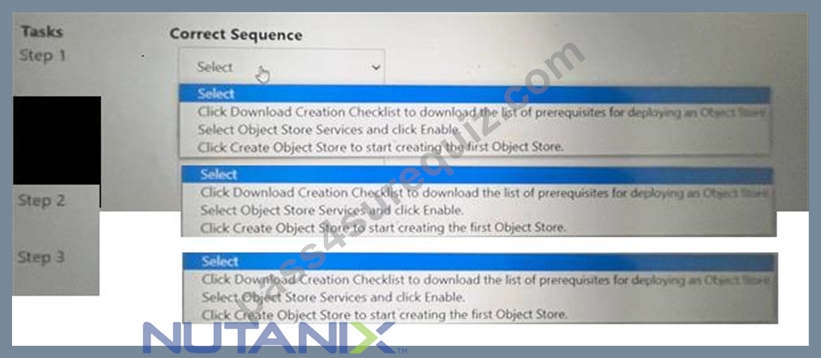
Answer:
Explanation: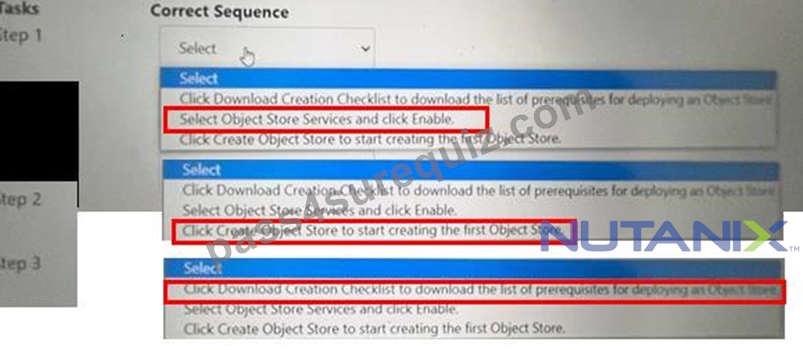
NEW QUESTION # 45
......
Latest 100% Passing Guarantee - Brilliant NCP-US-6.5 Exam Questions PDF: https://www.pass4surequiz.com/NCP-US-6.5-exam-quiz.html
NCP-US-6.5 Certification – Valid Exam Dumps Questions Study Guide: https://drive.google.com/open?id=1SbSwg_w5LG40WCQ5VSw2QTOnyAmLSaZl