

NSE 6 Network Security Specialist NSE6_FSW-7.2 Dumps Full Questions with Free PDF Questions to Pass
100% Updated Fortinet NSE6_FSW-7.2 Enterprise PDF Dumps
Fortinet NSE6_FSW-7.2 certification exam consists of multiple-choice questions that assess your understanding of FortiSwitch technologies and network security concepts. NSE6_FSW-7.2 exam duration is 120 minutes, and the passing score is 70%. NSE6_FSW-7.2 exam is available in multiple languages, including English, Japanese, and Simplified Chinese, to cater to a global audience.
NEW QUESTION # 24
Which two statements about 802.1X authentication on FortiSwitch ports are true? (Choose two.)
- A. All hosts behind an authenticated port are allowed access after a successful authentica-tion.
- B. A local user database must be used to authenticate devices using the 802.1X authentica-tion protocol.
- C. A security policy is used to apply 802.1 authentication on a port.
- D. All devices connecting to FortiSwitch must support 802.1X authentication.
Answer: A,C
NEW QUESTION # 25
Which is a requirement to enable SNMP v2c on a managed FortiSwitch?
- A. Create an SNMP user to use for authentication and encryption.
- B. Enable an SNMP v3 to handle traps messages with SNMP hosts.
- C. Specify an SNMP host to send traps to.
- D. Configure SNMP agent and communities.
Answer: D
Explanation:
To enable SNMP v2c on a managed FortiSwitch, the essential requirement involves configuring the SNMP agent and community strings:
Configure SNMP Agent and Communities (D):
SNMP Agent: Activating the SNMP agent on FortiSwitch allows it to respond to SNMP requests.
Community Strings: SNMP v2c uses community strings for authentication. These strings function as passwords to grant read-only or read-write access to the SNMP data.
Understanding Other Options:
Create an SNMP user (A) is necessary for SNMP v3, not v2c, as it involves user-based authentication and encryption.
Specify an SNMP host (B) is typically a part of SNMP configuration but not a requirement just to enable SNMP.
Enable SNMP v3 (C) is not related to enabling SNMP v2c.
Reference:
For detailed instructions on configuring SNMP on FortiSwitch, you can refer to the SNMP configuration section in the FortiSwitch administration guide available on: Fortinet Product Documentation
NEW QUESTION # 26
How is traffic routed on FortiSwitch?
- A. Layer 3 routing can be configured on FortiSwitch, while managed by FortiGate.
- B. Hardware-based routing on FortiSwitch is handled by the CPU.
- C. ASIC hardware routing can only handle dynamic routing, if supported.
- D. FortiSwitch looks up the hardware routing table and then the forwarding information base (FIB).
Answer: D
NEW QUESTION # 27
FortiGate is unable to establish a tunnel with the FortiSwitch device it is supposed to manage Based on the debug output shown in the exhibit, what is the reason for the failure?
- A. FortiSwitch has disabled FortiLink and is only managed as a standalone.
- B. The CAPWAP tunnel failed to come up due to a mismatch in time.
- C. DTLS client hello had the incorrect pre-shared key.
- D. The handshake process timed out before FortiSwitch responded.
Answer: B
Explanation:
The issue described pertains to the establishment of a tunnel (likely a CAPWAP tunnel for management purposes between FortiGate and FortiSwitch). Based on typical error analysis in tunnel setup scenarios:
The CAPWAP tunnel failed to come up due to a mismatch in time (Option C): This answer is plausible because time synchronization is crucial for security protocols that underpin tunnel establishments, such as DTLS (Datagram Transport Layer Security) used within CAPWAP tunnels. If the clocks on FortiGate and FortiSwitch are significantly out of sync, the security handshake (which can include timestamp validation) could fail, preventing the tunnel from coming up.
Reference:
Fortinet's technical documentation typically outlines the importance of time synchronization for secure communications. In CAPWAP/DLTS scenarios, precise time matching is crucial to ensure that the cryptographic parameters align correctly during the handshake process.
NEW QUESTION # 28
Which statement about using MAC, IP, and protocol-based VLANs on FortiSwitch is true?
- A. FortiSwitch uses only the Ethernet type to assign traffic to VLANs.
- B. It provides benefits that can be obtained when using 802.1X authentication.
- C. lt is a scalable and secure solution in comparison to other Layer 2 security measures.
- D. Endpoints are required to use the same FortiSwitch port to remain members of the VLAN.
Answer: B
NEW QUESTION # 29
Refer to the exhibit.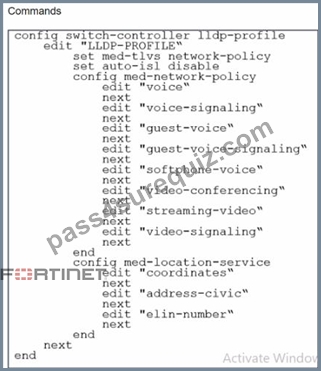
The profile shown in the exhibit is assigned to a group of managed FortiSwitch ports, and these ports are connected to endpoints which are powered by PoE.
Which configuration action can you perform on the LLDP profile to cause these endpoints to exchange PoE information and negotiate power with the managed FortiSwitch?
- A. Define an LLDP-MED location ID to use standard protocols for power.
- B. Assign a new LLDP profile to handle different LLDP-MED TLVs.
- C. Add power management as part of LLDP-MED TLVs to advertise.
- D. Create new a LLDP-MED application type to define the PoE parameters.
Answer: C
NEW QUESTION # 30
Which feature should you enable to reduce the number or unwanted IGMP reports processed by the IGMP querier?
- A. Enable IGMP flood unknown multicast traffic on the global setting.
- B. Enable the IGMP flood reports setting on the mRouter port.
- C. Enable the IGMP flood setting on the static port for all multicast groups.
- D. Enable IGMP snooping proxy.
Answer: D
Explanation:
Enable IGMP snooping proxy (C): To reduce the number of unwanted IGMP reports processed by the IGMP querier, enabling IGMP snooping proxy is effective. This feature acts as an intermediary between multicast routers and hosts, optimizing the management of IGMP messages by handling report messages locally and reducing unnecessary IGMP traffic across the network. This minimizes the processing load on the IGMP querier and improves overall network efficiency.
NEW QUESTION # 31
What can an administrator do to maintain a FortiGate-compatible FortiSwitch configuration when changing the management mode from standalone to FortiLinK?
- A. FortiGate automatically saves the existing FortiSwitch configuration during the FortiLink management process.
- B. Use a migration tool based on Python script to convert the configuration.
- C. Enable the FortiLink setting on FortiSwitch before the authorization process.
- D. Register FortiSwitch to FortiSwitch Cloud to save a copy before managing with FortiGate.
Answer: A
Explanation:
When transitioning the management of a FortiSwitch from standalone mode to being managed by FortiGate via FortiLink, it is critical to ensure that the existing configurations are preserved. The best practice involves:
FortiGate's Role in Configuration Preservation:
FortiGate has the capability to automatically preserve the existing configuration of a FortiSwitch when it is integrated into the network via FortiLink. This feature helps ensure that the transition does not disrupt the network's operational settings.
Configuration Integration:
As FortiSwitch is integrated into FortiGate's management via FortiLink, FortiGate captures and integrates the existing switch configuration, enabling a seamless transition. This process involves FortiGate recognizing the FortiSwitch and its current setup, then incorporating these settings into the centralized management interface without the need for manual reconfiguration or the use of additional tools.
Reference:
For further details on managing FortiSwitch with FortiGate and the capabilities of FortiLink, consult the FortiSwitch and FortiGate integration guide available on: Fortinet Product Documentation
NEW QUESTION # 32
Exhibit.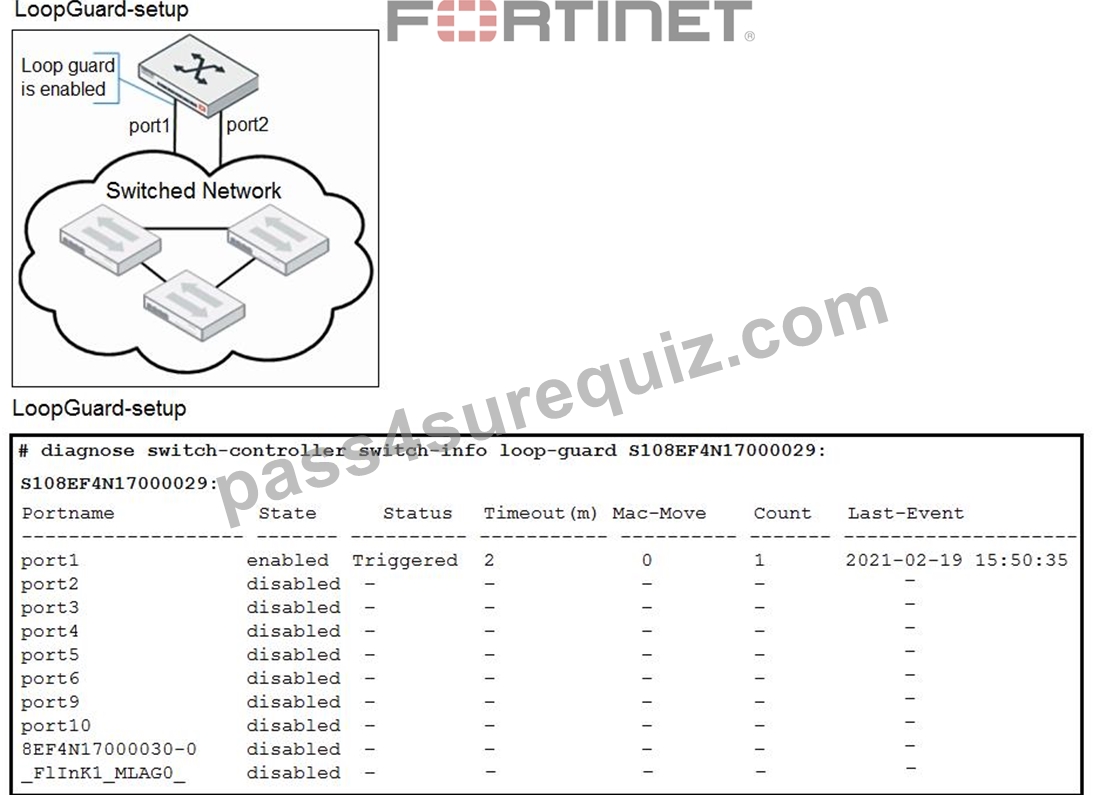
port1 and port2 are the only ports configured with the same native VLAN 10.
What are two reasons that can trigger port1 to shut down? (Choose two.)
- A. Loop guard frame sourced from port1 was received on port1.
- B. port1 was shut down by loop guard protection.
- C. STP triggered a loop and applied loop guard protection on port1.
- D. An endpoint sent a BPDU on port1 that it received from another interface.
Answer: A,B
NEW QUESTION # 33
Which statement about 802.1X security profiles using MAC-based authentication mode is true?
- A. FortiSwitch allows connectivity to all hosts connected to a port, if one host is authenticated.
- B. FortiSwitch must communicate with the RADIUS server to authenticate devices
- C. FortiSwitch performs faster when using this security mode on the ports.
- D. FortiSwitch can grant each device a different access level based on the credentials provided
Answer: D
NEW QUESTION # 34
What feature can network administrators use to segment network operations and the administration of managed FortiSwitch devices on FortiGate?
- A. Multi-chassis link aggregation trunk
- B. FortiGate multi-tenancy
- C. FortiGate clustering protocol
- D. FortiLink split interface
Answer: B
Explanation:
FortiGate's multi-tenancy feature, specifically Virtual Domains (VDOMs), is the most appropriate tool for segmenting network operations and the administration of managed FortiSwitch devices on FortiGate. Here's why:
VDOMs as Virtual Firewalls: VDOMs function as independent virtual firewalls within a single FortiGate device. Each VDOM can have its own:
Security policies
Interfaces (Including FortiLink interfaces for FortiSwitch management)
Routing table
Administrative access
Segmenting Network Operations: By assigning different FortiSwitch devices (or groups of ports) to separate VDOMs, you effectively partition your network. Network administrators can manage specific FortiSwitches through their assigned VDOMs, maintaining operational isolation.
Enhanced Administration: VDOMs offer granular administrative control. Different administrators can be assigned to specific VDOMs, limiting their management scope and reducing the risk of accidental configuration changes.
Why Other Options Are Less Suitable:
B . Multi-chassis link aggregation trunk: This focuses on link redundancy and bandwidth aggregation, not network segmentation.
C . FortiGate clustering protocol: This is aimed at high availability and scalability of the firewall functions themselves, not the management of switches.
D . FortiLink split interface: This allows dividing a FortiLink interface on the FortiGate for managing multiple FortiSwitches, but it doesn't provide the true segmentation and administrative isolation that VDOMs offer.
Reference:
Fortinet Document Library - VDOMs: [invalid URL removed]
Fortinet Document Library - FortiSwitch Multi-tenancy (using VDOMS): https://docs.fortinet.com/document/fortiswitch/7.4.2/fortilink-guide/801172/multitenancy-and-vdoms
NEW QUESTION # 35
What are two reasons why time synchronization between FortiGate and its managed FortiSwitch is critical in switch management? (Choose two.)
- A. FortiSwitch does not retain its time after a reboot, which gets reset after each reboot.
- B. FortiSwitch cannot complete the DTLS handshake used in the CAPWAP tunnel.
- C. FortiSwitch will not be able to become an NTP server for downstream devices.
- D. FortiSwitch will not allow other FortiSwitch devices in the chain be discovered by FortiGate.
Answer: A,B
NEW QUESTION # 36
An administrator needs to deploy managed FortiSwitch devices in a remote location where multiple VLANs must be utilized to segment devices. No Layer 3 switch or router is present. The the only WAN connectivity is the router provided by the ISP connected to the public internet.
Which two items will the administrator need to use? (Choose two.)
- A. FortiSwitch and FortiGate devices configured with VXLAN interfaces.
- B. FortiSwitch and FortiGate devices configured with IPsec interfaces.
- C. FortiSwitch devices that have the required internal hardware for this configuration.
- D. A FortiSwitch interface connected to the ISP router configured with fortilink-13-mode enabled.
- E. FortiSwitch devices configured with NAT disabled.
Answer: D,E
Explanation:
To deploy FortiSwitch in a remote location with multiple VLANs and no Layer 3 switch or router, you would need specific configurations:
VXLAN Interfaces (B):
Purpose: VXLAN (Virtual Extensible LAN) allows network segmentation without a Layer 3 device, extending VLAN capabilities across dispersed geographical locations over the WAN.
Implementation: Configuring VXLAN on both FortiSwitch and FortiGate can encapsulate Layer 2 traffic over a Layer 3 network, making it ideal for scenarios lacking dedicated routing hardware.
Appropriate Hardware (D):
Requirement: Not all FortiSwitch models might support advanced features like VXLAN; hence, ensuring that the hardware can support such configurations is crucial.
Reference:
For specific information on VXLAN configuration and hardware requirements, refer to the technical documentation provided by Fortinet: Fortinet Product Documentation
NEW QUESTION # 37
Which statement about the quarantine VLAN on FortiSwitch is true?
- A. It is only used for quarantined devices if global setting is set to quarantine by VLAN.
- B. Users who fail 802.1X authentication can be placed on the quarantine VLAN.
- C. FortiSwitch can block devices without configuring quarantine VLAN to be part of the allowed VLANs.
- D. Quarantine VLAN has no DHCP server
Answer: A
NEW QUESTION # 38
Which two statements about VLAN assignments on FortiSwitch ports are true? (Choose two.)
- A. Assign untagged VLANs using FortiGate CLI
- B. Assign an IP address and subnet mask to FortiSwitch VLANs
- C. Only assign one native VLAN on a port
- D. Configure a native VLAN on the FortiLink
Answer: A,C
Explanation:
VLAN assignments on FortiSwitch ports must follow certain rules and guidelines to ensure network integrity and proper traffic segregation:
Only Assign One Native VLAN on a Port (C):
Native VLAN Configuration: Each switch port can have only one native VLAN. The native VLAN carries untagged traffic for that port. If the port receives untagged frames, they are assumed to belong to the native VLAN.
Importance of Singular Native VLAN: This is crucial for preventing VLAN hopping attacks and ensures clear and secure VLAN demarcation on each port.
Assign Untagged VLANs Using FortiGate CLI (D):
CLI Configuration: Untagged VLANs, often equivalent to the native VLAN, can be assigned through the FortiGate CLI when managing a FortiSwitch via FortiLink. This allows for central management and configuration of VLANs across connected switches.
Operational Efficiency: Using the CLI ensures that VLAN settings are applied uniformly, reducing the likelihood of misconfigurations that might occur when managing VLANs individually on each switch.
Reference:
For detailed instructions and best practices on VLAN configuration on FortiSwitch, refer to the FortiSwitch administration guide available on: Fortinet Product Documentation
NEW QUESTION # 39
Which two types of Layer 3 interfaces can participate in dynamic routing on FortiSwitch? (Choose two.)
- A. Switch virtual interfaces
- B. Physical interfaces
- C. Detected management interfaces
- D. Loopback interfaces
Answer: A,D
Explanation:
In dynamic routing on FortiSwitch, certain types of interfaces are utilized to participate in the routing processes. The types of interfaces that can be used include:
Loopback Interfaces (B):
Loopback interfaces are virtual interfaces that are always up, making them ideal for use in routing protocols where a stable interface is necessary. They are commonly used to establish router IDs and manage routing information more reliably.
Switch Virtual Interfaces (C):
Switch Virtual Interfaces (SVIs) are assigned to VLANs and can have IP addresses assigned to them, making them capable of participating in Layer 3 routing. SVIs are essential for routing between different VLANs on a switch and can participate in dynamic routing protocols to advertise networks or make routing decisions.
Physical Interfaces (D) and Detected Management Interfaces (A) are not typically used directly by dynamic routing protocols for their operations in the context of FortiSwitch.
Reference:
For more information on how these interfaces interact with dynamic routing protocols, you can check the FortiSwitch documentation on Fortinet's official documentation site: Fortinet Product Documentation
NEW QUESTION # 40
How are the 'by VLAN redirect MAC address quarantine' mode and the 'by redirect MAC address quarantine' mode on FortiGate similar?
- A. Both modes move quarantined devices to the quarantine VLAN.
- B. Both modes require firewall policies to block inter-VLAN traffic.
- C. Both modes block intra-VLAN traffic by FortiGate automatically.
- D. Both modes add quarantined device MAC addresses to the blocked firewall address group.
Answer: C
NEW QUESTION # 41
Which Ethernet frame can create Layer 2 flooding due to all bytes on the destination MAC address being set to all FF?
- A. The broadcast Ethernet frame
- B. The unicast Ethernet frame
- C. The multicast Ethernet frame
- D. The anycast Ethernet frame
Answer: A
NEW QUESTION # 42
Refer to the exhibit.
The profile shown in the exhibit is assigned to a group of managed FortiSwitch ports. and these ports are connected to endpoints which are powered by PoE. Which configuration action can you perform on the LLDP profile to cause these endpoints to exchange PoE information and negotiate power with the managed FortiSwitch?
- A. Define an LLDP-ME0 location 10 to use standard protocols for power.
- B. Create new a LLOP-MEO application type to define the PoE parameters.
- C. Add power management as part of LLDP-MED TLVs to advertise.
- D. Assign a new LL0P profile to handle different LLDP-ME0 TLVs
Answer: C
NEW QUESTION # 43
To enhance service in emergency situations, to which LLDP-MED Type-Length-Values does Forti-Switch advertise to IP phones?
- A. Inventory management
- B. Network policy
- C. Location
- D. Power management
Answer: C
Explanation:
Location (C): FortiSwitch uses LLDP-MED (Link Layer Discovery Protocol - Media Endpoint Discovery) to advertise various attributes to IP phones, among which "Location" is crucial in emergency situations. This information helps emergency responders to determine the physical location of the calling device, which is vital for prompt response in critical situations.
NEW QUESTION # 44
Exhibit.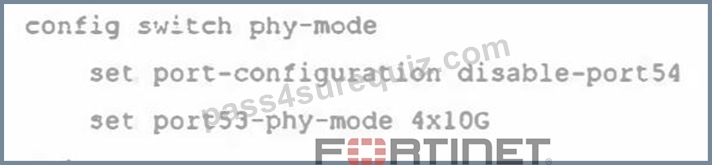
What conditions does a FortiSwitch need to have to successfully configure the options shown in the exhibit above? (Choose two.)
- A. The port full speed prior the split was 100G SFP+
- B. The split port can be assigned to native VLAN
- C. The FortiSwitch model is equipped with a maximum of 54 interfaces.
- D. The CLI commands are enabling a splitpo rt into four 10Gbps interfaces.
Answer: C,D
NEW QUESTION # 45
Refer to the exhibit.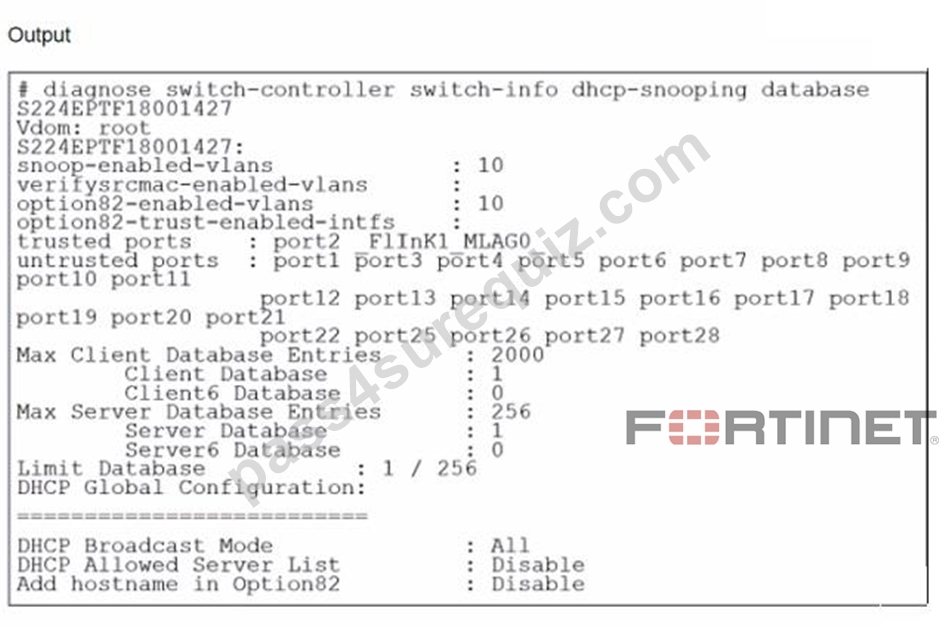
What two conclusions can be made regarding DHCP snooping configuration? (Choose two.)
- A. DHCP clients that are trusted by DHCP snooping configured is only one.
- B. Global configuration for DHCP snooping is set to forward DHCP client requests on all ports in the VLAN.
- C. Maximum value to accept clients DHCP request is configured as per DHCP server range.
- D. FortiSwitch is configured to trust DHCP replies coming on FortiLink interface.
Answer: A,D
NEW QUESTION # 46
Exhibit.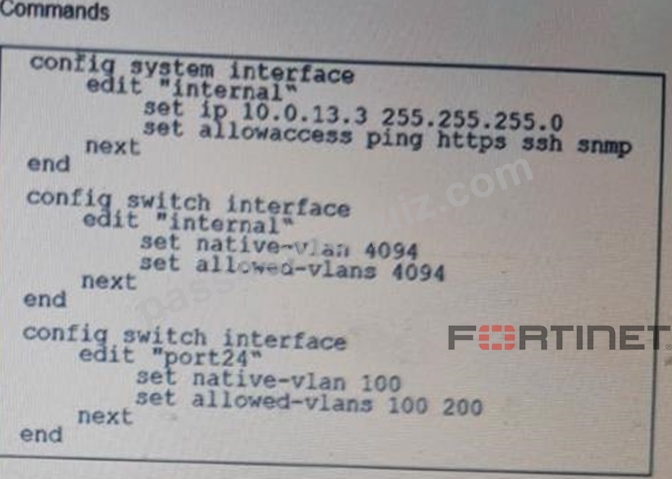
port24 is the only uplink port connected to the network where access to FortiSwitch management services is possible. However, FortiSwitch is still not accessible on the management interface. Which two actions should you take to fix the issue and access FortiSwitch? (Choose two.)
- A. You must add port24 native VLAN as an allowed VLAN on internal.
- B. You must add VLAN ID 200 to the allowed VLANS on internal.
- C. You must allow VLAN ID 4094 on port24, if management traffic is tagged.
- D. You should use VLAN ID 4094 as the native VLAN on port24.
Answer: C,D
NEW QUESTION # 47
Refer to the exhibit.
What two conclusions can be made regarding DHCP snooping configuration? (Choose two.)
- A. DHCP clients that are trusted by DHCP snooping configured is only one.
- B. Global configuration for DHCP snooping is set to forward DHCP client requests on all ports in the VLAN.
- C. Maximum value to accept clients DHCP request is configured as per DHCP server range.
- D. FortiSwitch is configured to trust DHCP replies coming on FortiLink interface.
Answer: B,D
Explanation:
Based on the DHCP snooping configuration details provided in the exhibit:
B . FortiSwitch is configured to trust DHCP replies coming on FortiLink interface. The configuration segment shows "trusted ports : port2 FlInK1 MLAG0," indicating that the FortiSwitch is configured to trust DHCP replies coming from the specified ports, including the FortiLink interface labeled FlInK1. This setup is critical in environments where the FortiLink interface connects directly to a trusted device, such as a FortiGate appliance, ensuring that DHCP traffic on these ports is considered legitimate.
D . Global configuration for DHCP snooping is set to forward DHCP client requests on all ports in the VLAN. The "DHCP Broadcast Mode" set to 'All' under the DHCP Global Configuration indicates that DHCP client requests are allowed to broadcast across all ports within the VLAN. This setting is essential for environments needing broad DHCP client servicing across multiple access ports without restriction, facilitating network connectivity and management.
NEW QUESTION # 48
......
Use Valid Exam NSE6_FSW-7.2 by Pass4SureQuiz Books For Free Website: https://www.pass4surequiz.com/NSE6_FSW-7.2-exam-quiz.html
Free NSE 6 Network Security Specialist NSE6_FSW-7.2 Official Cert Guide PDF Download: https://drive.google.com/open?id=1unOS50GCJ_OtnirAciclTRzRtSXv8gDX