

[Oct 19, 2025] New Updated JN0-637 Exam Questions 2025
Updated Free Juniper JN0-637 Test Engine Questions with 125 Q&As
NEW QUESTION # 71
You are not able to activate the SSH honeypot on the all-in-one Juniper ATP appliance.
What would be a cause of this problem?
- A. The collector must have a minimum of five interfaces.
- B. The collector must have a minimum of three interfaces.
- C. The collector must have a minimum of four interfaces.
- D. The collector must have a minimum of two interfaces.
Answer: B
Explanation:
https://www.juniper.net/documentation/en_US/release-independent/jatp/topics/task/configuration/jatp- traffic-collectorsetting-ssh-honeypot-detection.html
NEW QUESTION # 72
Referring to the exhibit,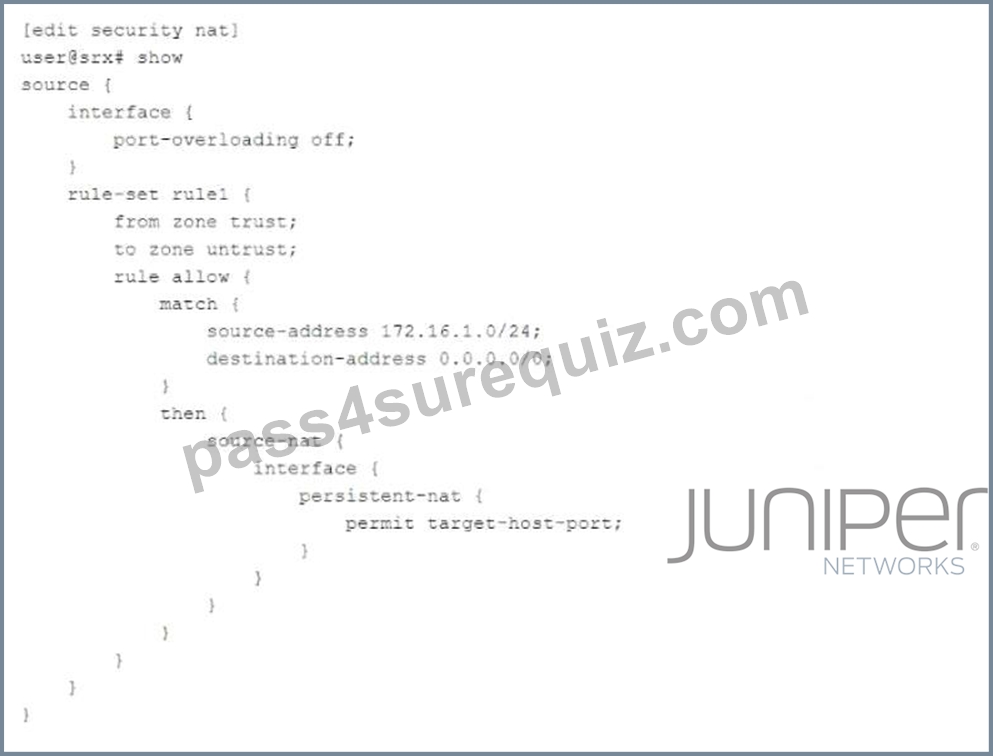
which two statements are correct about the NAT configuration? (Choose two.)
- A. Both the internal and the external host can initiate a session after the initial translation.
- B. The original destination port is used for the source port for the session.
- C. Only a specific host can initiate a session to the reflexive address after the initial session.
- D. Any external host will be able to initiate a session to the reflexive address.
Answer: B,C
Explanation:
Persistent NAT with target-host restricts session initiation to specific addresses, enhancing security. Reflexive NAT supports multiple connections by preserving the original port. Refer to Juniper NAT Configuration Documentation.
Referring to the NAT configuration shown in the exhibit:
* Specific Host Can Initiate a Session (Answer B): The configuration usespersistent NATwith the permit target-host-port statement. This allows a specific external host (based on the target host and port used in the initial session) to initiate a session back to the internal host after the initial session has been established.
Explanation: Persistent NAT ensures that the translation state is maintained, allowing external hosts to connect back only under specific conditions (e.g., the same target host and port as used in the original connection).
* Original Destination Port (Answer D): The original destination port used by the internal host is retained as the source port when the session is established from outside to inside. This behavior is a result of how persistent NAT binds the internal and external sessions, ensuring that communication occurs over the same port used for the initial session.
NEW QUESTION # 73
You have deployed automated threat mitigation using Security Director with Policy Enforcer, Juniper ATP Cloud, SRX Series devices, Forescout, and third-party switches.
In this scenario, which device is responsible for communicating directly to the third-party switches when infected hosts need to be blocked?
- A. SRX Series device
- B. Policy Enforcer
- C. Juniper ATP Cloud
- D. Forescout
Answer: D
Explanation:
In the described scenario, Forescout is responsible for communicating with the third-party switches to enforce mitigation actions when infected hosts are detected. Forescout integrates with Policy Enforcer and other network security products to provide dynamic network access control. When an infected host is detected by Juniper ATP Cloud or SRX devices, Forescout interacts with the switches to enforce the quarantine or block policy, ensuring that the compromised device is isolated from the network.
Forescout manages the access control lists (ACLs) or other blocking mechanisms on the third-party switches, while Policy Enforcer coordinates with different systems like SRX devices and ATP Cloud for real-time threat mitigation.
NEW QUESTION # 74
You have a webserver and a DNS server residing in the same internal DMZ subnet. The public Static NAT addresses for the servers are in the same subnet as the SRX Series devices internet-facing interface. You implement DNS doctoring to ensure remote users can access the webserver.
Which two statements are true in this scenario? (Choose two.)
- A. The Proxy ARP feature must be configured.
- B. The DNS doctoring ALG is not enabled by default.
- C. The DNS CNAME record is translated.
- D. The DNS doctoring ALG is enabled by default.
Answer: A,D
NEW QUESTION # 75
Which two statements are correct about mixed mode? (Choose two.)
- A. Layer 2 and Layer 3 interfaces can use separate security zones.
- B. IRB interfaces can be used to route traffic.
- C. IRB interfaces cannot be used to route traffic.
- D. Layer 2 and Layer 3 interfaces can use the same security zone.
Answer: A,B
NEW QUESTION # 76
After downloading the new IPS attack database, the installation of the new database fails. What caused this condition?
- A. Some of the new attack entries were already in use and had to be deactivated before installation.
- B. The new attack database was revoked between the time it was downloaded and installed.
- C. The new attack database no longer contained an attack entry that was in use.
- D. The new attack database was too large for the device on which it was being installed.
Answer: C
NEW QUESTION # 77
Exhibit: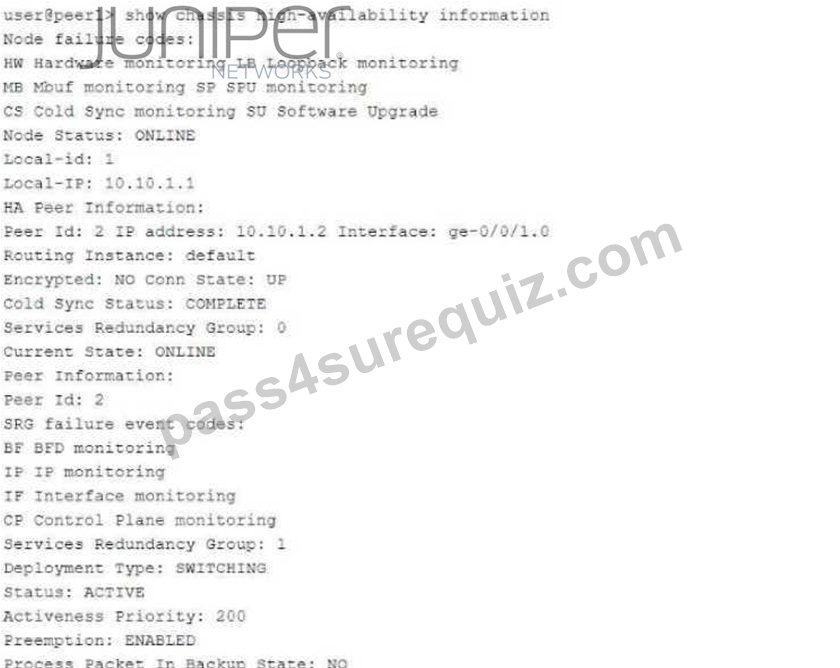

Referring to the exhibit, which statement is true?
- A. If SRG1 moves to peer 2, peer 1 will forward packets sent to the SRG1 interfaces.
- B. The ICL is encrypted.
- C. If SRG1 moves to peer 2, peer 1 will drop packets sent to the SRG1 interfaces.
- D. SRG1 is configured in hybrid mode.
Answer: A
Explanation:
The exhibit describes a Chassis Cluster configuration with high availability (HA) settings. The key information is related to Service Redundancy Group 1 (SRG1) and its failover behavior between the two peers.
In a typical SRX HA setup with active/backup configuration, if the SRG1 group moves to peer 2 (the backup), peer 1 (previously the active node) will forward packets to peer 2 instead of dropping them. This ensures smooth failover and seamless continuation of services without packet loss. This behavior is part of the active/backup failover process in SRX chassis clusters, where the standby peer takes over traffic processing without disruption.
NEW QUESTION # 78
Exhibit
Referring to the exhibit, which three statements are true? (Choose three.)
- A. The packet's destination is to a server in the DMZ zone.
- B. The packet's destination is to an interface on the SRX Series device.
- C. The packet is allowed to make an SSH connection.
- D. The packet is dropped before making an SSH connection.
- E. The packet originated within the Trust zone.
Answer: B,D,E
NEW QUESTION # 79
Exhibit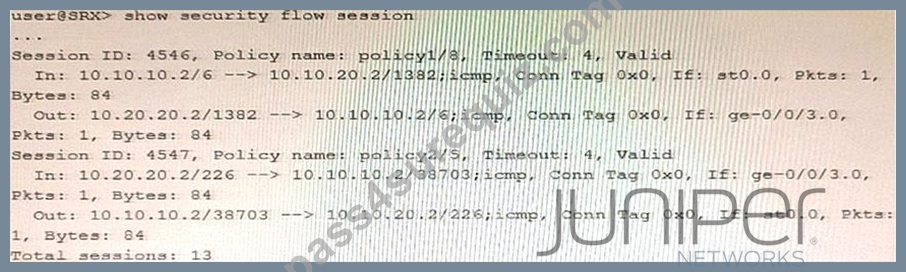
You are validating bidirectional traffic flows through your IPsec tunnel. The 4546 session represents traffic being sourced from the remote end of the IPsec tunnel. The 4547 session represents traffic that is sourced from the local network destined to the remote network.
Which statement is correct regarding the output shown in the exhibit?
- A. The remote gateway address for the IPsec tunnel is 10.20.20.2
- B. The session information indicates that the IPsec tunnel has not been established
- C. The local gateway address for the IPsec tunnel is 10.20.20.2
- D. NAT is being used to change the source address of outgoing packets
Answer: A
NEW QUESTION # 80
Exhibit: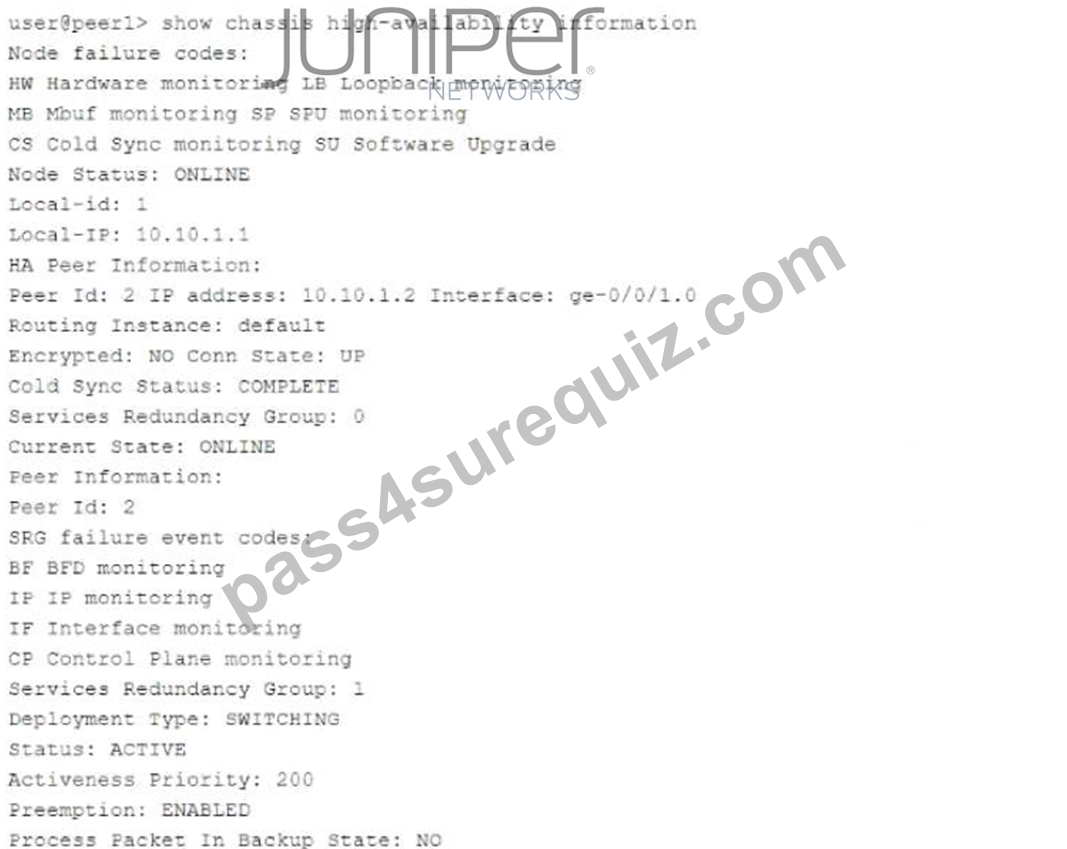

Referring to the exhibit, which statement is true?
- A. If SRG1 moves to peer 2, peer 1 will forward packets sent to the SRG1 interfaces.
- B. The ICL is encrypted.
- C. If SRG1 moves to peer 2, peer 1 will drop packets sent to the SRG1 interfaces.
- D. SRG1 is configured in hybrid mode.
Answer: A
Explanation:
The exhibit describes a Chassis Cluster configuration with high availability (HA) settings. The key information is related to Service Redundancy Group 1 (SRG1) and its failover behavior between the two peers.
* Explanation of Answer D (Packet Forwarding after Failover):
* In a typical SRX HA setup with active/backup configuration, if the SRG1 group moves to peer
2 (the backup), peer 1 (previously the active node) will forward packets to peer 2 instead of dropping them. This ensures smooth failover and seamless continuation of services without packet loss.
* This behavior is part of the active/backup failover process in SRX chassis clusters, where the standby peer takes over traffic processing without disruption.
Juniper Security Reference:
* Chassis Cluster Failover Behavior: When a service redundancy group fails over to the backup peer, the previously active peer forwards traffic to the new active node. Reference: Juniper Chassis Cluster Documentation.
NEW QUESTION # 81
Which two statements are correct about automated threat mitigation with Security Director?
(Choose two.)
- A. Infected hosts are tracked by their MAC address.
- B. Infected hosts are tracked by their chassis serial number.
- C. Infected hosts are tracked by their IP address.
- D. Infected hosts are tracked by their user identity.
Answer: A,C
NEW QUESTION # 82
Exhibit: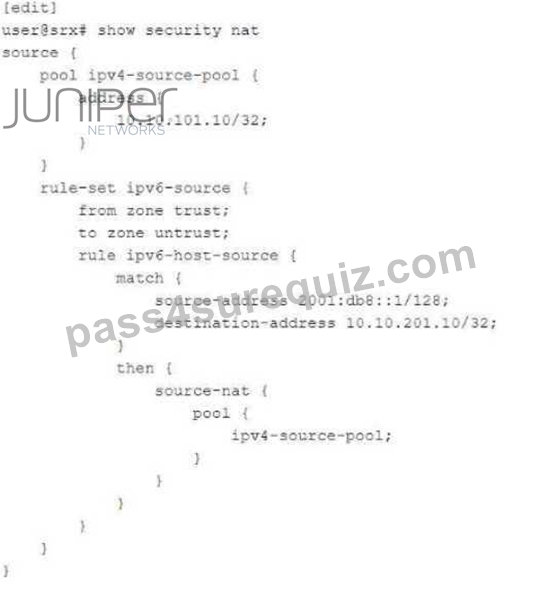
You are configuring NAT64 on your SRX Series device. You have committed the configuration shown in the exhibit. Unfortunately, the communication with the 10.10.201.10 server is not working. You have verified that the interfaces, security zones, and security policies are all correctly configured.
In this scenario, which action will solve this issue?
- A. Configure source NAT to translate return traffic from IPv4 address to the IPv6 address of your source device.
- B. Configure destination NAT to translate return traffic from the IPv4 address to the IPv6 address of your source device.
- C. Configure proxy-NDP on the IPv6 interface for the 2001:db8::1/128 address.
- D. Configure proxy-ARP on the external IPv4 interface for the 10.10.201.10/32 address.
Answer: B
NEW QUESTION # 83
You have deployed an SRX Series device at your network edge to secure Internet-bound sessions for your local hosts using source NAT. You want to ensure that your users are able to interact with applications on the Internet that require more than one TCP session for the same application session. Which two features would satisfy this requirement? (Choose two.)
- A. persistent NAT
- B. double NAT
- C. address persistence
- D. STUN
Answer: A,C
Explanation:
Address persistence ensures that the same NAT IP address is used for all sessions originating from a single source IP. Persistent NAT maintains connections for applications needing multiple sessions, like VoIP.
For applications that require multiple TCP sessions for the same application session (such as VoIP or certain online games), the SRX device needs to handle NAT properly to maintain session continuity.
NEW QUESTION # 84
Exhibit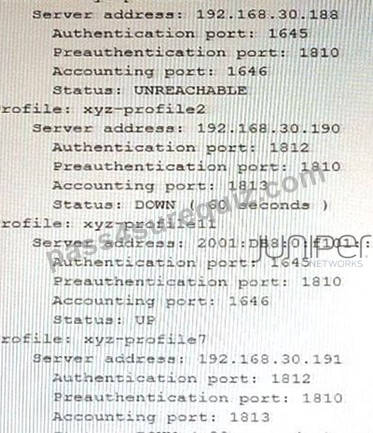
The show network-access aaa radius-servers command has been issued to solve authentication issues.
Referring to the exhibit, to which two authentication servers will the SRX Series device continue to send requests? (Choose TWO)
- A. 192.168.30.191
- B. 192.168.30.188
- C. 192.168.30.190
- D. 200l:DB8:0:f101;:2
Answer: A,B
NEW QUESTION # 85
Which Junos security feature is used for signature-based attack prevention?
- A. IPS
- B. AppQoS
- C. PIM
- D. RADIUS
Answer: A
NEW QUESTION # 86
You are asked to look at a configuration that is designed to take all traffic with a specific source ip address and forward the traffic to a traffic analysis server for further evaluation. The configuration is no longer working as intended.
Referring to the exhibit which change must be made to correct the configuration?
- A. Apply the filter as in input filter on interface xe-0/0/1.0
- B. Apply the filter as in input filter on interface xe-0/2/1.0
- C. Apply the filter as in output filter on interface xe-0/1/0.0
- D. Create a routing instance named default
Answer: A
NEW QUESTION # 87
Which method does an SRX Series device in transparent mode use to learn about unknown devices in a network?
- A. LLDP-MED
- B. IGMP snooping
- C. RSTP
- D. packet flooding
Answer: D
NEW QUESTION # 88
Click the Exhibit button.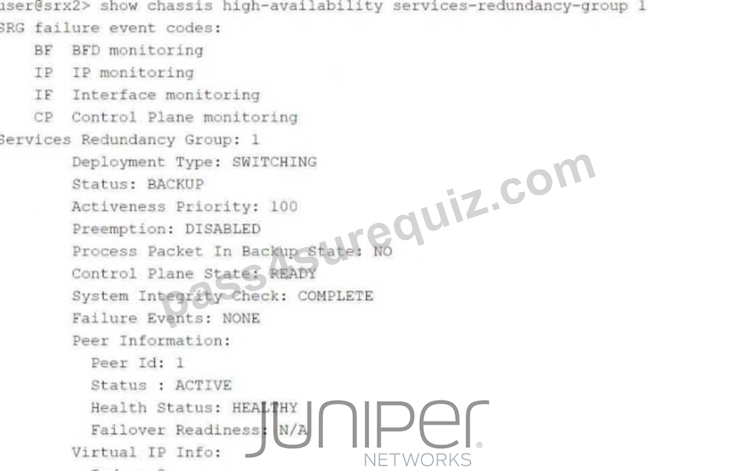
Referring to the exhibit, which two statements are correct? (Choose two.)
- A. The ge-0/0/3.0 and ge-0/0/4.0 interfaces are active and will respond to ARP requests to the virtual IP MAC address.
- B. This device is the backup node for SRG1.
- C. The ge-0/0/3.0 and ge-0/0/4.0 interfaces are not active and will not respond to ARP requests to the virtual IP MAC address.
- D. This device is the active node for SRG1.
Answer: A,D
NEW QUESTION # 89
Click the Exhibit button.
Which type of NAT is shown in the exhibit?
- A. DS-Lite
- B. persistent NAT
- C. NAT46
- D. NAT64
Answer: D
NEW QUESTION # 90
Exhibit: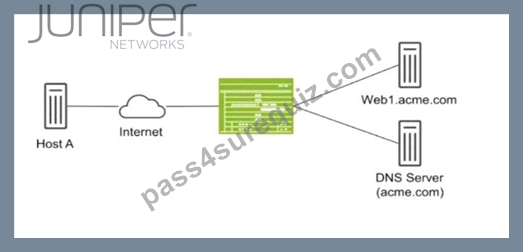
Host A shown in the exhibit is attempting to reach the Web1 webserver, but the connection is failing.
Troubleshooting reveals that when Host A attempts to resolve the domain name of the server (web.acme.
com), the request is resolved to the private address of the server rather than its public IP.
Which feature would you configure on the SRX Series device to solve this issue?
- A. DNS doctoring
- B. Persistent NAT
- C. Double NAT
- D. STUN protocol
Answer: A
Explanation:
DNS doctoring modifies DNS responses for hosts behind NAT devices, allowing them to receive the correct public IP address for internal resources when queried from the public network. This prevents issues where private IPs are returned and are not reachable externally. For details, visit Juniper DNS Doctoring Documentation.
In this scenario, Host A is trying to resolve the domain name web.acme.com, but the DNS resolution returns the private IP address of the web server instead of its public IP. This is a common issue in networks where private addresses are used internally, but public addresses are required for external clients.
* Explanation of Answer C (DNS Doctoring):
* DNS doctoring is a feature that modifies DNS replies as they pass through the SRX device. In this case, DNS doctoring can be used to replace the private IP address returned in the DNS response with the correct public IP address for Host A. This allows external clients to reach internal resources without being aware of their private IP addresses.
Configuration Example:
bash
set security nat dns-doctoring from-zone untrust to-zone trust
Juniper Security Reference:
* DNS Doctoring Overview: DNS doctoring is used to modify DNS responses so that external clients can access internal resources using public IP addresses. Reference: Juniper DNS Doctoring Documentation.
NEW QUESTION # 91
Click the Exhibit button.
Which type of NAT is shown in the exhibit?
- A. DS-Lite
- B. persistent NAT
- C. NAT46
- D. NAT64
Answer: D
NEW QUESTION # 92
Exhibit: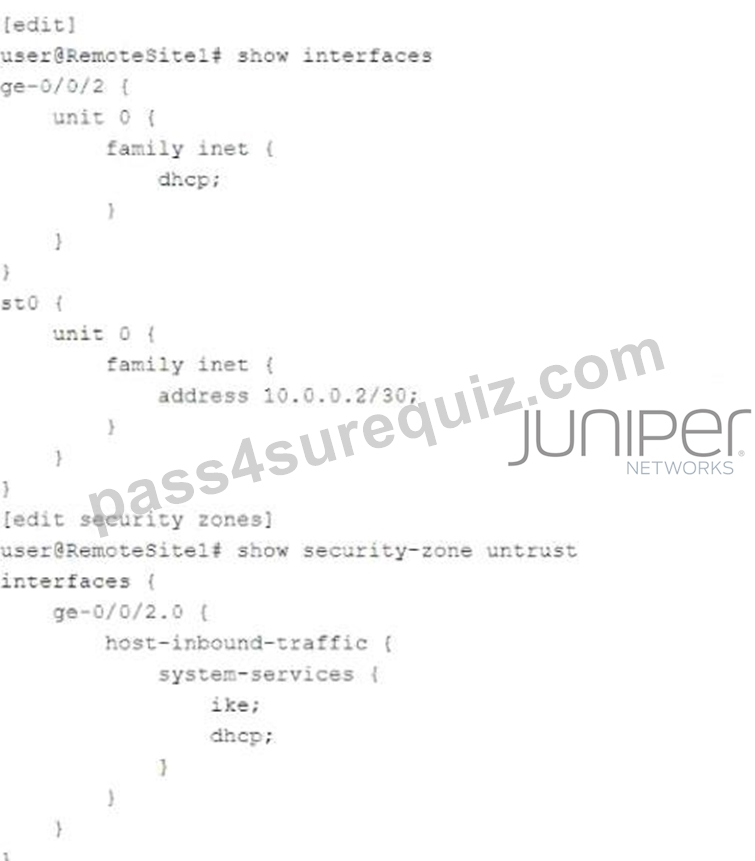
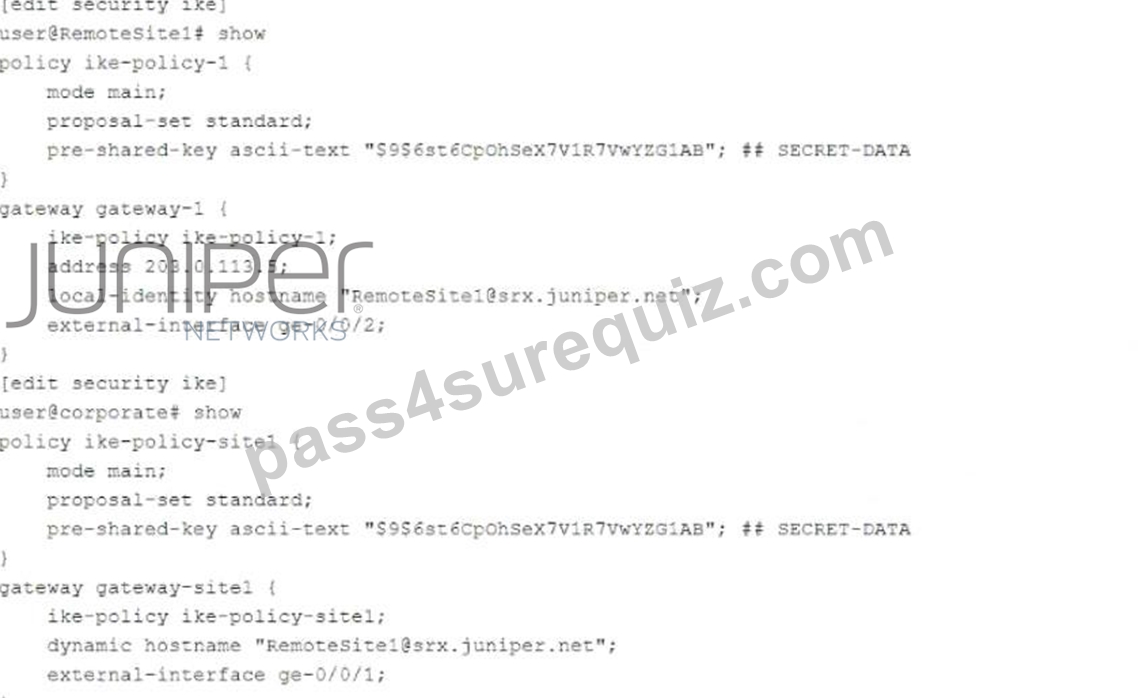
You are troubleshooting a new IPsec VPN that is configured between your corporate office and the RemoteSite1 SRX Series device. The VPN is not currently establishing. The RemoteSite1 device is being assigned an IP address on its gateway interface using DHCP.
Which action will solve this problem?
- A. On both devices, change the IKE policy proposal set to basic.
- B. On both devices, change the IKE version to use version 2 only.
- C. On the RemoteSite1 device, change the IKE gateway external interface to st0.0.
- D. On both devices, change the IKE policy mode to aggressive.
Answer: D
Explanation:
Aggressive mode is required when an IP address is dynamically assigned, such as through DHCP, as it allows for faster establishment with less identity verification. More details are available in Juniper IKE and IPsec Configuration Guide.
The configuration shown in the exhibit highlights that theRemoteSite1SRX Series device is using DHCP to obtain an IP address for its external interface (ge-0/0/2). This introduces a challenge in IPsec VPN configurations when the public IP address of the remote site is not static, as is the case here.
Aggressive modein IKE (Internet Key Exchange) is designed for situations where one or both peers have dynamically assigned IP addresses. In this scenario,aggressive modeallows the devices to exchange identifying information, such as hostnames, rather than relying on static IP addresses, which is necessary when the remote peer (RemoteSite1) has a dynamic IP from DHCP.
* Correct Action (D): Changing the IKE policy mode toaggressivewill resolve the issue by allowing the two devices to establish the VPN even though one of them is using DHCP. In aggressive mode, the initiator can present its identity (hostname) during the initial handshake, enabling the VPN to be established successfully.
* Incorrect Options:
* Option A: Changing the external interface to st0.0 is incorrect because the st0 interface is used for the tunnel interface, not for the IKE negotiation.
* Option B: Changing to IKE version 2 would not resolve the dynamic IP issue directly, and IKEv1 works in this scenario.
* Option C: Changing the IKE proposal set to basic doesn't address the dynamic IP challenge in this scenario.
Juniper References:
* Juniper IKE and VPN Documentation: Provides details on when to use aggressive mode, especially when a dynamic IP address is involved.
NEW QUESTION # 93
Which two statements are true regarding NAT64? (Choose two.)
- A. An SRX Series device should be in packet-based forwarding mode for IPv4.
- B. An SRX Series device should be in packet-based forwarding mode for IPv6.
- C. An SRX Series device should be in flow-based forwarding mode for IPv6.
- D. An SRX Series device should be in flow-based forwarding mode for IPv4.
Answer: C,D
Explanation:
NAT64 requires flow-based forwarding for both IPv4 and IPv6 to ensure proper stateful inspection and address translation. Packet-based forwarding does not support the necessary stateful inspection needed for NAT64. For more on NAT64, refer to Juniper NAT64 Overview.
NAT64 allows communication between IPv6 and IPv4 devices by translating IPv6 addresses to IPv4 addresses and vice versa. On Juniper SRX devices, the device's forwarding mode is crucial in how the device processes traffic.
* Flow-based forwarding mode:
* Correct: Option C: For IPv4 traffic in NAT64 configurations, SRX devices should be in flow- based forwarding mode. Flow-based mode means that the device inspects traffic sessions and tracks state, which is essential for proper NAT64 operations. This mode enables the device to monitor and translate between IPv4 and IPv6 protocols dynamically while maintaining session states.
* Correct: Option D: Similarly, for IPv6 traffic, the SRX device should also be in flow-based mode. Flow-based mode ensures the SRX tracks the IPv6-to-IPv4 translations properly by preserving the state of each connection, ensuring consistent NAT64 operations.
* Packet-based forwarding mode:Packet-based mode is not used for NAT64 operations because it does not provide stateful inspection, which is required for NAT64 to function correctly. Hence, options A and B are incorrect.
Juniper References:
* Juniper NAT64 Documentation: Discusses how NAT64 functions on SRX devices and specifies the requirement of flow-based mode for both IPv4 and IPv6 traffic when translating between these protocols.
NEW QUESTION # 94
You are configuring advanced policy-based routing. You have created a static route with next hop of an interface in your inet.0 routing table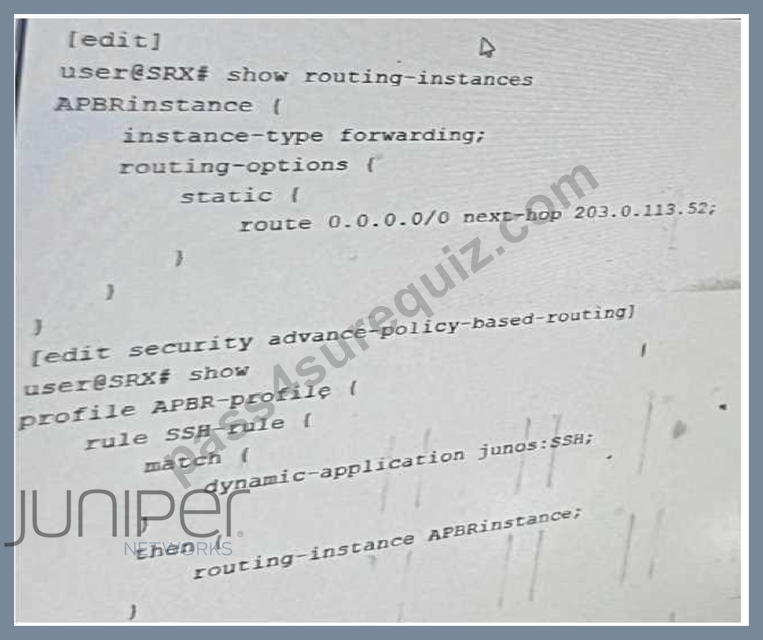

Referring to the exhibit, what should be changed to solve this issue?
- A. You should delete the interface-routes configuration under the routing-options hierarchy.
- B. You should move the inet. o table before the routing instance table in your rib-groups configuration.
- C. You should change the routing instance type to virtual-router.
- D. You should move the static route configuration to the main routing instance.
Answer: B
NEW QUESTION # 95
Exhibit: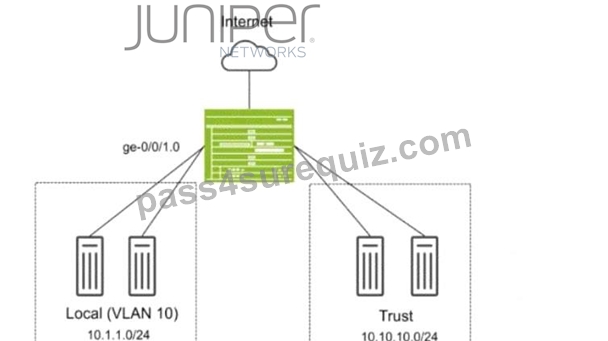
You have deployed an SRX Series device as shown in the exhibit. The devices in the Local zone have recently been added, but their SRX interfaces have not been configured. You must configure the SRX to meet the following requirements:
* Devices in the 10.1.1.0/24 network can communicate with other devices in the same network but not with other networks or the SRX.
* You must be able to apply security policies to traffic flows between devices in the Local zone.
Which three configuration elements will be required as part of your configuration? (Choose three.)
- A. set protocols l2-learning global-mode switching
- B. set interfaces ge-0/0/1 unit 0 family ethernet-switching vlan-members 10
- C. set security zones security-zone Local interfaces ge-0/0/1.0
- D. set protocols l2-learning global-mode transparent-bridge
- E. set security zones security-zone Local interfaces irb.10
Answer: B,C,D
Explanation:
In this scenario, we need to configure the SRX Series device so that devices in theLocal zone(VLAN 10,
10.1.1.0/24 network) can communicate with each other but not with other networks or the SRX itself.
Additionally, you must be able to apply security policies to traffic flows between the devices in the Local zone.
* Explanation of Answer A (Assigning Interface to Security Zone):
* You need to assign the interface ge-0/0/1.0 to theLocalsecurity zone. This is crucial because the SRX only applies security policies to interfaces assigned to security zones. Without this, traffic between devices in the Local zone won't be processed by security policies.
* Configuration:
bash
Copy code
set security zones security-zone Local interfaces ge-0/0/1.0
* Explanation of Answer B (Configuring Ethernet-Switching for VLAN 10):
* Since we are using Layer 2 switching between devices in VLAN 10, we need to configure the interface to operate inEthernet switchingmode and assign it toVLAN 10.
* Configuration:
bash
Copy code
set interfaces ge-0/0/1 unit 0 family ethernet-switching vlan-members 10
* Explanation of Answer D (Transparent Bridging Mode for Layer 2):
* The global mode for Layer 2 switching on the SRX device must be set totransparent-bridge.
This ensures that the SRX operates in Layer 2 mode and can switch traffic between devices without routing.
* Configuration:
bash
Copy code
set protocols l2-learning global-mode transparent-bridge
Summary:
* Interface Assignment: Interface ge-0/0/1.0 is assigned to the Local zone to allow policy enforcement.
* Ethernet-Switching: The interface is configured for Layer 2 Ethernet switching in VLAN 10.
* Transparent Bridging: The SRX is configured in Layer 2 transparent-bridge mode for switching between devices.
Juniper Security Reference:
* Layer 2 Bridging and Switching Overview: This mode allows the SRX to act as a Layer 2 switch for forwarding traffic between VLAN members without routing. Reference: Juniper Transparent Bridging Documentation.
NEW QUESTION # 96
......
Juniper JN0-637 Exam Syllabus Topics:
| Topic | Details |
|---|---|
| Topic 1 |
|
| Topic 2 |
|
| Topic 3 |
|
| Topic 4 |
|
| Topic 5 |
|
| Topic 6 |
|
Try 100% Updated JN0-637 Exam Questions [2025]: https://www.pass4surequiz.com/JN0-637-exam-quiz.html
The Best JNCIP-SEC JN0-637 Professional Exam Questions: https://drive.google.com/open?id=1h1LWlNNCBe6ZpKvPDIHrYU2hhtiu3tSO