

[Oct-2025] 100% Actual 1z0-1054-24 dumps Q&As with Explanations Verified & Correct Answers
1z0-1054-24 Dumps with Free 365 Days Update Fast Exam Updates
Oracle 1z0-1054-24 Exam Syllabus Topics:
| Topic | Details |
|---|---|
| Topic 1 |
|
| Topic 2 |
|
| Topic 3 |
|
| Topic 4 |
|
| Topic 5 |
|
NEW QUESTION # 36
You have enabled budgetary control and have a control budget set toAdvisorycontrol level. For September
2016, your budget for a given account combination is$5,000 USD.
In the same month, there is anapproved requisitionfor that account of$900and anapproved purchase order for that account of$2,500 USD. There is also aGeneral Ledger adjustment journal entryfor that account of
$1,600 USD. Anapproved purchase order line of $400 USDis thencanceled.
Aninvoice is matchedto the purchase order for$2,100 USD.
Which two statements are true? (Choose two.)
- A. Purchase order encumbrance will be released for $2,100 USD.
- B. Funds reservation only happens for non-matched invoices, so the system will not reserve funds.
- C. The system always consumes the budget of future periods if the limit for the current period is expired, so October 2016 budget will be considered for reservation.
- D. As there are cancellations for $400 USD, the system will partially reserve the funds in September 2016 and fully reserve it in October 2016.
Answer: A,D
NEW QUESTION # 37
Which two statements are true about balances cubes in General Ledger?
- A. They are updated automatically when the Translation process is run.
- B. They are updated automatically when the General Ledger period is opened.
- C. New dimensions can be added to a General Ledger balances cube.
- D. They are updated automatically when the Revaluation process is run.
- E. A new balances cube is created for a unique combination of ledger and currency.
Answer: C,E
Explanation:
Balances cubes are multidimensional databases that store financial balances for interactive reporting and analysis. A balances cube is created for each unique combination of ledger and currency, and it contains dimensions such as chart of accounts segments, periods, scenarios, and other user-defined attributes. New dimensions can be added to a balances cube by using the Manage Balances Cube Dimensions task in General Ledger. Balances cubes are updated automatically when journals are posted in General Ledger, and they can also be refreshed manually by using the Refresh Balances Cube task. Balances cubes are not affected by the Translation or Revaluation processes, as these processes only update the balances tables in General Ledger.
References:
* Overview of Oracle General Ledger Balances Cubes1
* Considerations for General Ledger Balances Cubes2
* Overview of Oracle Essbase Balances Cubes3
NEW QUESTION # 38
You notice that a lot of erroneous address data is being saved. How do you ensure that only valid addresses are entered in the system?
- A. Define the Geography Validation for Country option to No Validation.
- B. Define the Geography Validation for Country option to Error.
- C. Redefine the location structure.
- D. Redefine the geography hierarchy.
Answer: B
Explanation:
Geography validation is a feature that enables you to validate the address information entered for a location against the geography hierarchy defined for a country. You can set the Geography Validation for Country option to one of the following values:
* No Validation: No validation is performed on the address information.
* Warning: A warning message is displayed if the address information does not match the geography hierarchy, but the user can still save the address.
* Error: An error message is displayed if the address information does not match the geography hierarchy, and the user cannot save the address until the error is corrected. To ensure that only valid addresses are entered in the system, you should set the Geography Validation for Country option to Error. This will prevent users from saving erroneous address data and enforce data quality and accuracy. References:
* Oracle Financials Cloud: Enterprise Structures with General Ledger Implementation, Chapter 2: Define Geographies, Section: Geography Validation
* Oracle Financials Cloud: Implementing Enterprise Structures and General Ledger, Chapter 2: Define Geographies, Section: Geography Validation
NEW QUESTION # 39
You have set up asupporting reference with balancesto capturerevenue by account manager.
Which option should you use to view thesupporting reference balances?
- A. A SmartView analysis
- B. General Ledger inquiries and reports
- C. An Account Group
- D. An OTBI analysis
Answer: D
NEW QUESTION # 40
What are the tables or views from which the Create Accounting program takes source data that is used in rules to create journal entries?
- A. Transaction Objects
- B. Event Entities
- C. Accounting Attributes
- D. Mapping Sets
Answer: A
NEW QUESTION # 41
You already ranTranslation, but a last-minuteadjusting journal entryin yourledger currencywas entered after you consolidated your results.
What does Oracle considerbest practicewhen this occurs?
- A. Rerun Revaluation and then rerun Translation.
- B. Translate only the adjusting journal entry.
- C. Enter another adjusting journal entry in the target currency to true up the balances.
- D. Rerun Translation and then reconsolidate your results.
Answer: D
NEW QUESTION # 42
When constructing a new chart of accounts instances, it has been decided to control the list of values within certain segments, with the use of related value sets.
When defining new related value sets, which three configuration steps should be considered?
- A. Link multiple value sets together
- B. Order of the segments does not determine filtering sequence.
- C. Order of the segments determines filtering sequence
- D. Use table validated type value sets only
- E. Link two value sets together
- F. Use independent validation type value sets only
Answer: C,E,F
NEW QUESTION # 43
The current implementation project covers Financials (with Fixed Assets and Expenses) with operations planned in three countries (USA, Italy, and India).
Which three labels are required when designing the chart of account structure for this project? (Choose three.)
- A. Primary Balancing
- B. Intercompany Segment
- C. Cost center
- D. Natural Account
- E. Secondary Balancing
Answer: A,C,D
Explanation:
The three labels that are required when designing the chart of account structure for this project are Primary Balancing, Cost center, and Natural Account. A chart of account structure is composed of segments that represent different dimensions of accounting information, such as company, department, account, or project.
Each segment has a label that indicates its function or purpose within the chart of accounts. The Primary Balancing label is required for the segment that identifies the legal entity or business unit for which financial statements are prepared and balanced. The Cost center label is required for the segment that identifies the organizational unit or function that incurs expenses or generates revenues. The Natural Account label is required for the segment that identifies the nature of an account, such as asset, liability, revenue, or expense.
The Intercompany Segment label is not required when designing the chart of account structure for this project, as this is an optional label for the segment that identifies intercompany transactions between different legal entities or business units within the same enterprise. The Secondary Balancing label is not required when designing the chart of account structure for this project, as this is an optional label for the segment that identifies an additional balancing dimension other than the primary balancing segment, such as fund or region. Reference: Oracle Financials Cloud: General Ledger 2022 Implementation Professional Objectives - Define Chart of Accounts 12
NEW QUESTION # 44
You attempt to activate a tree version, but the audit process fails. In which two ways can you resolve this?
- A. Make sure all users sign out of the calculation manager.
- B. Run the Publish Chart of Accounts Dimension Members and Hierarchies program.
- C. Ensure that parent values have the summary attributes set correctly.
- D. Run the Chart of Accounts Deployment process.
- E. Ensure that you do not assign children to child values.
Answer: C,E
NEW QUESTION # 45
You have just been hired to add a new subsidiary to the corporate enterprise structure in the customer's Oracle Fusion Cloud.
The subsidiary will capture transaction information from subledgers in the local currency and under International Financial Reporting standards (IFRS) and local GAAP for corporate reporting requirements, which will report via the use of a secondary ledger.
The secondary ledger is used only at period end; there is no need to have real-time transaction or Journal details. It is noted that most of the accounting between IFRS and Corporate GAAP is similar.
Which conversion level would you recommend to keep a thin secondary ledger?
- A. Balance level
- B. Journal ledger
- C. Sub-ledger level.
- D. Adjustment only
Answer: A
Explanation:
To keep a thin secondary ledger, you should select the balance level as the data conversion level. This means that only the ending balances of the primary ledger are copied to the secondary ledger at the end of each period. This reduces the data volume and storage requirements of the secondary ledger, as well as the processing time and resources needed to copy the data. The balance level conversion is suitable for scenarios where the accounting methods or charts of accounts are similar between the primary and secondary ledgers, and there is no need to maintain detailed journals or subledger transactions in the secondary ledger. References: Primary Ledgers, Secondary Ledgers, and Reporting Currencies, How Journals Are Copied from Primary to Secondary Ledgers When ..., GL Secondary Ledger Conversion Level Change
NEW QUESTION # 46
You can run predefined reports to reconcile subledger application balances to General Ledger balances.
Which attribute must you set up on the Manage Values page for chart of accounts segment values so that you can run the Payables to General Ledger Reconciliation report or Receivables to General Ledger Reconciliation report?'
- A. Reconcile
- B. Third Party Control Account
- C. End Date
- D. Start Date
- E. Financial Category
Answer: E
NEW QUESTION # 47
You already ran Translation, but a last-minute adjusting journal entry in your ledger currency was entered and posted after you consolidated your results.
What is Oracle's recommended practice when this occurs?
- A. Rerun Revaluation and then rerun Translation.
- B. Translate only the adjusting journal entry.
- C. Enter another adjusting journal entry in the target currency to true up the balances.
- D. Rerun Translation and then reconsolidate your results.
Answer: D
Explanation:
According to Oracle's documentation, if you enter and post additional journal entries in your ledger currency after you run translation, you should rerun translation for the entire ledger or ledger set to ensure that all balances are translated using the same exchange rates. Then, you should reconsolidate your results to reflect the updated translated balances. References:
* Using General Ledger, page 9-7: "If you enter and post additional journal entries in your ledger currency after you run translation, you should rerun translation for the entire ledger or ledger set."
* Using General Ledger, page 9-8: "After you run translation, you can consolidate your results to create a consolidated balance sheet and income statement."
* Implement General Ledger, page 2-10: "You can translate and consolidate balances as part of the period close process."
NEW QUESTION # 48
When will Intercompany processing balance a journal using the accounts identified here for the UK Ledger?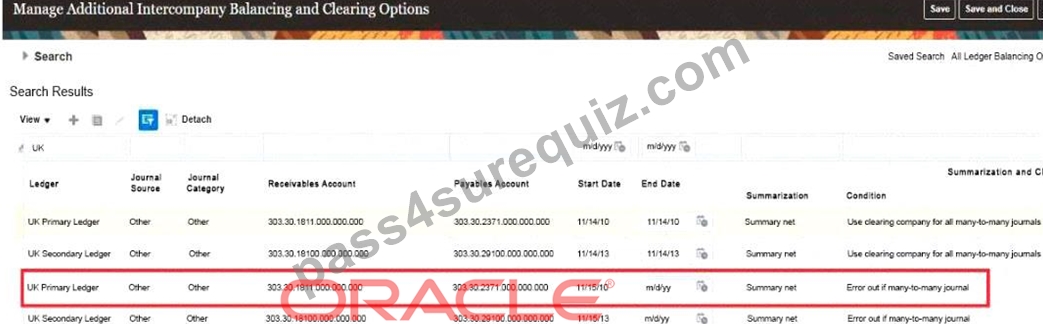
- A. when the journal is balanced by the primary BSV but not by second or third BSV
- B. when there is a many-to-many journal and you want to use a clearing company
- C. when the journal is not balanced by the primary balancing segment value (BSV)
- D. when the journal is balanced by second balancing segment value
Answer: A
Explanation:
Intercompany processing will balance a journal using the accounts identified here for the UK Ledger when the journal is balanced by the primary balancing segment value (BSV) but not by second or third BSV. A BSV is a segment in the chart of accounts that identifies a legal entity or business unit for which financial statements are prepared and balanced. A primary BSV is required for every ledger and is used to balance journal entries within a ledger. A secondary or tertiary BSV is optional and is used to balance journal entries across different dimensions other than the primary BSV, such as fund or region. Intercompany processing is a feature that enables intercompany transactions between different legal entities or business units within the same enterprise. Intercompany processing uses intercompany balancing rules to generate intercompany receivables and payables accounts for cross-ledger or cross-BSV journals. Intercompany processing will balance a journal using the accounts identified here for the UK Ledger when the journal is balanced by the primary BSV but not by second or third BSV, as thisindicates that there is an intercompany transaction between different legal entities or business units within the UK Ledger that requires intercompany balancing.
Intercompany processing will not balance a journal using the accounts identified here for the UK Ledger when there is a many-to-many journal and you want to use a clearing company, as this is a scenario that involves multiple legal entities or business units across different ledgers that requires a separate clearing company ledger to perform intercompany balancing. Intercompany processing will not balance a journal using the accounts identified here for the UK Ledger when the journal is not balanced by the primary BSV, as this is an invalid scenario that violates the accounting rules and prevents posting of the journal. Intercompany processing will not balance a journal using the accounts identified here for the UK Ledger when the journal is balanced by second balancing segment value, as this is an incomplete scenario that does not specify whether the journal is also balanced by primary and third BSV. Reference: Oracle Financials Cloud: General Ledger
2022 Implementation Professional Objectives - Configure and Process Intercompany 12
NEW QUESTION # 49
You need to define a chart of accounts that includes an intercompany segment. Your customer plans to use segment value security rules for the Company segment.
What is Oracle's recommended method to define this chart of accounts?
- A. Share the same value set for the company and intercompany segments.
- B. Define the intercompany segment with a default value.
- C. Create two different value sets for the company and intercompany segments.
- D. Define the company segment and assign both the primary balancing segment and intercompany segment labels.
Answer: A
Explanation:
According to Oracle documentation3, Oracle's recommended method to define a chart of accounts that includes an intercompany segment when your customer plans to use segment value security rules for the Company segment is to share the same value set for the company and intercompany segments. Sharing the same value set enables you to use segment value security rules for both segments and ensures that the values in both segments are consistent. Therefore, option B is correct. Option A is incorrect because defining the intercompany segment with a default value does not enable segment value security rules for the intercompanysegment. Option C is incorrect because defining the company segment and assigning both the primary balancing segment and intercompany segment labels does not enable segment value security rules for the intercompany segment. Option D is incorrect because creating two different value sets for the company and intercompany segments does not ensure that the values in both segments are consistent.
NEW QUESTION # 50
The Cloud Client wants to add a global branding logo and more predefined transactional attributes to the journal approval email notification.
Which two Business Intelligence catalog objects should you copy (or customize) and edit? (Choose two.)
- A. The layout-Template
- B. The Data Model
- C. The Data Source
- D. Output type
- E. The Sub_Template
Answer: A,B
Explanation:
To add a global branding logo and more predefined transactional attributes to the journal approval email notification, you should copy (or customize) and edit the layout template and the data model. The layout template is a file that defines the appearance and content of the notification, such as text, images, tables, or charts. The data model is a file that defines the data sources and queries that provide data for the notification, such as predefined transactional attributes. You can copy (or customize) and edit the layout template and the data model using Oracle Analytics Publisher reports. You do not need to copy (or customize) and edit the output type, as this is a setting that determines the format of the notification output, such as HTML or PDF.
You do not need to copy (or customize) and edit the data source, as this is a component of the data model that specifies where data for the notification comes from, such as an SQL query or an XML file. You do not need to copy (or customize) and edit the sub template, as this is a file that contains reusable content or logic that can be referenced by multiple layout templates. Reference: Oracle Financials Cloud: General Ledger 2022 Implementation Professional Objectives - Configure Workflow Approvals and Notifications 12
NEW QUESTION # 51
When working with Essbase, versions of the tree hierarchy as defined in the Fusion are not available in the Essbase balances cube. What should you do to correct this situation?
- A. Make sure the tree version was published successfully.
- B. Make sure the tree is active.
- C. Make sure to flatten the rows of the tree version.
- D. Redeploy the chart of accounts.
Answer: A
NEW QUESTION # 52
You are implementing amultipillarimplementation of bothHCM CloudandERP Cloud. You are implementingERP first, followed byHCM Cloud. You want to ensure yourledgers and chart of accounts are correctly defined.
What should you do? (Choose three.)
- A. Use the Rapid Implementation spreadsheet when creating your enterprise structure.
- B. Use file-based spreadsheet loaders using UCM to mass load and maintain chart of accounts segment values and hierarchies.
- C. Create your chart of accounts in the following order: value sets, COA structure, and instance before assigning values to the value sets.
- D. Use HCM's Enterprise Structure Configurator (ESC) first.
- E. Deploy your chart of accounts.
Answer: A,C,D
NEW QUESTION # 53
You are creating values for thechart of account value setthat you are planning to use for theaccount segment within yourChart of Accounts. You are not able to assign anAccount Type.
What is the reason for this?
- A. You have not set the Allow Budgeting attribute for the value set.
- B. You have not set the Allow Posting attribute for the value set.
- C. You are creating values before assigning the value set to the structure.
- D. The Account Type qualifier has not been enabled when defining the value set.
Answer: D
NEW QUESTION # 54
On a primary ledger in Use system options close section, the following field has been selected:
'Prevent General Ledger Period Close When Open Subledger Periods Exist'.
What three exceptions will prevent closing of the accounting period?
- A. Intercompany Transactions are completed
- B. Pending Intercompany Transactions
- C. No pending transaction in the General Ledger Interface table
- D. Pending Transaction in General Ledger Interface
Answer: A,B,D
NEW QUESTION # 55
......
Verified 1z0-1054-24 dumps Q&As - 2025 Latest 1z0-1054-24 Download: https://www.pass4surequiz.com/1z0-1054-24-exam-quiz.html
Dumps Questions [2025] Pass for 1z0-1054-24 Exam: https://drive.google.com/open?id=1X7bffz2Zjk-3KTB-qkBKZdKPg6YQacR-