

[Oct 27, 2025] Valid CTAL-TM-001 Test Answers Full-length Practice Certification Exams
Accurate & Verified 2025 New CTAL-TM-001 Answers As Experienced in the Actual Test!
How to Prepare For CTAL-TM Certification Exam
Preparation Guide for CTAL-TM Certification Exam
Introduction to CTAL-TM Exam
Certified Tester Advanced Level Test Manager(CTAL-TM), This is a rigorous professional certification program based on exams. The CTAL-TM certification is offered to candidates who pass the Tester Advanced Level Test Manager(CTAL-TM) of the International Board of Software Testing Qualifications (ISTQB).
This ISTQB course is intended for testing professionals who want to excel in a management or lead role. In this course, students will learn how to administer a testing project and execute a risk-based technique for testing. Students will also be examining how a technique correlates with test estimation, monitoring, and planning. During this course, students will learn how to send report to stakeholders, build successful test teams and implement significant test plans
The creation of the ISTQB exams is the responsibility of the councils of each member country so that they better reflect the language, use and specific conditions of the country. Unlike other English-based ISTQB exams that you can find, ASTQB exams are created as original exams for English speakers, not translated from another language. US employers recognize this and have expressed their preference for evaluators who have passed the ASTQB ISTQB exams.
Our world-renowned subject matter experts have worked very hard to create the ASTQB versions of the ISTQB exams and we believe that our exams are of the highest quality, without difficult questions. This gives you a better exam experience.
ISTQB Test Manager certification takes aspirants career to the next level. This certification adds a grat value to candidates skills and demonstrates their commitment to the testing profession and lead others as a manager in the organization. Certified professionals are recognized as an expert in software testing, quality, and project management.
Under your guidance, the team profile is raised as more effective and efficient in testing by practicing methods and techniques included in the Test Manager Certification series.
An Advanced Test Manager would be able to :
- Create and implement test plans consistent with organizational policies and test strategies.
- Identify skills and resource gaps in their test team and participate in sourcing adequate resources.
- Participate in and lead test process improvement initiatives.
- Organize and lead risk identification and risk analysis sessions and use the results of such sessions for test estimation, planning, monitoring and control.
- Assess and report relevant and timely test status to project stakeholders.
- Manage a testing project by implementing the mission, goals and testing processes established for the testing organization.
- Propose a business case for test activities which outlines the costs and benefits expected.
- Ensure proper communication within the test team and with other project stakeholders.
How to book CTAL-TM Exams
In order to apply for the NET, You have to follow these steps
- Go to the CTAL-TM Official Site
- Read the instruction Carefully
- Follow the given steps
- Apply for the CTAL-TM
NEW QUESTION # 38
What is the Risk Priority Number for risk item number 2? 2 credits
- A. 0
- B. 1
- C. 2
- D. 3
Answer: A
NEW QUESTION # 39
You tend to be conservative in your project estimations because you know how many things can go wrong and extend the schedule. You manager is not happy with your estimates and thinks you are being too negative with your numbers and not trying hard enough Which estimation method should you use to provide your manager with a positive' number while still also providing the number you think is more realistic?
- A. Wideband defphi
- B. Extrapolation
- C. Three-point estimation
- D. Planning poker
Answer: C
Explanation:
Context Analysis:
The manager perceives conservative estimates as overly negative. The goal is to balance optimism with realism to satisfy both the team and the manager.
Three-point estimation provides a range of estimates: optimistic, pessimistic, and most likely, addressing the need for a positive yet realistic projection.
Evaluation of Options:
A . Wideband Delphi:
Involves group-based estimation using consensus techniques. While reliable, it does not explicitly offer optimistic vs. realistic estimates.
B . Planning Poker:
Often used in Agile projects, this technique involves relative estimation but does not inherently provide optimistic and pessimistic figures.
C . Three-point estimation:
Correct. Combines optimistic, pessimistic, and realistic estimates to calculate a weighted average. This allows presentation of both realistic and "positive" numbers to the manager.
D . Extrapolation:
Based on past data trends but does not offer a range of estimates or a way to address manager concerns directly.
Syllabus Alignment:
The ISTQB syllabus mentions estimation methods like three-point estimation as effective techniques for providing balanced and transparent project timelines (TM-2.2.1).
Reference:
ISTQB Advanced Level Test Management Syllabus
NEW QUESTION # 40
Which work experience is likely to develop the necessary skills to effectively test a software system? [3]
- A. Being a member of the production group that supported the previous release of the system
- B. Being the current Project Manager for the system
- C. Being the developer of testing tools used for automation
- D. Being a former Test Manager
Answer: C
Explanation:
Being the developer of testing tools used for automation is likely to develop the necessary skills to effectively test a software system because it involves a deep understanding of testing processes and the creation of tools that facilitate these processes. This experience provides insight into the intricacies of test automation, which is crucial for designing effective tests and ensuring thorough coverage of the system under test.
NEW QUESTION # 41
You are the manager of a test team. You inherited most of these people from a previous manager who promoted technical skills, particularly programming skills. As a result, your people are very strong in test automation skills, white box testing and complex test design techniques. You have just been told that you can hire five new people. You want the new people to complement the existing skill sets and you want to be sure the team will have a strong mutual respect.
Given the following options, who should you hire? [3]
- A. Hire a mix of people with strong testing and domain skills.
- B. Hire college interns who can be trained by the existing people.
- C. Hire all black box testers because you are severely lacking in that skill set.
- D. Hire customer support people who have experience with the customer interface.
Answer: A
Explanation:
The best option to hire new people for your test team is to hire a mix of people with strong testing and domain skills. This means that the new people have both the technical knowledge and the business understanding to test the software system effectively and efficiently. Hiring a mix of people with strong testing and domain skills can complement the existing skill sets of your test team, as well as enhance the team's diversity, creativity, and collaboration. Hiring a mix of people with strong testing and domain skills can also help the team to achieve a balance between white box and black box testing, and to cover different aspects and perspectives of the software system. How to Build a Software Testing TeamHow to Hire a Software Tester Reference:
How to Build a Software Testing Team - Testim.io
How to Hire a Software Tester - The Ultimate Guide
NEW QUESTION # 42
Which of the following are primary activities in conducting product risk analysis? [1]
- A. Risk identification, risk testing
- B. Risk management, risk assessment
- C. Risk identification, risk assessment
- D. Risk testing, risk management
Answer: C
Explanation:
Product risk analysis is the process of identifying and assessing the product risks that may affect the quality or functionality of the software under test1. Product risk analysis involves two primary activities: risk identification and risk assessment. Risk identification is the activity of finding, naming, and describing the risks that might affect the software under test2. Risk assessment is the activity of estimating the impact and probability of occurrence (likelihood) of the identified risks, and prioritizing them based on these factors3. Therefore, option B is the correct answer. Option A is incorrect because risk testing and risk management are not primary activities of product risk analysis, but rather activities that follow or use the results of product risk analysis. Risk testing is the activity of designing, implementing, and executing tests based on the product risk levels to reduce the level of product risks and inform stakeholders of their status4. Risk management is the activity of planning, monitoring, and controlling the risks and the risk mitigation actions in the software project5. Option C is incorrect because risk identification and risk testing are not primary activities of product risk analysis, but rather activities that are part of product risk analysis and risk-based testing respectively. Option D is incorrect because risk management and risk assessment are not primary activities of product risk analysis, but rather activities that are part of risk management and product risk analysis respectively. Reference: 1: ISTQB Glossary, Product Risk Analysis 2: ISTQB Glossary, Risk Identification 3: ISTQB Glossary, Risk Assessment 4: ISTQB Glossary, Risk-Based Testing 5: ISTQB Glossary, Risk Management : Product Risk Analysis (PRA) | TMap : Risk-Based Testing | ISTQB Glossary : Risk Analysis | ISTQB Glossary
NEW QUESTION # 43
Which of the following is a typical use of risk analysis? [1]
- A. Identifying the appropriate depth of testing for each identified risk
- B. Forecasting the product delivery date
- C. Determining the design of the tests used to mitigate each identified risk
- D. Deciding what personnel should be assigned to which tests
Answer: A
Explanation:
Risk analysis is typically used to identify the appropriate depth of testing for each identified risk. This involves assessing the potential impact and likelihood of risks to prioritize testing efforts and ensure that high-risk areas are thoroughly tested.
References:The ISTQB Advanced Level Test Manager syllabus and e-learning materials emphasize the importance of organizing and leading risk identification and risk analysis sessions. The outcomes of these sessions are used for test estimation, planning, monitoring, and control, which includes determining the depth of testing based on the identified risks
NEW QUESTION # 44
A test log is one of the documents that need to be produced in this domain in order to provide evidence of testing. However, the level of detail of test logs can vary. Which of the following is NOT an influencing factor for the level of detail of the test logs being produced? 1 credit
- A. Regulatory requirements
- B. Level of test execution automation
- C. Test level
- D. Experience level of testers
Answer: D
NEW QUESTION # 45
You are a newly appointed Test Manager in an organisation that has no separate test team, no formal testing process and testing is considered to be, at best, ad-hoc in approach. The IT director is keen to introduce improvement across all areas of the organisation, not just testing. This is so that the current level of maturity can be assessed and roadmaps outlined for improving processes in a staged way. He has asked you to recommend a test process improvement model and you have suggested TMMi.
Which ONE of the following is a valid reason for your recommendation? SELECT ONE OPTION
- A. It provides the fastest way to take testing to an optimized state.
- B. It helps address highest priority testing issues with limited formality.
- C. It provides bench-marking against industry averages using objective measurements.
- D. It naturally complements the IT director's process improvement goals for the organisation.
Answer: D
NEW QUESTION # 46
Your test team is in the process of completing final regression testing one week before the release date. One of your staff has just uncovered a critical defect that causes data corruption.
What should you do? [2]
- A. Update the risks in your test plan to cover data corruption issues and update your test cases to be sure you test for this in the future
- B. Update the weekly status charts and change the project status to red
- C. Write a high priority defect and follow the escalation communication plan as defined in your test plan
- D. Write a high priority defect and call the business stakeholders to warn them about it
Answer: C
Explanation:
The best action that you should take in this situation is to write a high priority defect and follow the escalation communication plan as defined in your test plan. This is because a critical defect that causes data corruption is a serious issue that can affect the quality, functionality, and reliability of the system, and it needs to be reported and resolved as soon as possible. By writing a high priority defect, you can document the details and the impact of the defect, and alert the development team and the project manager about it. By following the escalation communication plan, you can ensure that the defect is communicated to the appropriate stakeholders, such as the business sponsors, the customers, or the senior management, in a timely and effective manner, and that the necessary actions are taken to address the defect. Defect Reporting - ISTQB not-for-profit association References: Certified Tester Advanced Level Test Manager (CTAL-TM) - ISTQB not-for-profit association, ISTQB Test Manager Certification - ISTQB Exams Worldwide - ISTQB Official Registration, Defect Reporting - ISTQB not-for-profit association
NEW QUESTION # 47
Your test process is fully integrated into the software development lifecycle. You are at which TMMi level? [1]
- A. Managed
- B. Initial
- C. Defined
- D. Optimized
Answer: C
Explanation:
According to the TMMi model, the test process is fully integrated into the software development lifecycle at the Defined level. This level establishes that all projects are following the same standards and procedures throughout the organization or organizational unit. Test is integrated into the development life cycle and into all projects from early in development. TMMi ModelTMMi Introduction Reference:
TMMi Model - TMMi
What is TMMI (Test Maturity Model Integration) in Software Testing?
NEW QUESTION # 48
A number of options have been suggested for the level of independence to be employed for the testing on the next project, and are shown below.
i. External test specialists perform non-functional testing.
ii. Testing is outsourced.
iii. Testing is carried out by the developer.
iv.
A separate test team carries out the testing.
v.Testing is performed by the business.
vi. Testing is performed by a different developer.
Which of the following orders the above in a correct order of independence? 1 credit
- A. i, ii, iv, vi
- B. i, iv, v, vi
- C. ii, i, v, vi
- D. ii, v, i, iii
Answer: C
NEW QUESTION # 49
Your organisation has decided to move from using the V-model software development lifecycle to Agile Scrum. Due to inexperience in Agile methodologies and to mitigate risk, the next project will use a hybrid model, beginning with a traditional requirement definition phase and transitioning to an Agile Scrum approach for development and testing.
Which would be an appropriate test management task to perform FIRST for this next project?
- A. Produce a detailed test estimate for each test level that will be used in each sprint
- B. Enroll the testers on an online User Story development course to better understand the test basis
- C. Track and review test efforts within the sprints to ensure they align with Agile practices
- D. Ensure the team is adept at combining structured processes with Agile flexibility
Answer: D
Explanation:
The hybrid approach demands alignment between traditional and Agile practices. The Test Manager mustfirst ensure the team is capable of combining structured process with Agile adaptability. This aligns with the guidance that in hybrid models, one must balance flexibility with formal test planning and risk management strategies, especially during the transition phase .
NEW QUESTION # 50
Which test management control option is most appropriate to adopt under these circumstances? 2 credits
- A. Advise the user community regarding the reduced scope of requirements and the additional incremental delivery.
- B. Reconsider the exit criteria and review the test plan in the context of the current situation.
- C. Introduce mandatory evening and weekend working to retrieve the 3 week slippage.
- D. Arrange a meeting with the user community representatives to discuss the user interface.
Answer: B
NEW QUESTION # 51
You have been carefully monitoring the progress of testing for your project. You have been using the established traceability to verify that the requirements and test conditions are being adequately addressed. The test team is proceeding well in their test case execution and you can see that you are achieving about 80% coverage of the test conditions per the traceability mapping in your test management system. You have seen a number of defects being logged against test conditions that are failing, but you do not see a mapping of the test cases to those conditions.
What is likely to be occurring in the testing area that is causing the traceability to break down? [2]
- A. The testers are not updating the test execution information in the test management system.
- B. The testers are running exploratory tests that are not mapped to the test conditions.
- C. The testers are executing the wrong tests.
- D. The test cases are mapped to the test strategy and are bypassing the test conditions.
Answer: A
Explanation:
The most likely cause of the traceability breakdown in the testing area is that the testers are not updating the test execution information in the test management system. This is because the test management system is a tool that supports the test process, and it can store and manage the test documentation, such as the requirements, the test conditions, the test cases, and the test results. If the testers do not update the test execution information in the test management system, such as the test cases that are run, the test results that are obtained, and the defects that are found, the traceability between the test cases and the test conditions will be lost or inaccurate. This can affect the test analysis and reporting, and the test coverage measurement. Test Management - ISTQB not-for-profit association References: Certified Tester Advanced Level Test Manager (CTAL-TM) - ISTQB not-for-profit association, ISTQB Test Manager Certification - ISTQB Exams Worldwide - ISTQB Official Registration, Test Management - ISTQB not-for-profit association
NEW QUESTION # 52
One of your team members is struggling to identify the requirements to be tested for a project The requirements documents are not conventional but you have determined that the data is there. If they do some digging to find it Given this information in what competence area does this person need to improve?
- A. Personal competence
- B. Social competence
- C. Professional competence
- D. Methodical competence
Answer: D
Explanation:
* Competence in Handling Non-Standard Requirements:
* Methodical competence refers to the ability to systematically analyze and interpret information, even when it is unconventional or unstructured.
* The tester needs to refine their skills in identifying and deriving testable requirements from the available data.
* Evaluation of Options:
* A(Professional competence) refers to domain knowledge but does not address the specific challenge.
* Bis correct as it pertains to systematically working through unconventional requirements.
* C(Social competence) andD(Personal competence) do not address the analytical challenge.
References and Syllabus Alignment:
* Methodical competence is emphasized under "Test Management Skills" in the ISTQB syllabus (TM-
3.1.1).
NEW QUESTION # 53
Your company just won a contract to create a new sales application and has committed to a very aggressive delivery timeline. Due to the quick turnaround your primary stakeholder wants to be heavily involved in the design and is very anxious to see the outcome. Because of this, your company has decided to use a spiral development approach. You have a defined test policy and typically use an analytical approach to testing, however, this approach will not work with the development approach.
What test strategy should be utilized?
- A. Standard-compliant
- B. Reactive
- C. Methodical
- D. Model-based
Answer: B
Explanation:
A reactive test strategy is a test strategy that uses the actual behavior and results of the software under test to design and execute tests, without prior knowledge or documentation of the software1. A reactive test strategy should be utilized for a project that uses a spiral development approach, which is a type of iterative
/incremental approach that adds risk analysis and prototyping activities to each iteration2. A reactive test strategy is suitable for a spiral development approach because it allows for flexibility, adaptability, and creativity in the testing process, as well as for early feedback, risk reduction, and continuous improvement in the software development process3. Therefore, option D is the correct answer. Option A is incorrect because a model-based test strategy is a test strategy that uses models to represent the desired behavior and structure of the software under test, and to derive test cases, test data, test procedures, and test oracles. A model-based test strategy may not work well with a spiral development approach, as it requires the availability and stability of the models, which may not be the case in a spiral development approach that involves frequent changes and refinements of the software under test. Option B is incorrect because a methodical test strategy is a test strategy that uses predefined test methods, techniques, and procedures to design and execute tests, such as equivalence partitioning, boundary value analysis, or decision table testing. A methodical test strategy may not work well with a spiral development approach, as it requires the availability and stability of the test basis, such as the requirements, specifications, or design documents, which may not be the case in a spiral development approach that involves frequent changes and refinements of the software under test. Option C is incorrect because a standard-compliant test strategy is a test strategy that follows a predefined set of standards, guidelines, or regulations to design and execute tests, such as ISO, IEEE, or CMMI. A standard- compliant test strategy may not work wellwith a spiral development approach, as it requires the compliance and consistency of the testing process, which may not be the case in a spiral development approach that involves frequent changes and refinements of the software under test. References: 1: ISTQB Glossary, Reactive Test Strategy 2: ISTQB Glossary, Spiral Model 3: ISTQB Advanced Level Test Manager Syllabus, Section 1.1.1 : Spiral Model in Software Development Life Cycle - Software Testing Material : Spiral Model
- Tools QA : Strategic Test Management - ISTQB not-for-profit association : ISTQB Glossary, Model-Based Testing : ISTQB Glossary, Methodical Test Strategy : ISTQB Glossary, Standard-Compliant Test Strategy ISTQB Foundation Level #39 - Test Approach and Strategy - Software Testing Mentor
NEW QUESTION # 54
SCENARIO 1
DreamPartner dating agency are redesigning their dating application following a major security breach in which sensitive customer data was made publically available. The redesign includes stronger security encryption and performance tuning.
The product risk register for the redesign project, which was produced after all requirements had been agreed, includes the following: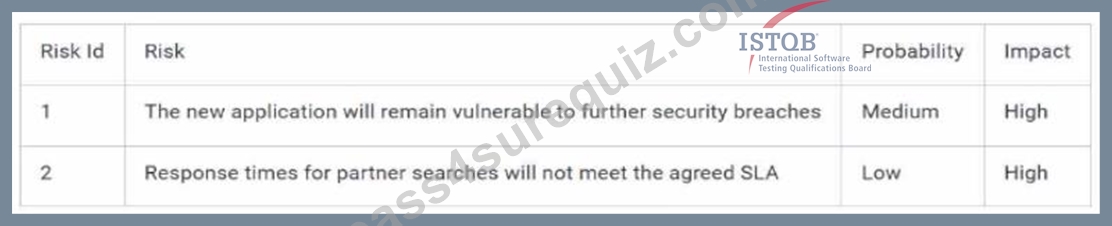
The organisational Test Strategy contains the following objectives:
1. A Risk-based lest approach must be adopted for all projects
2. Functional regression testing should start as soon as functional testing is complete
3. Automated tests may be run before or in parallel with manual tests
The project Test Plan has allocated 6 weeks to complete all test execution, with functional testing taking 3 weeks to execute, performance and security testing 2 weeks each and regression testing 1 week.
Which of the following options places the test suites (TS1 to TS5) in the correct order for test execution?
SELECT ONE OPTION
- A. TS5, TR1, TS3 TSA, TS2
- B. TS3, TS1, TS2, TS5, TS4.
- C. TS3, TS4, TS1, TS2, TS5.
- D. TS1, TS2, TS5, TS3, TS4.
Answer: B
NEW QUESTION # 55
What is the Risk Priority Number for risk item number 2? 2 credits
- A. 0
- B. 1
- C. 2
- D. 3
Answer: A
Explanation:
Explanation/Reference:
Explanation:
NEW QUESTION # 56
Which work experience is likely to develop the necessary skills to effectively test a software system?
- A. Being a member of the production group that supported the previous release of the system
- B. Being the current Project Manager for the system
- C. Being the developer of testing tools used for automation
- D. Being a former Test Manager
Answer: C
Explanation:
Being the developer of testing tools used for automation is likely to develop the necessary skills to effectively test a software system because it involves a deep understanding of testing processes and the creation of tools that facilitate these processes. This experience provides insight into the intricacies of test automation, which is crucial for designing effective tests and ensuring thorough coverage of the system under test.
References: The current page suggests referring to the ISTQB Advanced Level Test Manager Syllabus and other ISTQB documents for a comprehensive understanding of the roles and skills required for effective software testing. It emphasizes the importance of alignment of methodologies in distributed testing models, which is relevant to the development and use of testing tools.
NEW QUESTION # 57
You are testing a new product that will turn on the windshield wipers of a car when the sensorsdetect there is moisture on the windshield. Depending on the information returned from the sensors, the wipers will be turned on at one of the following speeds: slow intermittent, medium intermittent, fast intermittent, slow constant, medium constant, fast constant. Your team has identified the following test condition:
Test Condition 1.1.1 - Verify that the windshield wipers can go from slow constant to fast constant speed when the amount of moisture increases appropriately.
Your team has defined the following steps for a test case for this test condition:
1. Set the moisture sensor to request slow constant
2. Increase the moisture to set the sensor to request fast constant
3. Verify that the wipers respond with fast constant speed
Given this information, which of the following statements is correct? [2]
- A. The test case is traceable to the test condition and provides 100% statement coverage of the defined test condition.
- B. This test case is traceable to the test condition and provides 100% requirements coverage of the defined test condition.
- C. This test case is not traceable to the test condition.
- D. There is not enough information in the test condition to define a test case.
Answer: A
Explanation:
The correct answer is D. The test case is traceable to the test condition and provides 100% statement coverage of the defined test condition. This is because the test case is derived from the test condition, and it covers all the possible outcomes of the test condition, such as the initial state, the input, and the expected output.
Statement coverage is a metric that measures the percentage of executable statements that are exercised by a test case. In this case, the test case exercises all the statements in the test condition, thus achieving 100% statement coverage. Statement Coverage - ISTQB not-for-profit association References: Certified Tester Advanced Level Test Manager (CTAL-TM) - ISTQB not-for-profit association, ISTQB Test Manager Certification - ISTQB Exams Worldwide - ISTQB Official Registration, Statement Coverage - ISTQB not-for-profit association
NEW QUESTION # 58
You have been seeing a high number of rejections of defect reports The developers are complaining that they do not understand what the problem is. even though they have been supplied with screenshots. You have checked a number of the 'problem' defect reports and have not found any information that is missing. The descriptions are very detailed and include all the necessary information in a long descriptive paragraph.
What change should you recommend that should help with the developer s problems?
- A. In addition to attaching the screenshots to the defect report, ask the testers to also email them to the developer
- B. With the problem reports highlight all the information and then walk through it with the developers so they see it is all there
- C. Separate out the steps to reproduce the defect in the description so it is clearer for the developers and easier to find
- D. instruct your team to make all defects high priority so the developers have more urgency behind making the fixes
Answer: C
Explanation:
* Context Analysis:
* Long descriptive paragraphs are difficult to parse, even if they contain all necessary information.
Developers need concise, structured information for quick understanding.
* Evaluation of Options:
* A. Instruct your team to make all defects high priority:
* Incorrect. Changing priority does not address the clarity issue in defect reports.
* B. Highlight all the information and walk through it with the developers:
* Incorrect. This is time-consuming and not scalable as a general solution.
* C. Email screenshots to developers in addition to attaching them to defect reports:
* Incorrect. Duplication of information does not solve the clarity problem.
* D. Separate out the steps to reproduce the defect in the description so it is clearer for the developers and easier to find:
* Correct. Structuring defect reports improves clarity and makes them easier to process.
* Syllabus Alignment:
* ISTQB recommends clear and concise defect reports to facilitate understanding and resolution (TM-2.3.5).
References:
ISTQB Advanced Level Test Management Syllabus (TM-2.3.5)
NEW QUESTION # 59
Which of the following metrics is MOST LIKELY to trigger a control directive to increase test execution resources?
- A. Percentage of test cases that have been automated, showing that this is less than planned
- B. Percentage of manual test cases by their execution status, showing that the number of tests run is less than planned
- C. Percentage of test environment availability during scheduled hours, showing that this is less than planned
- D. Percentage of test cases by their execution status, showing that the number of failures is greater than expected
Answer: B
Explanation:
The most direct trigger forresource adjustmentis evidence thattest execution is behind schedule.
"Test control... includes re-prioritizing tests... or changing the test schedule due to availability of resources."
- ISTQB-CTFL_Syllabus_2018_V3.1, section 5.3
Option A points directly to under-execution relative to plan, suggesting a need to scale up resources.
NEW QUESTION # 60
......
For more info visit:
Certification Topics of CTAL-TM-001 Exam PDF Recently Updated Questions: https://www.pass4surequiz.com/CTAL-TM-001-exam-quiz.html
CTAL-TM-001 Certification Sample Questions certification Exam: https://drive.google.com/open?id=18BAeVdYYMPLl8I1qB8PAcMeaYMlqnqWD