

Real Cybersecurity-Architecture-and-Engineering Exam PDF Test Engine Practice Test Questions
WGU Cybersecurity-Architecture-and-Engineering Real 2025 Braindumps Mock Exam Dumps
NEW QUESTION # 77
A software development company is concerned about the potential risks associated with exploits that target vulnerabilities in the Linux operating system used by the company's servers. Thecompany has decided to implement hardening techniques and endpoint security controls to mitigate the risk.
Which hardening technique will meet the needs of this company?
- A. Enforcing strict access control policies for all users
- B. Conducting regular security assessments and penetration testing
- C. Implementing shell restrictions
- D. Implementing a host-based intrusion detection and prevention system
Answer: D
Explanation:
AHost-based Intrusion Detection and Prevention System (HIDPS)can detect unauthorized activity or suspicious changesat the OS level, including those specifically targetingLinux kernel modules, services, or rootkits.
NIST SP 800-94 Rev. 1:
"HIDPS software runs on individual hosts or devices in the network, analyzing inbound and outbound packets and alerting administrators to suspicious activity." HIDPS is especially effective in server environments wherekernel-level visibilityis critical.
#WGU Course Alignment:
Domain:System Security Engineering
Topic:Implement and monitor HIDPS on enterprise Linux servers
NEW QUESTION # 78
What is a function of a proxy server?
- A. It stores files that any user of the network may wish to access.
- B. It responds to HTTP requests and can execute scripts to generate dynamic pages.
- C. It acts as a giant cache of web pages that anyone in the organization has recently retrieved.
- D. It responds to user queries to create, manipulate, and retrieve records from a database.
Answer: C
Explanation:
* Proxy Server Functions:
* Caching: Proxy servers can store copies of web pages and other web resources. This helps to improve load times for frequently accessed resources and reduce bandwidth usage.
* Security: They can provide additional security by anonymizing the user's IP address and filtering unwanted content.
* Correct Function:
* Acting as a cache (B) is one of the primary functions, where it stores web pages that users in the organization have recently accessed.
* Incorrect Functions:
* A: Describes a file server.
* C: Describes a database server.
* D: Describes a web server.
References:
* Proxy servers: Proxy Server
* Caching in proxy servers:Caching Proxy
NEW QUESTION # 79
An IT organization needs to enable secure communication across virtual networks in Microsoft Azure and Amazon Web Services.
Which protocol will offer the most reliable and secure method for data transport?
- A. File Transfer Protocol (FTP)
- B. Secure Shell (SSH)
- C. Transmission Control Protocol (TCP)
- D. Internet Protocol Security (IPsec)
Answer: D
Explanation:
The correct answer is B - Internet Protocol Security (IPsec).
According to WGU Cybersecurity Architecture and Engineering (KFO1 / D488), IPsec provides secure communication over IP networks by encrypting and authenticating IP packets. It is widely used for site-to-site VPNs and ensures confidentiality, integrity, and authentication between different cloud environments like Azure and AWS.
TCP (A) is a transport layer protocol ensuring reliable delivery but not encryption. FTP (C) is used for file transfer and is insecure unless secured with extensions. SSH (D) secures remote terminal sessions but is not primarily used for network-wide secure communication.
Reference Extract from Study Guide:
"IPsec provides a secure method of communication across IP networks, ensuring data confidentiality, integrity, and authentication for VPN connections and hybrid cloud communications."
- WGU Cybersecurity Architecture and Engineering (KFO1 / D488), Secure Protocols for Hybrid Environments
NEW QUESTION # 80
Management has asked its networking team to recommend a solution for direct communication between multiple virtual networks in the cloud. The solution must utilize the least amount of administrative effort.
Which solution meets the requirements?
- A. Virtual local area network
- B. Remote Desktop Protocol
- C. Domain name system
- D. Virtual network peering
Answer: D
Explanation:
The correct answer is A - Virtual network peering.
According to the WGU Cybersecurity Architecture and Engineering (KFO1 / D488) Study Guide, virtual network peering enables direct communication between two or more virtual networks without the need for gateways, VPNs, or additional configurations. It allows seamless interconnectivity with minimal administrative overhead. Peered networks can communicate as if they were part of the same network, which meets the organization's request for the least administrative effort.
Other options like Virtual LANs (B) operate within the same network and don't span multiple virtual networks. Remote Desktop Protocol (C) is used for remote access, not network interconnection. Domain Name System (D) resolves names to IP addresses but does not establish communication pathways between networks.
Reference Extract from Study Guide:
"Virtual network peering provides a low-latency, high-bandwidth connection between virtual networks with minimal administrative setup. It is the recommended solution for direct communication across cloud-based virtual networks."
- WGU Cybersecurity Architecture and Engineering (KFO1 / D488), Network Architectures Module
NEW QUESTION # 81
Which risk management strategy will supplement privacy requirements for data on an electronic health record (EHR) system?
- A. Implementation of role-based access controls and encryption of all sensitive data
- B. Implementation of a strict firewall policy to restrict access to the system's server
- C. Configuration of the system to disable universal serial bus (USB) ports on all workstations
- D. Encryption of all network traffic between the EHR system and external networks
Answer: A
Explanation:
The correct answer is C - Implementation of role-based access controls and encryption of all sensitive data.
According to WGU Cybersecurity Architecture and Engineering (KFO1 / D488), the combination of role- based access control (RBAC) and encryption protects sensitive health data by ensuring only authorized users can access necessary information, while encryption ensures the data remains secure both at rest and in transit.
Disabling USB ports (A) prevents data exfiltration but does not fulfill broad privacy requirements. Encrypting network traffic (B) protects in-transit data only. Firewalls (D) protect against unauthorized access but do not manage user roles or internal data privacy.
Reference Extract from Study Guide:
"Protecting sensitive health data requires a combination of access control models such as RBAC and encryption, ensuring both authorization and confidentiality."
- WGU Cybersecurity Architecture and Engineering (KFO1 / D488), Privacy and Data Protection Strategies
NEW QUESTION # 82
Which item is an input device?
- A. Printer
- B. Flash Drive
- C. Scanner
- D. CD
Answer: C
Explanation:
* An input device is any hardware component that allows a user to enter data into a computer.
* A scanner is an input device that converts physical documents into digital format.
* The other options:
* Printer is an output device.
* Flash drive is a storage device.
* CD can be both storage and media for input/output depending on the context but is not primarily used for direct data input.
* Therefore, a scanner is the correct answer for an input device.
References:
* "Introduction to Computer Science" by ITL Education Solutions Limited, which discusses input and output devices.
* "Digital Fundamentals" by Thomas L. Floyd, which includes information on various peripherals.
NEW QUESTION # 83
Which software allows the user to easily access the hardware of a computer?
- A. FTP client
- B. Operating system
- C. Productivity
- D. Application
Answer: B
Explanation:
The operating system (OS) is the primary software that manages all the hardware and other software on a computer. It acts as an intermediary between users and the computer hardware. The OS handles basic tasks such as controlling and allocating memory, prioritizing system requests, controlling input and output devices, facilitating networking, and managing files. Examples include Windows, macOS, and Linux.
NEW QUESTION # 84
What is the role of the compiler?
- A. To create executable code that is compatible with different operating systems
- B. To create an executable program by translating all of the code at one time
- C. To run scripting languages to test one line of code at a time
- D. To take the most recent line of code, translate it, and execute the machine code
Answer: B
Explanation:
Step by Step Comprehensive Detailed ExplanationA compiler is a program that translates source code written in a high-level programming language into machine code.
* Definition: A compiler processes the entire source code of a program and translates it into a machine code executable.
* Functionality: This process is typically done in several stages, including lexical analysis, syntax analysis, semantic analysis, optimization, and code generation.
* Output: The result is an executable file that can be run on a specific operating system.
References
* "Compilers: Principles, Techniques, and Tools" by Alfred V. Aho, Monica S. Lam, Ravi Sethi, and Jeffrey D. Ullman
* NISTIR 7860, "C++ Coding Standards"
NEW QUESTION # 85
How does application software differ from operating systems?
Choose 2 answers
- A. Application software includes system utilities that run on demand of the user.
- B. Application software consists of programs that end users run to accomplish business or personal tasks, such as e-mail.
- C. Application software supports the computer hardware system directly.
- D. Application software includes word processors and spreadsheet software that are useful to end users.
Answer: B,D
Explanation:
* Application Software:
* Application software refers to programs that help end users perform specific tasks. Examples include email clients, word processors, and spreadsheet programs.
* These are designed to be used by people to perform tasks such as writing documents, managing data, or communicating.
* Operating Systems:
* Operating systems (OS) manage the hardware and software resources of a computer system. They provide a platform for application software to run.
* Examples include Microsoft Windows, macOS, and Linux. The OS handles system-level tasks like memory management, process scheduling, and hardware interaction.
* Key Differences:
* Application software (B, C) is user-oriented, aimed at helping users complete tasks.
* Operating systems (A, D) manage the computer's hardware and system resources.
References:
* Application software: Application Software
* Operating system functions: Operating System Functions
NEW QUESTION # 86
A cloud hosting provider is concerned about the potential risks associated with attacks that target the confidentiality and integrity of sensitive data stored on its servers' volatile storage. The provider has decided to implement hardening techniques and endpoint security controls to mitigate the risk.
Which hardening technique will meet the needs of this provider?
- A. Enforcing a strong password complexity policy for all user accounts
- B. Conducting regular security awareness training for all employees
- C. Implementing a next-generation antivirus system to detect and prevent malware attacks
- D. Implementing secure encrypted enclaves and Advanced Micro Devices (AMD) Secure Memory Encryption
Answer: D
Explanation:
The correct answer is A - Implementing secure encrypted enclaves and Advanced Micro Devices (AMD) Secure Memory Encryption.
WGU Cybersecurity Architecture and Engineering (KFO1 / D488) explains that encryption at the memory level (such as AMD SME) and secure enclaves protect data in volatile memory, safeguarding it even if physical attacks occur.
Security training (B), antivirus (C), and password policies (D) improve security generally but do not specifically address data in volatile memory.
Reference Extract from Study Guide:
"Encrypted enclaves and secure memory encryption protect sensitive data in volatile storage, maintaining confidentiality and integrity even during advanced attacks."
- WGU Cybersecurity Architecture and Engineering (KFO1 / D488), Server and Memory Security Controls
NEW QUESTION # 87
What is the role of the compiler?
- A. To create executable code that is compatible with different operating systems
- B. To create an executable program by translating all of the code at one time
- C. To run scripting languages to test one line of code at a time
- D. To take the most recent line of code, translate it, and execute the machine code
Answer: B
Explanation:
Step by Step Comprehensive Detailed Explanation
A compiler is a program that translates source code written in a high-level programming language into machine code.
Definition: A compiler processes the entire source code of a program and translates it into a machine code executable.
Functionality: This process is typically done in several stages, including lexical analysis, syntax analysis, semantic analysis, optimization, and code generation.
Output: The result is an executable file that can be run on a specific operating system.
References
"Compilers: Principles, Techniques, and Tools" by Alfred V. Aho, Monica S. Lam, Ravi Sethi, and Jeffrey D.
Ullman
NISTIR 7860, "C++ Coding Standards"
NEW QUESTION # 88
What are three operating systems that are commonly used today?
Choose 3 answers
- A. MySQL
- B. Microsoft Outlook
- C. Mac OS
- D. Microsoft Windows
- E. Mozilla Firefox
- F. Linux
Answer: C,D,F
Explanation:
* Operating Systems:
* Operating systems are software that manage computer hardware and software resources, providing common services for computer programs.
* Commonly Used Operating Systems:
* Mac OS: Developed by Apple Inc., used on Apple computers.
* Linux: An open-source operating system used on a wide variety of devices from servers to personal computers.
* Microsoft Windows: Developed by Microsoft, it is one of the most widely used operating systems for personal and business computers.
* Not Operating Systems:
* Microsoft Outlook: An email client, part of the Microsoft Office suite.
* MySQL: A relational database management system.
* Mozilla Firefox: A web browser.
References:
* Types of operating systems: Types of Operating Systems
* Mac OS:macOS
* Linux:Linux
* Microsoft Windows:Windows
NEW QUESTION # 89
A healthcare organization is required to comply with the Health Insurance Portability and Accountability Act (HIPAA), which regulates the privacy and security of personal health information. The organization uses simple network management protocol (SNMP) to manage and monitor its network devices.
Which security control will protect the confidentiality of network device information within this organization?
- A. Access controls
- B. Security monitoring
- C. Encryption
- D. Network segmentation
Answer: C
Explanation:
The correct answer is C - Encryption.
WGU Cybersecurity Architecture and Engineering (KFO1 / D488) clearly states that encryption protects the confidentiality of transmitted information. In the case of SNMP (especially older versions like SNMPv1 and SNMPv2), communications are unencrypted, making encryption critical to protecting network management information from unauthorized disclosure.
Access controls (A) restrict who can access systems but do not encrypt data. Network segmentation (B) separates systems but does not encrypt traffic. Security monitoring (D) detects threats but does not protect data confidentiality.
Reference Extract from Study Guide:
"Encryption safeguards sensitive data transmitted over the network, ensuring confidentiality in compliance with privacy regulations such as HIPAA."
- WGU Cybersecurity Architecture and Engineering (KFO1 / D488), Network Security and Data Protection
NEW QUESTION # 90
A corporate website is currently being redesigned, which leaves it vulnerable to security threats. Management does not want to provide an attacker with any information about the web server.
Which strategy should be used to prevent an attacker from gaining unauthorized information?
- A. Obfuscating error messages on the site or within the uniform resource locator (URL)
- B. Using Hypertext Transfer Protocol Secure (HTTPS) for all page and content requests
- C. Becoming Payment Card Industry Data Security Standard (PCI-DSS) compliant and certified
- D. Enabling Hypertext Transfer Protocol Secure (HTTPS) over Domain Name Service (DNS)
Answer: A
Explanation:
The correct answer is C - Obfuscating error messages on the site or within the uniform resource locator (URL).
WGU Cybersecurity Architecture and Engineering (KFO1 / D488) states that minimizing the information revealed through error messages and URLs prevents attackers from gathering reconnaissance information that could be used to exploit vulnerabilities.
HTTPS (A and B) protects data in transit but does not conceal server details. PCI-DSS certification (D) improves overall security but is not focused specifically on information disclosure during a redesign.
Reference Extract from Study Guide:
"Obfuscating detailed error messages and removing revealing information in URLs help prevent attackers from gaining reconnaissance data that could be used in targeted attacks."
- WGU Cybersecurity Architecture and Engineering (KFO1 / D488), Web Application Security
NEW QUESTION # 91
Which life cycle is part of the process for planning, creating, testing, and deploying information systems?
- A. Network Development Life Cycle (NDLC)
- B. Database Creation System Life Cycle (DCSLC)
- C. Software Test Life Cycle (STLC)
- D. System Development Life Cycle (SDLC)
Answer: D
Explanation:
The System Development Life Cycle (SDLC) is a process used for planning, creating, testing, and deploying an information system. It involves several stages, including requirements gathering, system design, implementation, testing, deployment, and maintenance. The SDLC ensures that the system meets the needs of users and is developed in a structuredand efficient manner.
NEW QUESTION # 92
A company has recently implemented a hybrid cloud deployment. The security team has been notified about thousands of failed attempts to connect to routers and switches in the on-premises network. A solution must be implemented to block connections after three unsuccessful SSH attempts on any network device.
Which solution meets the requirements in this scenario?
- A. File integrity monitoring
- B. Intrusion prevention system
- C. Firewall
- D. Data loss prevention
Answer: B
Explanation:
The correct answer is C - Intrusion prevention system.
WGU Cybersecurity Architecture and Engineering (KFO1 / D488) states that an Intrusion Prevention System (IPS) actively monitors network traffic and can block malicious activity in real-time. It can enforce rules like blocking an IP address after multiple failed SSH login attempts, stopping brute force attacks.
DLP (A) focuses on preventing sensitive data loss. A firewall (B) controls network traffic but generally does not automatically block based on login attempts unless highly customized. File integrity monitoring (D) watches file changes, not login attempts.
Reference Extract from Study Guide:
"An intrusion prevention system (IPS) monitors network traffic for malicious activities and can automatically block connections that meet predefined suspicious criteria."
- WGU Cybersecurity Architecture and Engineering (KFO1 / D488), Intrusion Detection and Prevention Systems
NEW QUESTION # 93
Which motherboard component is used for short-term storage of data?
- A. Hard Drive
- B. Read Only Memory
- C. RAM
- D. BIOS
Answer: C
Explanation:
* Short-term storage of data on a motherboard is managed by Random Access Memory (RAM).
* RAM is volatile memory, meaning it temporarily stores data that is actively being used or processed by the CPU.
* The other options:
* The hard drive is used for long-term storage.
* BIOS (Basic Input/Output System) is firmware for hardware initialization.
* Read Only Memory (ROM) is used for permanent data storage that doesn't change.
* Thus, RAM is the correct answer for short-term data storage.
References:
* "Computer Organization and Architecture" by William Stallings, which covers the various types of memory.
* "Operating System Concepts" by Abraham Silberschatz, Peter B. Galvin, and Greg Gagne, which explains memory management.
NEW QUESTION # 94
What is true about an operating system?
- A. It is a hardware component of the computer system.
- B. It is a software program that directly supports the computer itself.
- C. It is a firmware burned onto the computer mother board.
- D. It is an application program similar to word processors.
Answer: B
Explanation:
* Anoperating system (OS)is a system software that manages computer hardware and software resources and provides common services for computer programs.
* It serves as an intermediary between users and the computer hardware.
* Key functionsof an OS include:
* Managinghardware resourceslike the CPU, memory, and I/O devices.
* Providing auser interface(UI) for interaction with the system.
* File managementand handling file operations.
* Process managementand multitasking.
* Securityand access control.
* Examples include Windows, Linux, and macOS.
References:
* "Operating System Concepts" by Abraham Silberschatz, Greg Gagne, and Peter B. Galvin.
* "Modern Operating Systems" by Andrew S. Tanenbaum.
NEW QUESTION # 95
An IT organization has recently suffered multiple data breaches. The security operations center (SOC) team has been tasked with preventing future breaches by implementing user monitoring. The proposed solution must provide insights about unusual user behaviors from a variety of internal corporate resources.
Which solution meets the requirements?
- A. Web application firewall (WAF)
- B. Virtual private network (VPN)
- C. Security information and event management (SIEM)
- D. Secure Shell (SSH) Protocol
Answer: C
Explanation:
The correct answer is D - Security information and event management (SIEM).
WGU Cybersecurity Architecture and Engineering (KFO1 / D488) explains that a SIEM solution collects, correlates, and analyzes logs and events from multiple sources to detect unusual patterns of behavior across an organization's infrastructure. SIEM systems are specifically designed for centralized monitoring and alerting on suspicious activities, which helps prevent future breaches.
VPN (A) secures communications but does not monitor behavior. SSH (B) is a secure protocol for remote access but not a monitoring tool. WAF (C) protects web applications but does not monitor user behavior across systems.
Reference Extract from Study Guide:
"Security information and event management (SIEM) platforms aggregate and analyze security data from across an enterprise, providing actionable insights into anomalous user activities and potential threats."
- WGU Cybersecurity Architecture and Engineering (KFO1 / D488), Security Monitoring and Event Management
NEW QUESTION # 96
Which protocol can be used to provide secure email communication and ensure the confidentiality, integrity, and authenticity of email messages?
- A. Simple Mail Transfer Protocol (SMTP)
- B. Internet Protocol Security (IPsec)
- C. Secure/Multipurpose Internet Mail Extensions (S/MIME)
- D. Pretty Good Privacy (PGP)
Answer: C
Explanation:
The correct answer is C - Secure/Multipurpose Internet Mail Extensions (S/MIME).
As outlined in WGU Cybersecurity Architecture and Engineering (KFO1 / D488), S/MIME provides encryption, integrity, and authentication for email messages by using public key cryptography and digital signatures.
SMTP (A) is used for sending emails but does not secure them. PGP (B) also secures emails but is not a protocol; it is a program and standard. IPsec (D) secures network communications, not email specifically.
Reference Extract from Study Guide:
"Secure/Multipurpose Internet Mail Extensions (S/MIME) is a protocol used to encrypt and digitally sign email communications, ensuring confidentiality, integrity, and authenticity."
- WGU Cybersecurity Architecture and Engineering (KFO1 / D488), Secure Communication Technologies
NEW QUESTION # 97
Which risk management strategy will ensure the secure configuration and deployment of a new supply chain management system and prevent identity theft?
- A. Implementation of multifactor authentication for all user accounts
- B. Configuration of the system to disable all universal serial bus (USB) ports on all workstations
- C. Implementation of regular vulnerability scans and patch management
- D. Use of a strict firewall policy to restrict access to the system's server
Answer: A
Explanation:
The correct answer is D - Implementation of multifactor authentication for all user accounts.
According to WGU Cybersecurity Architecture and Engineering (KFO1 / D488), multifactor authentication (MFA) strengthens identity verification by requiring multiple forms of credentials, significantly reducing the risk of identity theft.
Firewalls (A) and USB port controls (B) improve system security but do not directly prevent identity theft.
Vulnerability scanning and patch management (C) address software weaknesses but not user authentication.
Reference Extract from Study Guide:
"Multifactor authentication (MFA) enhances user account security by requiring multiple verification factors, making it significantly harder for attackers to commit identity theft."
- WGU Cybersecurity Architecture and Engineering (KFO1 / D488), Identity and Access Management Best Practices
NEW QUESTION # 98
What type of software utilizes a commercial software license?
- A. Proprietary
- B. Shareware
- C. Open Source
- D. Public Domain
Answer: A
Explanation:
* Proprietary softwareis a type of software that is owned by an individual or a company.
* It is usually sold commercially and comes with acommercial software license.
* This type of license typically restricts the ways in which the software can be used, modified, and distributed.
* Users must agree to the terms of the license, which often include restrictions on copying, sharing, and modifying the software.
* Example:Microsoft Windows and Adobe Photoshop are proprietary software products.
References:
* "The Cathedral and the Bazaar" by Eric S. Raymond.
* "Understanding Open Source and Free Software Licensing" by Andrew M. St. Laurent.
NEW QUESTION # 99
Match the legislative purpose with the corresponding legislation.
Answer options may be used more than once or not at all.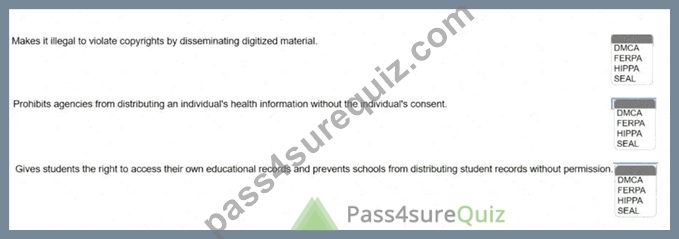
Answer:
Explanation: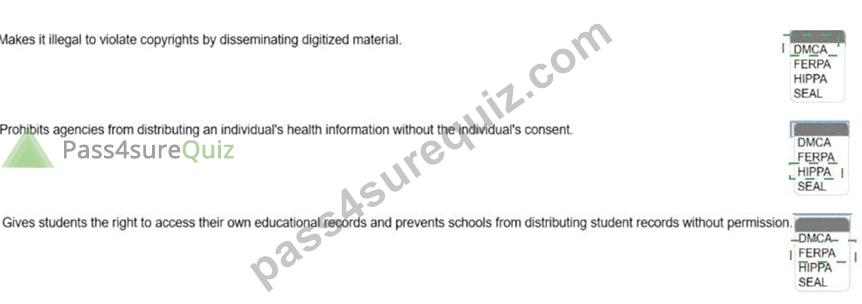
Explanation:
DMCA (Digital Millennium Copyright Act)
Purpose: The DMCA makes it illegal to violate copyrights by disseminating digitized material.
The DMCA was enacted in 1998 to address the issues of digital rights management and copyright infringement in the digital age. It provides legal protection to copyright holders against unauthorized copying, sharing, and distribution of their digital works. The legislation criminalizes the production and dissemination of technology, devices, or services intended tocircumvent measures that control access to copyrighted works (commonly known as DRM-Digital Rights Management).
DMCA Overview - U.S. Copyright Office
HIPAA (Health Insurance Portability and Accountability Act)
Purpose: Prohibits agencies from distributing an individual's health information without the individual's consent.
HIPAA, enacted in 1996, is designed to protect individuals' medical records and other personal health information. The Privacy Rule under HIPAA sets standards for the protection of health information by health plans, healthcare clearinghouses, and healthcare providers that conduct certain healthcare transactions electronically. It mandates the protection and confidential handling of protected health information (PHI).
References: HIPAA Privacy Rule - U.S. Department of Health & Human Services FERPA (Family Educational Rights and Privacy Act) Purpose: Gives students the right to access their own educational records and prevents schools from distributing student records without permission.
Explanation: FERPA is a federal law enacted in 1974 that protects the privacy of student education records. It grants parents certain rights with respect to their children's education records, which transfer to the student when they reach 18 years of age or attend a school beyond the high school level. FERPA requires that schools must have written permission from the student or parent to release any information from a student's education record.
References: FERPA Regulations - U.S. Department of Education
NEW QUESTION # 100
A software development company is concerned about the potential risks associated with exploits that target vulnerabilities in the Linux operating system used by the company's servers. The company has decided to implement hardening techniques and endpoint security controls to mitigate the risk.
Which hardening technique will meet the needs of this company?
- A. Implementing shell restrictions
- B. Enforcing strict access control policies for all users
- C. Conducting regular security assessments and penetration testing
- D. Implementing a host-based intrusion detection and prevention system
Answer: A
Explanation:
The correct answer is C - Implementing shell restrictions.
According to WGU Cybersecurity Architecture and Engineering (KFO1 / D488), shell restrictions on Linux systems can prevent users (or attackers) from executing unauthorized commands, significantly reducing the exploitation risk on Linux servers.
Host-based IDPS (A) detects attacks but does not directly harden the OS. Access control (B) andassessments
/penetration testing (D) are important but do not focus specifically on securing the Linux shell environment.
Reference Extract from Study Guide:
"Implementing shell restrictions on Linux systems minimizes the attack surface by limiting the ability of users and processes to execute unauthorized commands."
- WGU Cybersecurity Architecture and Engineering (KFO1 / D488), Linux System Hardening Techniques
NEW QUESTION # 101
......
Prepare For The Cybersecurity-Architecture-and-Engineering Question Papers In Advance: https://www.pass4surequiz.com/Cybersecurity-Architecture-and-Engineering-exam-quiz.html
Released WGU Cybersecurity-Architecture-and-Engineering Updated Questions PDF: https://drive.google.com/open?id=1cdLkdbrBMHaBCuswWE7AeTb19Qn_bE2n