

Verified AZ-305 Dumps Q&As - AZ-305 Test Engine with Correct Answers
Pass Your AZ-305 Dumps as PDF Updated on 2025 With 430 Questions
NEW QUESTION # 56
You need to recommend a notification solution for the IT Support distribution group.
What should you include in the recommendation?
- A. an action group
- B. Azure Network Watcher
- C. Azure AD Connect Health
- D. a SendGrid account with advanced reporting
Answer: C
Explanation:
Reference:
https://docs.microsoft.com/en-us/azure/active-directory/hybrid/how-to-connect-health-operations This is a case study. Case studies are not timed separately. You can use as much exam time as you would like to complete each case. However, there may be additional case studies and sections on this exam. You must manage your time to ensure that you are able to complete all questions included on this exam in the time provided.
To answer the questions included in a case study, you will need to reference information that is provided in the case study. Case studies might contain exhibits and other resources that provide more information about the scenario that is described in the case study. Each question is independent of the other questions in this case study.
At the end of this case study, a review screen will appear. This screen allows you to review your answers and to make changes before you move to the next section of the exam. After you begin a new section, you cannot return to this section.
To start the case study
To display the first question in this case study, click the Next button. Use the buttons in the left pane to explore the content of the case study before you answer the questions. Clicking these buttons displays information such as business requirements, existing environment, and problem statements. If the case study has an All Information tab, note that the information displayed is identical to the information displayed on the subsequent tabs. When you are ready to answer a question, click the Question button to return to the question.
Topic 3, Contoso
Existing Environment
Technical Environment
The on-premises network contains a single Active Directory domain named contoso.com.
Contoso has a single Azure subscription.
Existing Environment: Business Partnerships
Contoso has a business partnership with Fabrikam, Inc. Fabrikam users access some Contoso applications over the internet by using Azure Active Directory (Azure AD) guest accounts.
Requirements: Planned Changes
Contoso plans to deploy two applications named App1 and App2 to Azure.
Requirements: App1
App1 will be a Python web app hosted in Azure App Service that requires a Linux runtime. Users from Contoso and Fabrikam will access App1.
App1 will access several services that require third-party credentials and access strings. The credentials and access strings are stored in Azure Key Vault.
App1 will have six instances: three in the East US Azure region and three in the West Europe Azure region.
App1 has the following data requirements:
Each instance will write data to a data store in the same availability zone as the instance.
Data written by any App1 instance must be visible to all App1 instances.
App1 will only be accessible from the internet. App1 has the following connection requirements:
Connections to App1 must pass through a web application firewall (WAF).
Connections to App1 must be active-active load balanced between instances.
All connections to App1 from North America must be directed to the East US region. All other connections must be directed to the West Europe region.
Every hour, you will run a maintenance task by invoking a PowerShell script that copies files from all the App1 instances. The PowerShell script will run from a central location.
Requirements: App2
App2 will be a NET app hosted in App Service that requires a Windows runtime. App2 has the following file storage requirements:
Save files to an Azure Storage account.
Replicate files to an on-premises location.
Ensure that on-premises clients can read the files over the LAN by using the SMB protocol.
You need to monitor App2 to analyze how long it takes to perform different transactions within the application. The solution must not require changes to the application code.
Application Development Requirements
Application developers will constantly develop new versions of App1 and App2. The development process must meet the following requirements:
A staging instance of a new application version must be deployed to the application host before the new version is used in production.
After testing the new version, the staging version of the application will replace the production version.
The switch to the new application version from staging to production must occur without any downtime of the application.
Identity Requirements
Contoso identifies the following requirements for managing Fabrikam access to resources:
Every month, an account manager at Fabrikam must review which Fabrikam users have access permissions to App1. Accounts that no longer need permissions must be removed as guests.
The solution must minimize development effort.
Security Requirement
All secrets used by Azure services must be stored in Azure Key Vault.
Services that require credentials must have the credentials tied to the service instance. The credentials must NOT be shared between services.
NEW QUESTION # 57
You plan to deploy the backup policy shown in the following exhibit.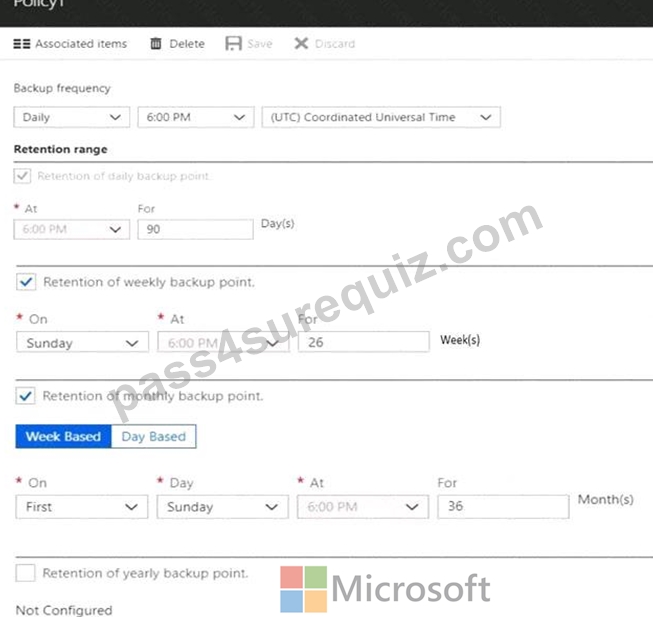
Use the drop-down menus to select the answer choice that completes each statement based on the information presented in the graphic.
NOTE: Each correct selection is worth one point.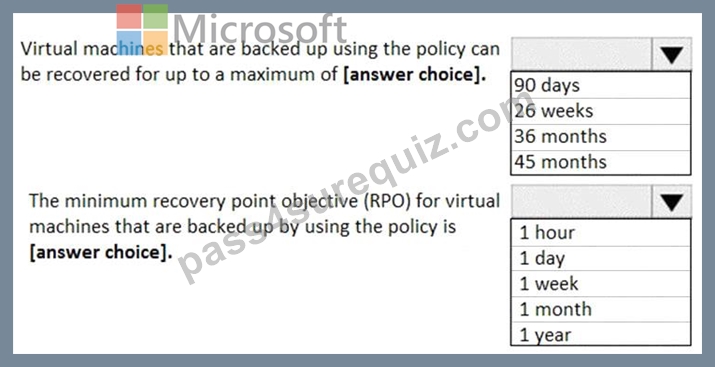
Answer:
Explanation: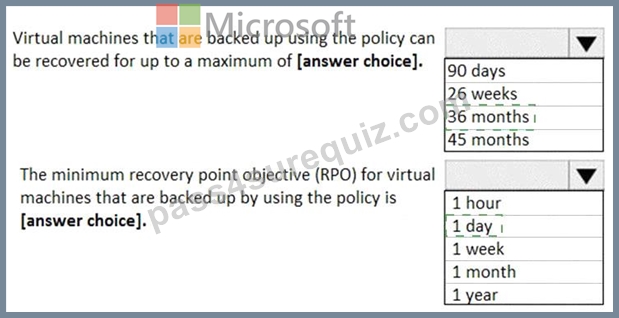
Explanation: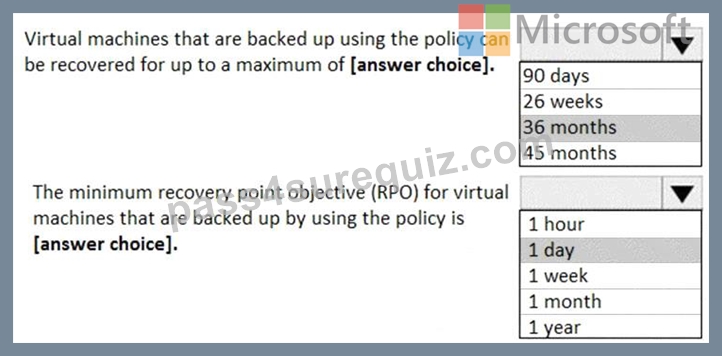
NEW QUESTION # 58
You have an Azure subscription.
You plan to deploy an app named App1 that will be hosted on multiple virtual machines. App1 requires a service-level agreement (SLA) of 99.99%.
You need to recommend a high availability solution for the virtual machines.
What should you include in the recommendation?
- A. availability zones
- B. availability sets
- C. application groups
- D. Azure Site Recovery
Answer: A
Explanation:
For all Virtual Machines that have two or more instances deployed across two or more Availability Zones in the same Azure region, we guarantee you will have Virtual Machine Connectivity to at least one instance at least 99.99% of the time.
Reference:
https://learn.microsoft.com/en-us/answers/questions/1114758/sla-for-virtual-machines
NEW QUESTION # 59
You have an Azure subscription. The subscription contains Azure virtual machines that run Windows Server 2016 and Linux.
You need to use Azure Log Analytics design an alerting strategy for security-related events.
Which Log Analytics tables should you query? To answer, drag the appropriate tables to the correct log types. Each value may be used once, more than once, or not at all. You may need to drag the split bar between panes or scroll to view content.
NOTE: Each correct selection is worth one point.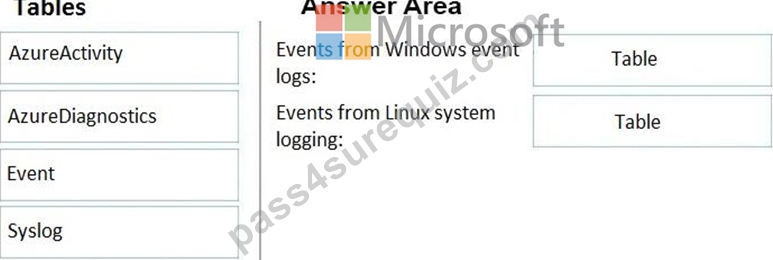
Answer:
Explanation: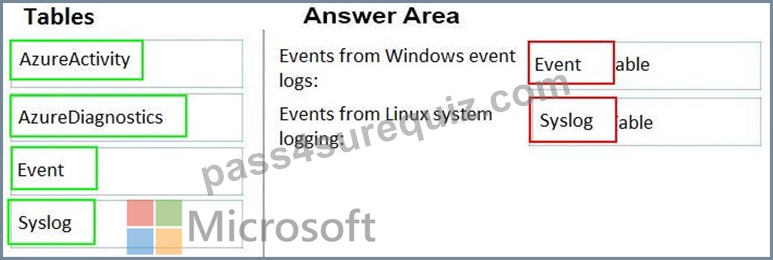
NEW QUESTION # 60
You need to recommend a notification solution for the IT Support distribution group.
What should you include in the recommendation?
- A. an action group
- B. Azure Network Watcher
- C. Azure AD Connect Health
- D. a SendGrid account with advanced reporting
Answer: C
Explanation:
Reference:
https://docs.microsoft.com/en-us/azure/active-directory/hybrid/how-to-connect-health-operations
Topic 3, Contoso
Overview
This is a case study. Case studies are not timed separately. You can use as much exam time as you would like to complete each case. However, there may be additional case studies and sections on this exam. You must manage your time to ensure that you are able to complete all questions included on this exam in the time provided.
To answer the questions included in a case study, you will need to reference information that is provided in the case study. Case studies might contain exhibits and other resources that provide more information about the scenario that is described in the case study. Each question is independent of the other questions in this case study.
At the end of this case study, a review screen will appear. This screen allows you to review your answers and to make changes before you move to the next section of the exam. After you begin a new section, you cannot return to this section.
To start the case study
To display the first question in this case study, click the Next button. Use the buttons in the left pane to explore the content of the case study before you answer the questions. Clicking these buttons displays information such as business requirements, existing environment, and problem statements. If the case study has an All Information tab, note that the information displayed is identical to the information displayed on the subsequent tabs. When you are ready to answer a question, click the Question button to return to the question.
Existing Environment: Technical Environment
The on-premises network contains a single Active Directory domain named contoso.com.
Contoso has a single Azure subscription.
Existing Environment: Business Partnerships
Contoso has a business partnership with Fabrikam, Inc. Fabrikam users access some Contoso applications over the internet by using Azure Active Directory (Azure AD) guest accounts.
Requirements: Planned Changes
Contoso plans to deploy two applications named App1 and App2 to Azure.
Requirements: App1
App1 will be a Python web app hosted in Azure App Service that requires a Linux runtime. Users from Contoso and Fabrikam will access App1.
App1 will access several services that require third-party credentials and access strings. The credentials and access strings are stored in Azure Key Vault.
App1 will have six instances: three in the East US Azure region and three in the West Europe Azure region.
App1 has the following data requirements:
Each instance will write data to a data store in the same availability zone as the instance.
Data written by any App1 instance must be visible to all App1 instances.
App1 will only be accessible from the internet. App1 has the following connection requirements:
Connections to App1 must pass through a web application firewall (WAF).
Connections to App1 must be active-active load balanced between instances.
All connections to App1 from North America must be directed to the East US region. All other connections must be directed to the West Europe region.
Every hour, you will run a maintenance task by invoking a PowerShell script that copies files from all the App1 instances. The PowerShell script will run from a central location.
Requirements: App2
App2 will be a NET app hosted in App Service that requires a Windows runtime. App2 has the following file storage requirements:
Save files to an Azure Storage account.
Replicate files to an on-premises location.
Ensure that on-premises clients can read the files over the LAN by using the SMB protocol.
You need to monitor App2 to analyze how long it takes to perform different transactions within the application. The solution must not require changes to the application code.
Application Development Requirements
Application developers will constantly develop new versions of App1 and App2. The development process must meet the following requirements:
A staging instance of a new application version must be deployed to the application host before the new version is used in production.
After testing the new version, the staging version of the application will replace the production version.
The switch to the new application version from staging to production must occur without any downtime of the application.
Identity Requirements
Contoso identifies the following requirements for managing Fabrikam access to resources:
Every month, an account manager at Fabrikam must review which Fabrikam users have access permissions to App1. Accounts that no longer need permissions must be removed as guests.
The solution must minimize development effort.
Security Requirement
All secrets used by Azure services must be stored in Azure Key Vault.
Services that require credentials must have the credentials tied to the service instance. The credentials must NOT be shared between services.
NEW QUESTION # 61
You need to design a solution that will execute custom C# code in response to an event routed to Azure Event Grid. The solution must meet the following requirements:
* The executed code must be able to access the private IP address of a Microsoft SQL Server instance that runs on an Azure virtual machine.
Costs must be minimized.
What should you include in the solution?
- A. Azure Logic Apps in the integrated service environment
- B. Azure Functions in the Dedicated plan and the Basic Azure App Service plan
- C. Azure Logic Apps in the Consumption plan
- D. Azure Functions in the Consumption plan
Answer: D
Explanation:
Explanation
When you create a function app in Azure, you must choose a hosting plan for your app. There are three basic hosting plans available for Azure Functions: Consumption plan, Premium plan, and Dedicated (App Service) plan.
For the Consumption plan, you don't have to pay for idle VMs or reserve capacity in advance.
Connect to private endpoints with Azure Functions
As enterprises continue to adopt serverless (and Platform-as-a-Service, or PaaS) solutions, they often need a way to integrate with existing resources on a virtual network. These existing resources could be databases, file storage, message queues or event streams, or REST APIs.
Reference:
https://docs.microsoft.com/en-us/azure/azure-functions/functions-scale
https://techcommunity.microsoft.com/t5/azure-functions/connect-to-private-endpoints-with-azure-functions/ba-p
NEW QUESTION # 62
You need to design an Azure policy that will implement the following functionality:
* For new resources, assign tags and values that match the tags and values of the resource group to which the resources are deployed.
* For existing resources, identify whether the tags and values match the tags and values of the resource group that contains the resources.
* For any non-compliant resources, trigger auto-generated remediation tasks to create missing tags and values.
The solution must use the principle of least privilege.
What should you include in the design? To answer, select the appropriate options in the answer area.
NOTE: Each correct selection is worth one point.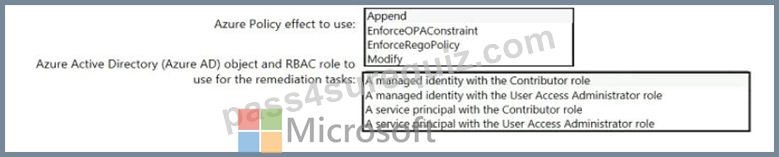
Answer:
Explanation: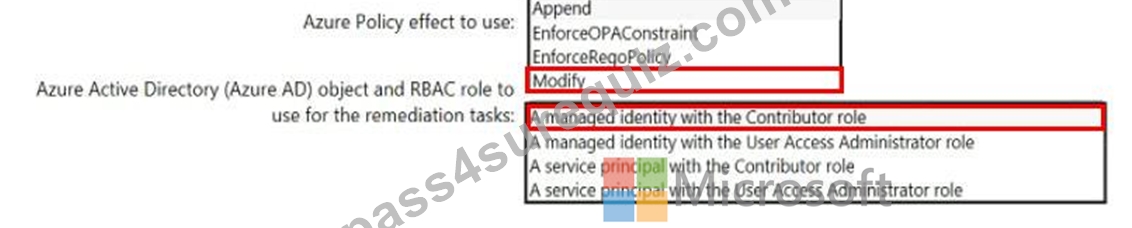
Reference:
https://docs.microsoft.com/en-us/azure/governance/policy/concepts/effects
https://docs.microsoft.com/en-us/azure/governance/policy/how-to/remediate-resources
https://docs.microsoft.com/en-us/azure/azure-resource-manager/management/tag-resources
https://docs.microsoft.com/en-us/azure/governance/policy/concepts/effects#modify
NEW QUESTION # 63
You need to recommend a solution to integrate Azure Cosmos DB and Azure Synapse. The solution must meet the following requirements:
* Traffic from an Azure Synapse workspace to the Azure Cosmos D8 account must be sent via the Microsoft backbone network.
* Traffic from the Azure Synapse workspace to the Azure Cosmos DB account must NOT be routed over the internet.
* Implementation effort must be minimized.
What should you include in the recommendation? To answer, select the appropriate options in the answer area.
NOTE: Each correct selection is worth one point.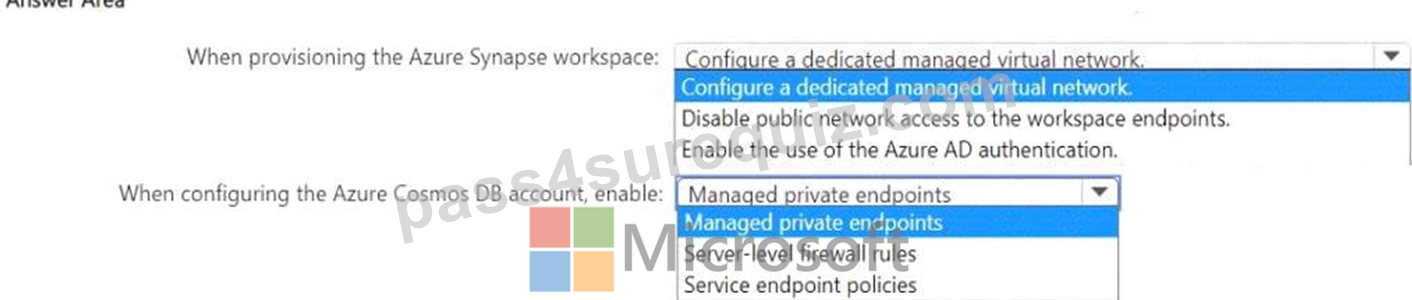
Answer:
Explanation: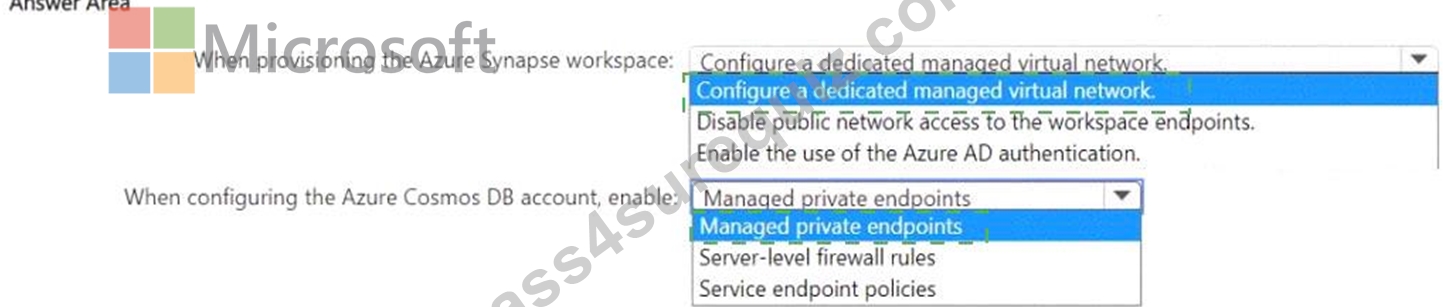
Explanation:
NEW QUESTION # 64
You have an Azure Load Balancer named LB1 that balances requests to five Azure virtual machines.
You need to develop a monitoring solution for LB1. The solution must generate an alert when any of the following conditions are met:
* A virtual machine is unavailable.
* Connection attempts exceed 50,000 per minute.
Which signal should you include in the solution for each condition? To answer, select the appropriate options in the answer area.
NOTE: Each correct selection is worth one point.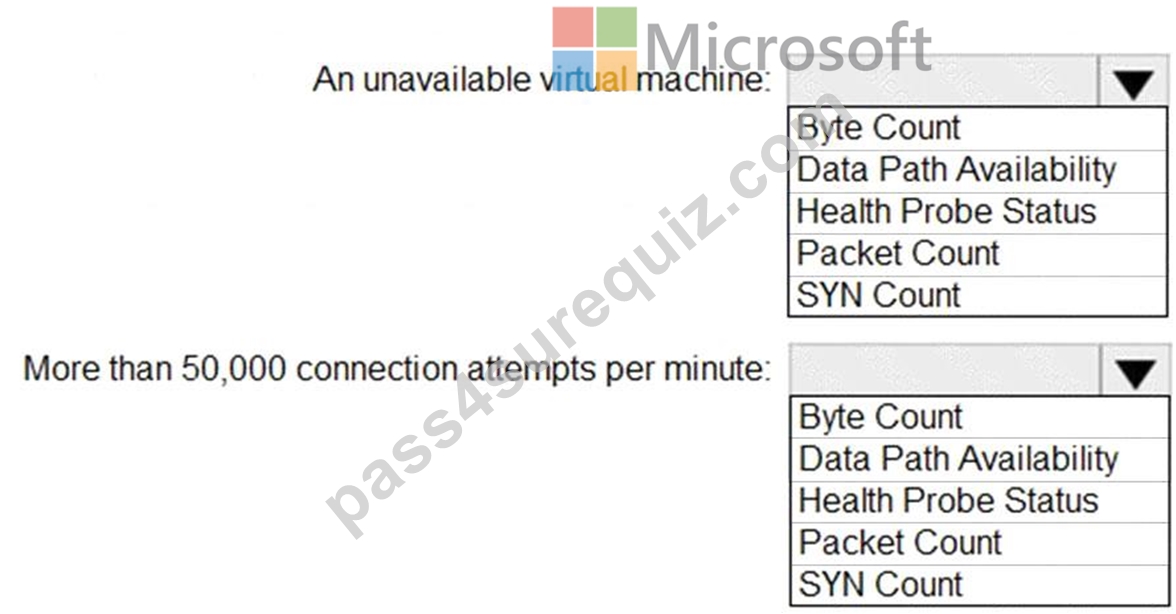
Answer:
Explanation: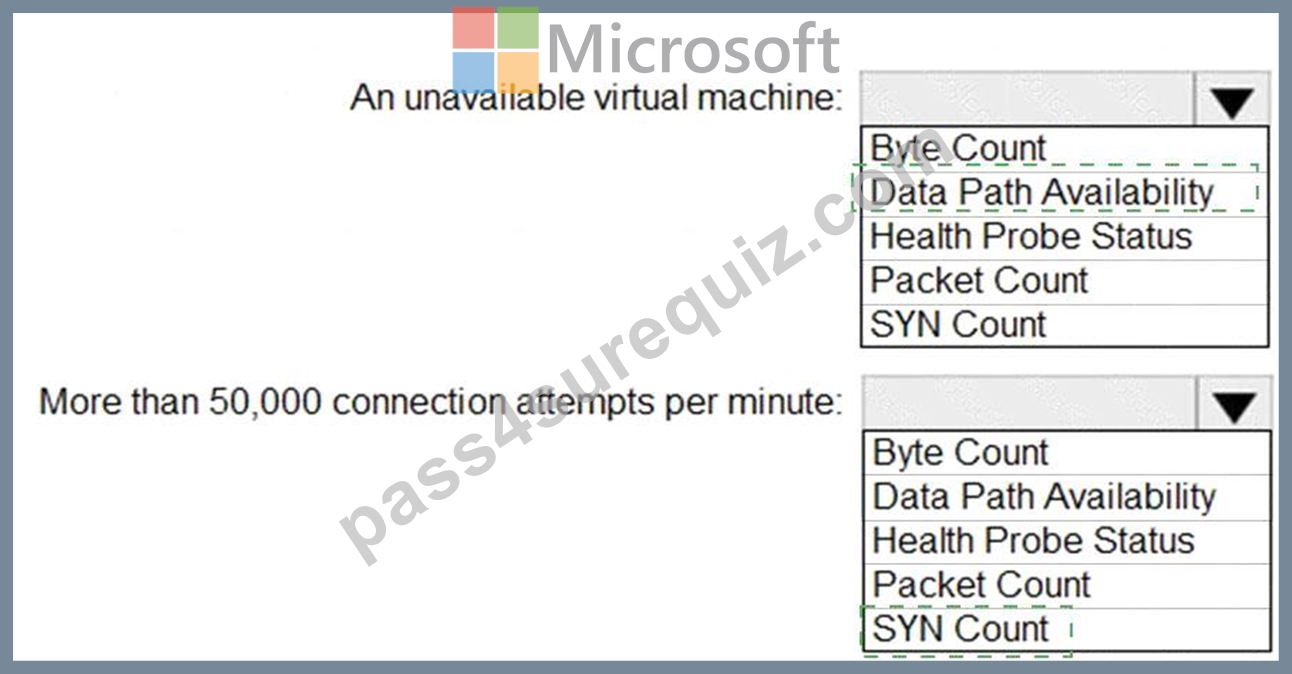
Explanation
Graphical user interface, text, application Description automatically generated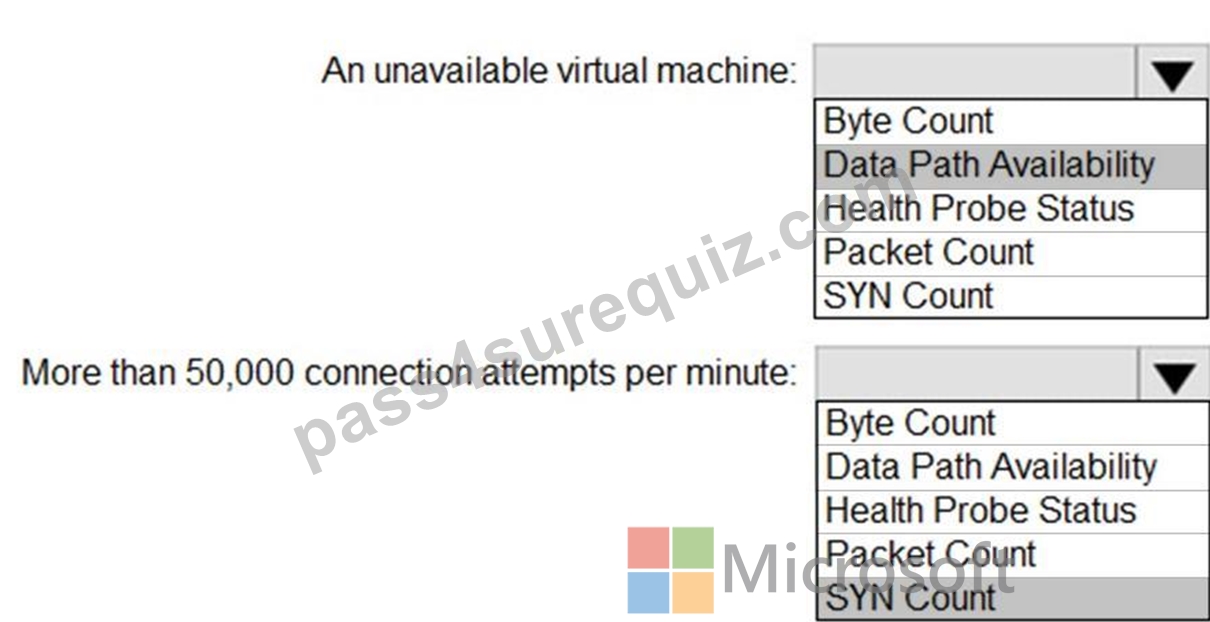
Box 1: Data path availability
Standard Load Balancer continuously exercises the data path from within a region to the load balancer front end, all the way to the SDN stack that supports your VM. As long as healthy instances remain, the measurement follows the same path as your application's load-balanced traffic. The data path that your customers use is also validated. The measurement is invisible to your application and does not interfere with other operations.
Note: Load balancer distributes inbound flows that arrive at the load balancer's front end to backend pool instances. These flows are according to configured load-balancing rules and health probes. The backend pool instances can be Azure Virtual Machines or instances in a virtual machine scale set.
Box 2: SYN count
SYN (synchronize) count: Standard Load Balancer does not terminate Transmission Control Protocol (TCP) connections or interact with TCP or UDP packet flows. Flows and their handshakes are always between the source and the VM instance. To better troubleshoot your TCP protocol scenarios, you can make use of SYN packets counters to understand how many TCP connection attempts are made. The metric reports the number of TCP SYN packets that were received.
Reference:
https://docs.microsoft.com/en-us/azure/load-balancer/load-balancer-standard-diagnostics
NEW QUESTION # 65
You have an Azure subscription that contains multiple storage accounts.
You assign Azure Policy definitions to the storage accounts.
You need to recommend a solution to meet the following requirements:
* Trigger on-demand Azure Policy compliance scans.
* Raise Azure Monitor non-compliance alerts by querying logs collected by Log Analytics.
What should you recommend for each requirement? To answer, select the appropriate options in the answer area. NOTE: Each correct selection is worth one point.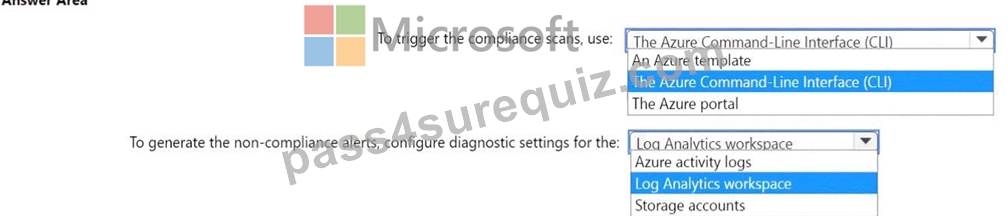
Answer:
Explanation: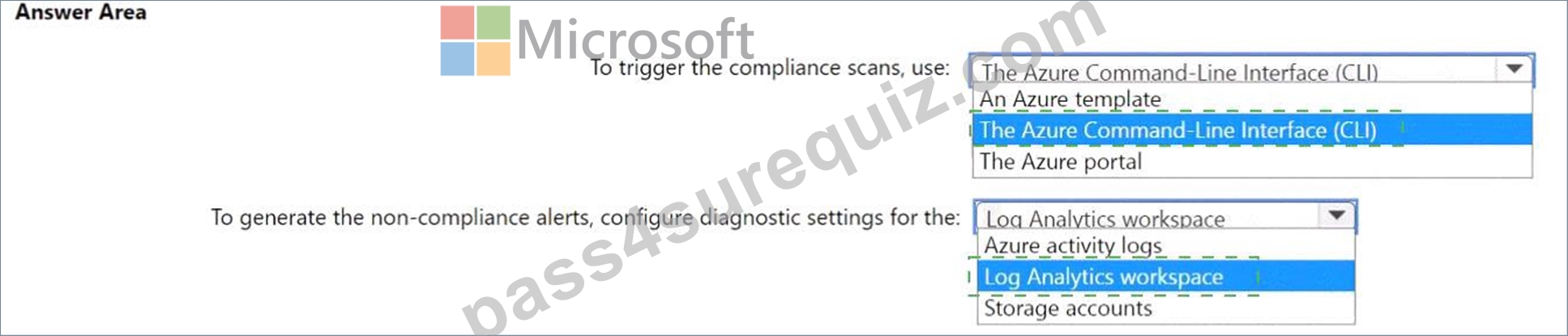
Explanation:
NEW QUESTION # 66
You have an Azure subscription named Subscription1 that is linked to a hybrid Azure Active Directory (Azure AD) tenant.
You have an on-premises datacenter that does have a VPN connection to Subscription1. The datacenter contains a computer named Server1 that has Microsoft SQL Server 2016 installed. Server1 is prevented from accessing the internet.
An Azure logic app named LogicApp1 requires write access to a database on Server1.
You need to recommend a solution to provide LogicApp1 with the ability to access Server1.
What should you recommend deploying on-premises and in Azure? To answer, select the appropriate options in the answer area.
NOTE: Each correct selection is worth one point.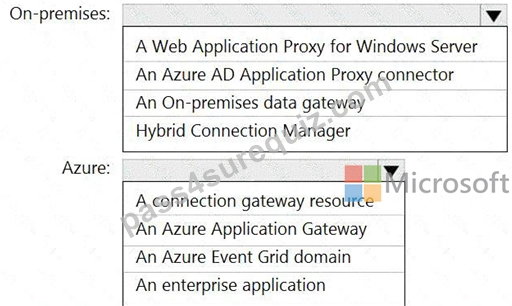
Answer:
Explanation: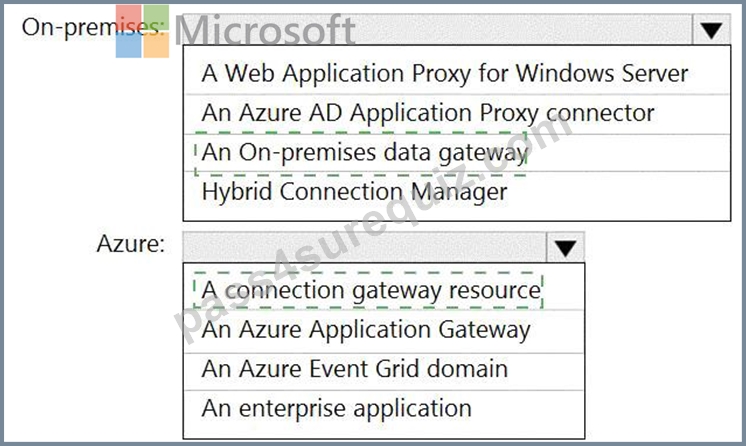
Explanation
Graphical user interface, text, application, chat or text message Description automatically generated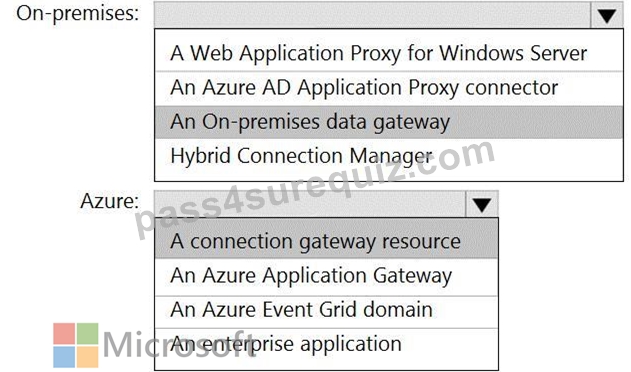
Box 1: An on-premises data gateway
For logic apps in global, multi-tenant Azure that connect to on-premises SQL Server, you need to have the on-premises data gateway installed on a local computer and a data gateway resource that's already created in Azure.
Box 2: A connection gateway resource
Reference:
https://docs.microsoft.com/en-us/azure/connectors/connectors-create-api-sqlazure
NEW QUESTION # 67
Note: This question is part of a series of questions that present the same scenario. Each question in the series contains a unique solution that might meet the stated goals. Some question sets might have more than one correct solution, while others might not have a correct solution.
After you answer a question in this section, you will NOT be able to return to it. As a result, these questions will not appear in the review screen.
Your company plans to deploy various Azure App Service instances that will use Azure SQL databases. The App Service instances will be deployed at the same time as the Azure SQL databases.
The company has a regulatory requirement to deploy the App Service instances only to specific Azure regions.
The resources for the App Service instances must reside in the same region.
You need to recommend a solution to meet the regulatory requirement.
Solution: You recommend using the Regulatory compliance dashboard in Azure Security Center.
Does this meet the goal?
- A. Yes
- B. No
Answer: B
Explanation:
The Regulatory compliance dashboard in Azure Security Center is not used for regional compliance.
Note: Instead Azure Resource Policy Definitions can be used which can be applied to a specific Resource Group with the App Service instances.
Note 2: In the Azure Security Center regulatory compliance blade, you can get an overview of key portions of your compliance posture with respect to a set of supported standards. Currently supported standards are Azure CIS, PCI DSS 3.2, ISO 27001, and SOC TSP.
Reference:
https://docs.microsoft.com/en-us/azure/governance/policy/overview
https://azure.microsoft.com/en-us/blog/regulatory-compliance-dashboard-in-azure-security-center-now-available
NEW QUESTION # 68
You have an Azure Active Directory (Azure AD) tenant.
You plan to use Azure Monitor to monitor user sign-ins and generate alerts based on specific user sign-in events.
You need to recommend a solution to trigger the alerts based on the events.
What should you include in the recommendation? To answer, select the appropriate options in the answer area.
NOTE: Each correct selection is worth one point.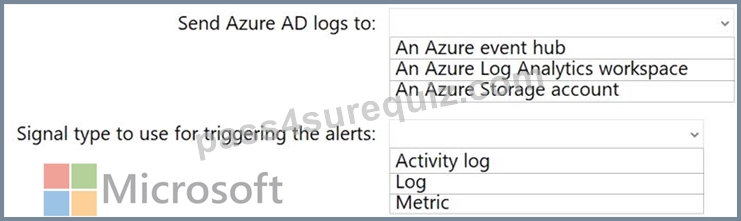
Answer:
Explanation: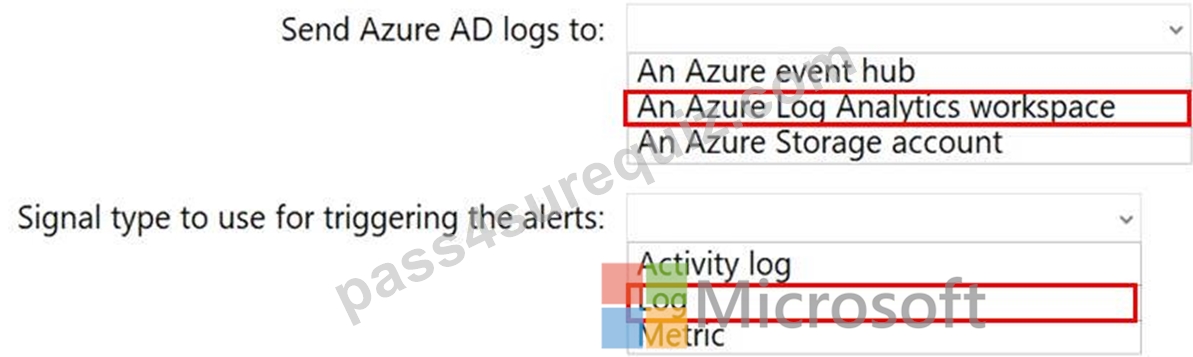
Reference:
https://4sysops.com/archives/how-to-create-an-azure-ad-admin-login-alert/
https://docs.microsoft.com/en-us/azure/azure-monitor/platform/alerts-log
NEW QUESTION # 69
Note: This section contains one or more sets of questions with the same scenario and problem. Each question presents a unique solution to the problem. You must determine whether the solution meets the stated goals. More than one solution in the set might solve the problem. It is also possible that none of the solutions in the set solve the problem.
After you answer a question in this section, you will NOT be able to return. As a result, these questions do not appear on the Review Screen.
Your company, named Contoso, Ltd., has a Microsoft Entra tenant named contoso.com that uses Privileged Identity Management (PIM) and is linked to an Azure subscription named Sub1.
You use Azure Backup to back up all the resources in Sub1 to a Recovery Services vault named Vault1.
An external company named Fabrikam, Inc. provides security management services to Contoso.
Fabrikam has a Microsoft Entra tenant named fabrikam.com and an Azure subscription.
You need to prevent a compromised administrator account in contoso.com from modifying backup policies in and deleting backups from Sub1.
Solution: In Vault1, you generate a security PIN for critical operations.
Does this meet the goal?
- A. Yes
- B. No
Answer: B
Explanation:
Reference:
https://learn.microsoft.com/en-us/azure/backup/multi-user-authorization-concept
NEW QUESTION # 70
You have five datacenters across North America and Europe.
You have an Azure subscription.
You need to recommend a solution to provide connectivity between the datacenters and Azure.
The solution must meet the following requirements:
- Ensure that apps hosted in a datacenter can access the resources
hosted in Azure and the other datacenters.
- Ensure that apps hosted in Azure can access the resources hosted in
the datacenters.
- Support the central management of network routes.
- Support the central management of firewall rules.
- Minimize administrative effort.
What should you include in the recommendation?
- A. Azure Front Door
- B. Azure VPN Gateway
- C. Azure Virtual WAN
- D. ExpressRoute
Answer: A
Explanation:
Azure Front Door and Azure Application Gateway are both load balancers for HTTP/HTTPS traffic, but they have different scopes. Front Door is a global service that can distribute requests across regions, while Application Gateway is a regional service that can balance requests within a region.
Reference:
https://learn.microsoft.com/en-us/azure/frontdoor/front-door-faq
NEW QUESTION # 71
Your company deploys an Azure App Service Web App.
During testing the application fails under load. The application cannot handle more than 100 concurrent user sessions. You enable the Always On feature. You also configure auto-scaling to increase counts from two to 10 based on HTTP queue length.
You need to improve the performance of the application.
Which solution should you use for each application scenario? To answer, select the appropriate options in the answer area.
NOTE: Each correct selection is worth one point.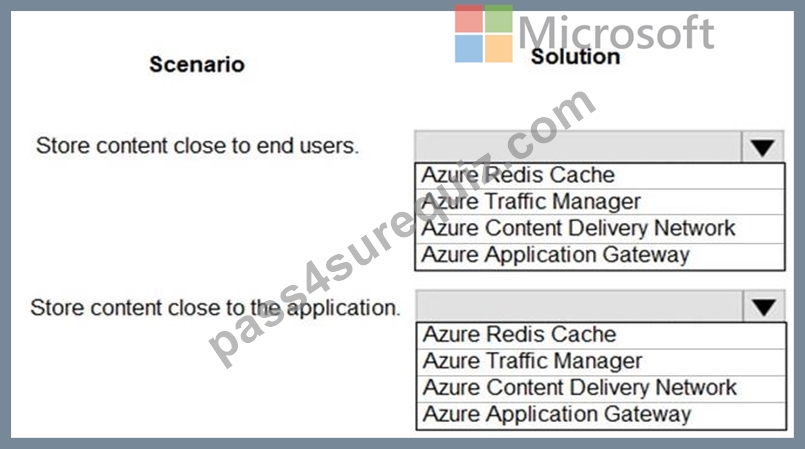
Answer:
Explanation: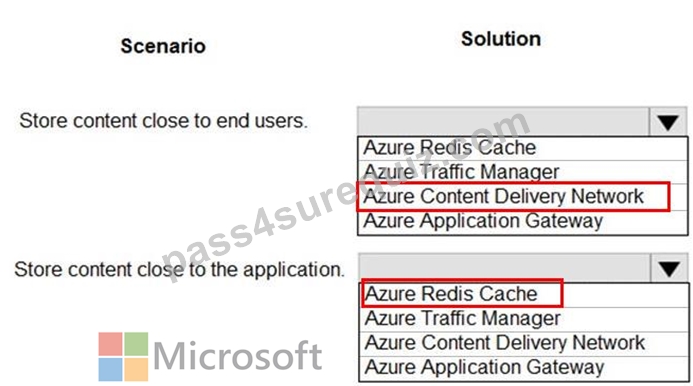
Reference:
https://docs.microsoft.com/en-us/azure/azure-cache-for-redis/cache-overview
NEW QUESTION # 72
Your on-premises datacenter contains a server named Server1 that runs Microsoft SQL Server 2022. Server1 contains a 30-TB database named DB1 that stores customer data. Server1 runs a custom application named App1 that verifies the compliance of records in DB1. App1 must run on the same server as DB1.
You have an Azure subscription.
You need to migrate DB1 to Azure. The solution must minimize administrative effort.
To which service should you migrate DB1, and what should you use to perform the migration? To answer, select the appropriate options in the answer area.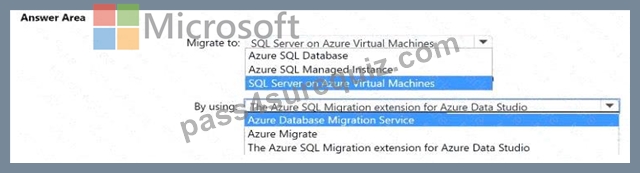
Answer:
Explanation: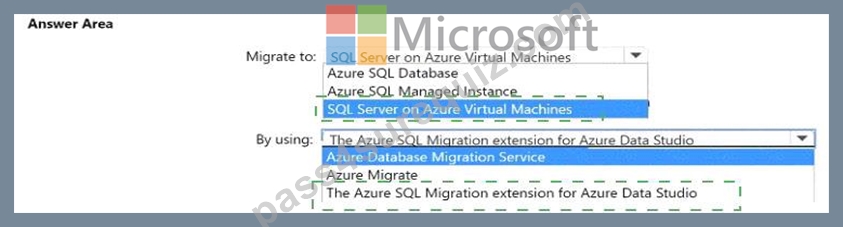
Explanation:
NEW QUESTION # 73
......
Pass Microsoft AZ-305 Exam Info and Free Practice Test: https://www.pass4surequiz.com/AZ-305-exam-quiz.html
Microsoft AZ-305 Real Exam Questions and Answers FREE: https://drive.google.com/open?id=1QbyCfO8hWSIPInl3IYJxFLgBZe5KJJOt