

Aug 02, 2026 Detailed New PMI-RMP Exam Questions for Concept Clearance
PMI-RMP Exam Preparation Material with New PMI-RMP Dumps Questions.
NEW QUESTION # 52
After presenting a list of risks to the major project stakeholders and project sponsor, the board requested the risks be sorted differently from the results presented by the project team.
This is a major issue and will cause a 2-week delay in the project.
How could the risk manager have avoided the board's response?
- A. Engaging the key stakeholders during the prioritization process
- B. Prioritizing the risks based on the project sponsor's risk appetite
- C. Working with an established industry standard prioritization method
- D. Engaging with the project sponsor before presenting to the board
Answer: A
Explanation:
According to the PMBOK Guide, risk prioritization is the process of assigning a level of importance to each identified risk based on its probability and impact, as well as other factors such as urgency, stakeholder tolerance, and project objectives.
Risk prioritization helps the project team to focus on the most significant risks and allocate resources accordingly. One of the tools and techniques for risk prioritization is stakeholder engagement, which involves involving the key stakeholders in the risk analysis and decision making process.
Stakeholder engagement helps to ensure that the risk prioritization reflects the expectations and preferences of the stakeholders, and that they are aware of and agree with the results.
By engaging the key stakeholders during the prioritization process, the risk manager could have avoided the board's request to sort the risks differently, as the board would have been part of the process and would have accepted the outcome.
References: = PMBOK Guide, 6th edition, pages 406-407; The Standard for Risk Management in Portfolios, Programs, and Projects, page 67.
NEW QUESTION # 53
You are the project manager for the NHH project. You are working with your project team to examine the project from four different defined perspectives to increase the breadth of identified risks by including internally generated risks. What risk identification approach are you using in this example?
- A. Influence diagramming techniques
- B. Assumptions analysis
- C. Root cause analysis
- D. SWOT analysis
Answer: D
NEW QUESTION # 54
Which of the following characteristics would a risk-tolerant person or group demonstrate?
- A. Risk taking is a price worth paying for future payoffs; seeks strategies and tactics that have high future payoffs; thinks abstractly and creatively envisioning possibilities, and not afraid of change or unknowns
- B. Discomfort with uncertainty; low tolerance for ambiguity. seeks security and resolution in the face of risk
- C. Reasonable comfort with most uncertainty; accepts risk as a normal feature of projects and business, and takes uncertainty in stride with no apparent or significant influence on their behavior.
- D. Adaptable and resourceful; not afraid to take action; thrill seeking
Answer: C
NEW QUESTION # 55
As a part of monitoring and controlling the project, the project manager should update the risk register. The project manager should update the risk register with information on risk reassessment, risk audits, and periodic risk reviews. What other information should the project manager update the risk register with?
- A. Actual costs and schedule delays of risk events.
- B. Actual outcomes of risk management duties by the project team.
- C. Actual outcomes of the project's risks and of the risk responses.
- D. Actual cost of risk events.
Answer: C
NEW QUESTION # 56
During a project review meeting, an executive scrutinizes the risk section, including risks on the watch list, and demands action to close them out. What is the executive's risk attitude?
- A. Averse
- B. Tolerant
- C. Neutral
- D. Seeking
Answer: A
NEW QUESTION # 57
A project manager was informed that the testing of the latest component in the project's software update release was not successful. As a result, 1he delivery timelines for the software release wifi be delayed, The project manager did not previously capture this as a risk to the project.
What should the project manager do next to avoid similar risks?
- A. Review the risk response plan looking for lessons learned.
- B. Log the event in the issue log and update the project management plan.
- C. Add contingencies to other tasks to mitigate similar risks.
- D. Reassess risks with a new assumptions and constraints analysis.
Answer: D
Explanation:
Explanation
The project manager should reassess risks by conducting a new assumptions and constraints analysis. This will help identify any previously overlooked risks and ensure that the risk register is comprehensive and up-to-date.
NEW QUESTION # 58
Ben is the project manager of the CMH Project for his organization. He has identified a risk that has a low probability of happening, but the impact of the risk event could save the project and the organization with a significant amount of capital. Ben assigns Laura to the risk event and instructs her to research the time, cost, and method to improve the probability of the positive risk event. Ben then communicates the risk event and response to management. What risk response has been used here?
- A. Transference
- B. Enhance
- C. Exploit
- D. Sharing
Answer: B
NEW QUESTION # 59
In a project to promote public health and mitigate health risks, the national health authorities intend to take actions to limit the risks of harmful insects by using pesticides; however, it is expected that some residents will have negative health effects due to the use of the pesticides but according to the assessment completed by the health authorities, not moving forward with this plan will have much more serious consequences on public health rather than following through with the original plan.
How should the project manager address this concern with the health authorities?
- A. Proceed with the project as normal since a minor number of residents will be effected negatively.
- B. Suspend the project as the secondary risk will negatively impact residents' health which is not acceptable.
- C. Assess and record associated secondary risks and proceed to treat them as any other risks.
- D. Consult with health experts to provide a risk trigger before using pesticides that will impact the residents.
Answer: C
Explanation:
The project manager should assess and record associated secondary risks and proceed to treat them as any other risks. This involves identifying and evaluating the potential negative health effects of using pesticides and developing a plan to mitigate these risks. While it is important to consider the concerns of residents, the health authorities have determined that not moving forward with the plan will have more serious consequences on public health.
Secondary risks are those that arise as a direct outcome of implementing a risk response. In this case, the use of pesticides is a risk response to limit the risks of harmful insects, but it may also cause negative health effects to some residents. This is a secondary risk that needs to be assessed and recorded in the risk register, along with its probability, impact, and response plan. The project manager should not suspend the project, as this would ignore the primary risk of harmful insects. The project manager should not consult with health experts to provide a risk trigger, as this is not a valid risk management technique. A risk trigger is an indication that a risk event is about to occur or has occurred, not a condition that prevents a risk response from being implemented. The project manager should not proceed with the project as normal, as this would neglect the secondary risk and its potential consequences. The project manager should follow the risk management process and treat the secondary risk as any other risk in the project. References: PMI. (2017). A Guide to the Project Management Body of Knowledge(PMBOK® Guide) - Sixth Edition. Chapter 11: Project Risk Management, p. 408. 5
NEW QUESTION # 60
A project manager realizes the team undertaking the project work has fallen behind the planned schedule. The risk manager identifies a new risk resulting from this delay and will need to understand how this will affect the project deadline.
Which kind of numerical analysis should be performed to understand the worst-case scenarios?
- A. Qualitative risk analysis
- B. Root cause analysis
- C. Sensitivity analysis
- D. Earned value analysis
Answer: C
Explanation:
sensitivity analysis is a technique that helps to determine which risks have the most potential impact on the project. It examines the extent to which the uncertainty of each project element affects the objective being examined when all other uncertain elements are held at their baseline values. Sensitivity analysis is often used to assess the risk exposure of the project schedule and cost, and to identify the critical risks that need to be managed. In this case, the risk manager needs to understand how the new risk resulting from the delay will affect the project deadline, which is the objective being examined. By performing sensitivity analysis, the risk manager can compare the relative importance and interaction of the new risk with other existing risks, and determine the worst-case scenarios for the project completion date. Sensitivity analysis can also help to prioritize risks for response planning and to develop contingency reserves. This is part of the Perform Quantitative Risk Analysis process in the PMBOKGuide2. Reference: 1: PMI Risk Management Professional (PMI-RMP)Examination Content Outline 2: A Guide to the Project Management Body of Knowledge (PMBOKGuide) - Sixth Edition
NEW QUESTION # 61
A risk management professional is currently facilitating the risk planning process with the project team. To increase the breadth of considered risks, the team wants to include high-level and strategic project risks.
What should the risk management professional do next?
- A. Perform a sensitivity analysis to the higher-level aggregate activities
- B. Develop a risk breakdown structure (RBS) identifying the potential risk categories
- C. Conduct a strengths, weaknesses, opportunities, and threats (SWOT) analysis
- D. Perform a base line Monte Carlo simulation to address overall threats to project objectives
Answer: C
Explanation:
A SWOT analysis is a risk identification technique that helps to identify high-level and strategic project risks by examining the internal and external factors that may affect the project objectives. A SWOT analysis involves listing the strengths, weaknesses, opportunities, and threats of the project, and then analyzing how they may impact the project positively or negatively. A SWOT analysis can help to uncover potential risks that may not be obvious from other techniques, such as prompt lists, interviews, or brainstorming12 References: 1: PMI Risk Management Professional (PMI-RMP)® Handbook, page 10 2: AGuide to the Project Management Body of Knowledge (PMBOK® Guide) - Seventh Edition, page 11.2.2.1
NEW QUESTION # 62
A risk manager is managing risks of a mission critical application. A subject matter expert (SME) asks the risk manager to treat every single risk identified as an extremely high priority.
What should the risk manager do?
- A. Mark every identified risk as an extremely high priority and any future risks as a lower priority.
- B. Perform a sensitivity analysis and determine the correct priority of every identified risk.
- C. Agree with the SME, treat every risk with equal priority, and inform all stakeholders.
- D. Ask the project sponsor if every risk in the risk register can have the same priority.
Answer: B
Explanation:
According to the PMBOK Guide, 6th edition, Section 11.6.2.1, Sensitivity Analysis, a sensitivity analysis is a technique that helps to determine which individual project risks or other sources of uncertainty have the most potential impact on project outcomes. A sensitivity analysis can be used to prioritize risks based on their relative effect on the project objectives, such as cost, schedule, quality, or scope. A sensitivity analysis can also help to identify areas where risk response efforts may be most effective. Therefore, the risk manager should perform a sensitivity analysis and determine the correct priority of every identified risk, rather than agreeing with the SME or the project sponsor, or marking every risk with the same or different priority without proper analysis. Reference: PMBOK Guide, 6th edition, Section 11.6.2.1, Sensitivity Analysis1 The risk manager should perform a sensitivity analysis to assess the impact of each risk on the project objectives. This will help in determining the correct priority of every identified risk, ensuring that resources are allocated effectively and that the most critical risks are addressed first.
NEW QUESTION # 63
In reviewing the team's identified project risks, a project manager identified an opportunity to assign more resources to ensure the company receives the project's incentive payment for early completion.
In implementing this plan, which response should the risk manager use?
- A. Share
- B. Enhance
- C. Accept
- D. Exploit
Answer: D
NEW QUESTION # 64
Multiple new risks have come up on a project that were not included on the risk register. The project manager met with the team to explain that risk management is critical for the success of the project, and risk identification is key.
What should the project manager do next?
- A. Determine the likelihood and impact of the risks.
- B. Develop the risk response plans for identified risks.
- C. Apply an iterative approach to risk identification.
- D. Review assumptions and constraints around risks.
Answer: C
Explanation:
Explanation
The project manager should apply an iterative approach to risk identification, which involves continuous risk identification throughout the project lifecycle. This will help to identify and address new risks that may arise during the project.
NEW QUESTION # 65
A project is in progress when the product team requests a change to the scope. The team indicates that this is a minimal change and should not create any problems.
What should the risk manager do next?
- A. Analyze any potential impact.
- B. Update the work breakdown structure (WBS).
- C. Add a new risk to the risk register.
- D. Escalate the issue to management.
Answer: A
Explanation:
Any change to project scope, regardless of perceived size, should trigger a risk analysis to determine potential impact. The PMBOK Guide states:
"When a change request is submitted, it should be evaluated for potential impact on project objectives, including risk. Analysis of impact is a best practice before implementing any change."
- PMBOK Guide, 6th Edition, Section 4.6.2 (Perform Integrated Change Control) This ensures that the team does not overlook risks associated with even "minimal" changes.
References:
PMI PMBOK Guide, 6th Edition, Section 4.6
Practice Standard for Project Risk Management, PMI, Section 5.5
NEW QUESTION # 66
Business rhythm can fluctuate greatly between different industries and vary between companies within the same industry. What should be used 10 determine how often a project's risk register should be updated or reviewed in a given year when the project is in an industry with a very high business rhythm?
- A. The risk management plan
- B. The risk prioritization criteria
- C. The portfolio management plan
- D. The risk triggers
Answer: A
Explanation:
Explanation
The risk management plan provides guidance on how often the risk register should be updated or reviewed. It takes into account the specific industry, project, and organizational context, including the business rhythm.
NEW QUESTION # 67
You are the project manager of the GHG project for your company. You have identified the project risks, completed qualitative and quantitative analysis, and created risk responses. You also need to document how and when risk audits will be performed in the project. Where will you define the frequency of risk audits?
- A. Risk management plan
- B. Risk response plan
- C. Schedule management plan
- D. Quality management plan
Answer: A
NEW QUESTION # 68
You are the project manager of the GYH project for your organization. Management has asked you to begin identifying risks and to use an information gathering technique. Which one of the following risk identification approaches is an information gathering technique?
- A. Root cause analysis
- B. Documentation reviews
- C. Assumptions analysis
- D. SWOT analysis
Answer: A
NEW QUESTION # 69
Melody is the project manager for her organization. She has created a risk response to conduct more tests on the software her project is creating. The identified risk that prompted this response was that the software is mission-critical and must be flawless before it can be put into product.
What type of a risk response has Melody used in this scenario?
- A. Avoidance
- B. Transference
- C. Enhance
- D. Mitigation
Answer: D
NEW QUESTION # 70
You are the project manager of the GHY Project for your company. You need to complete a project management process that will be on the lookout for new risks, changing risks, and risks that are now outdated.
Which project management process is responsible for these actions?
- A. Risk identification
- B. Risk monitoring and controlling
- C. Risk planning
- D. Risk analysis
Answer: B
NEW QUESTION # 71
While executing an oil extraction project in an environmentally sensitive area, weather is the main cause of delay in the project work. The risk manager was aware that the delays caused by the weather could not be avoided or mitigated.
What should the risk manager do to manage this risk?
- A. Perform time recovery actions.
- B. Perform change management.
- C. Execute the prevention plans.
- D. Execute the contingency plans.
Answer: D
Explanation:
Contingency plans are predefined actions that the project team will take if an identified risk event occurs.
They are designed to reduce the impact or probability of the risk, or to restore the project to its original objectives. Contingency plans are part of the risk response planning process, and they should be documented in the risk register. In this case, the risk manager should execute the contingency plans to deal with the delays caused by the weather, as they cannot be avoided or mitigated. Performing time recovery actions, executing prevention plans, or performing change management are not appropriate responses for this risk, as they are either reactive, proactive, or corrective measures that do not address the risk directly. References: = PMBOK Guide, 6th edition, page 443; The Standard for Risk Management in Portfolios, Programs, and Projects, page
75.
NEW QUESTION # 72
A project has consistently been lagging in cost performance index (CPI) and schedule performance index (SPI) over the past few months. The risk manager realizes that some activities are taking longer than expected and more resources are needed.
Which project artifact should the risk manager analyze to mitigate the risk of further project overrun?
- A. Contingency reserves
- B. Risk impact matrix
- C. Schedule and resource assumptions
- D. Work breakdown structure (WBS)
Answer: C
Explanation:
When a project experiences consistent deviations in cost performance index (CPI) and schedule performance index (SPI), it indicates underlying issues with the project's assumptions regarding schedule and resources.
Analyzing these assumptions helps identify discrepancies between planned and actual performance, such as underestimated task durations or insufficient resource allocation. By revisiting and adjusting these assumptions, the risk manager can develop strategies to mitigate further overruns and align the project with its objectives.
PMI Risk Management Study Guide References:
The PMI-RMP Exam Content Outline emphasizes the importance of examining assumption and constraint analyses to identify risks arising from inaccurate or incomplete project assumptions, which can lead to performance issues.
NEW QUESTION # 73 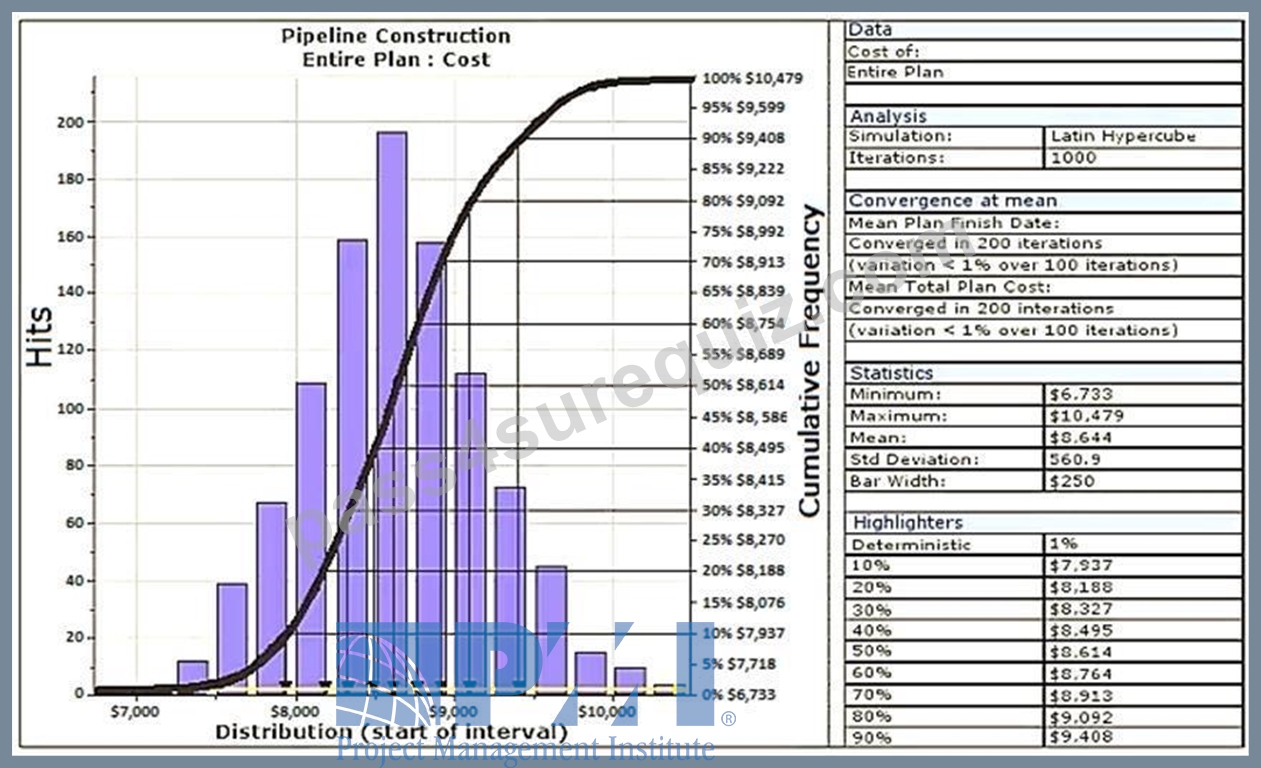
The project sponsor has asked the project manager how much more a P90 will cost. The sponsor has budgeted for a P40. The project values are in thousands.
How much additional funding would the sponsor need to budget for a P90?
- A. US$8,495,000
- B. US$913,000
- C. US$794,000
- D. US$9,408,000
Answer: B
NEW QUESTION # 74
A two-year project with a budget of US$2 million has completed about 60% of the work at the end of the first year. The actual cost incurred to complete the remaining 40% of work is about USS1.5 million. As a part of performing a specialized risk analysis, the calculated schedule performance index (SPI) is 1.2 and cost performance index (CPI) is 0.53.
How should the risk manager interpret such a low CPI value?
- A. The cost baseline is inaccurate.
- B. The actual reported costs are inaccurate.
- C. The cost related risks are effectively managed.
- D. The cost control processes is ineffective.
Answer: A
Explanation:
Explanation
A low CPI value (0.53) indicates that the project is over budget. This may be due to an inaccurate cost baseline, which means the initial budget estimation was not correct. This would not necessarily mean that cost control processes are ineffective, actual reported costs are inaccurate, or cost-related risks are effectively managed.
The CPI value is calculated by dividing the earned value (EV) by the actual cost (AC). A CPI value of less than 1 indicates that the project is over budget, meaning that the actual cost is higher than the planned cost. A low CPI value can have several possible causes, such as poor estimation, scope creep, change requests, or inaccurate reporting. However, in this case, the SPI value is greater than 1, which indicates that the project is ahead of schedule, meaning that the earned value is higher than the planned value. This suggests that the cost baseline, which is derived from the planned value, is inaccurate and does not reflect the true cost of the work. Therefore, the risk manager should interpret such a low CPI value as a sign of an inaccurate cost baseline, and not as a result of ineffective cost control processes, inaccurate actual costs, or effective cost related risk management. References: PMI-RMP Certification Handbook1, page 9; PMBOK Guide, page
267.
NEW QUESTION # 75
The project manager has completed four projects all with similar scope. The project manager has recently been assigned to start on a new project and believes some risks may occur again on this project.
What should the project manager do?
- A. Implement the risk response strategies into the risk plan.
- B. Inform the sponsor that these risks should be added according to experience.
- C. Discuss and evaluate the identified risks with the project team.
- D. Add the risks to the risk register and determine a contingency.
Answer: C
Explanation:
The project manager should discuss the identified risks with the project team to ensure that everyone is aware of the potential risks and can provide input on the likelihood and impact of each risk. This collaborative approach will help in developing a comprehensive risk management plan.
The project manager should discuss and evaluate the identified risks with the project team, as this is part of the risk identification process. The project manager can use their experience from previous projects to identify potential risks that may occur again on the new project, but they should also involve the project team to obtain their input and perspectives. The project team can help the project manager to validate, refine, and prioritize the identified risks, as well as to suggest possible risk responses. The project manager should document the identified risks and their characteristics in the risk register, which is a tool for risk management. The other options are not appropriate actions for the project manager to take. Implementing the risk response strategies into the risk plan is premature, as the project manager should first analyze and evaluate the risks before deciding on the best response strategies. Informing the sponsor that these risks should be added according to experience is not sufficient, as the project manager should also consult the project team and other stakeholders to ensure that all relevant risks are identified and assessed. Adding the risks to the risk register and determining a contingency is part of the risk analysis and response planning processes, which come after the risk identification process. The project manager should first discuss and evaluate the identified risks with the project team before moving to the next steps of risk management. References: 2, 3, [5]
NEW QUESTION # 76
......
PMI-RMP 2026 Training With 293 QA's: https://www.pass4surequiz.com/PMI-RMP-exam-quiz.html
PMI PMI-RMP Certification Exam Questions: https://drive.google.com/open?id=1RPDwhd_aILRjA4Pe-n4r4xuYAROMXsb0