

2024 New Training Course Databricks-Certified-Professional-Data-Engineer Tutorial Preparation Guide
Dumps of Databricks-Certified-Professional-Data-Engineer Cover all the requirements of the Real Exam
Databricks Certified Professional Data Engineer certification exam is designed for data engineers who work with Databricks. Databricks-Certified-Professional-Data-Engineer exam tests the candidate's ability to design, build, and maintain data pipelines, as well as their knowledge of various data engineering tools and techniques. Databricks-Certified-Professional-Data-Engineer exam is intended to validate the candidate's proficiency in using Databricks for data engineering tasks.
NEW QUESTION # 12
A data engineer wants to join a stream of advertisement impressions (when an ad was shown) with another stream of user clicks on advertisements to correlate when impression led to monitizable clicks.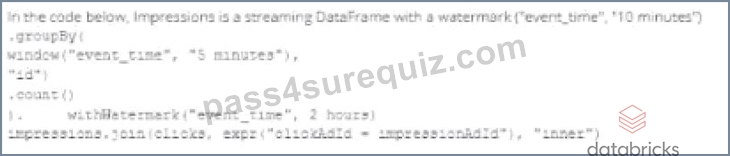
Which solution would improve the performance?
- A.

- B.

- C.

- D.

Answer: A
Explanation:
When joining a stream of advertisement impressions with a stream of user clicks, you want to minimize the state that you need to maintain for the join. Option A suggests using a left outer join with the condition that clickTime == impressionTime, which is suitable for correlating events that occur at the exact same time.
However, in a real-world scenario, you would likely need some leeway to account for the delay between an impression and a possible click. It's important to design the join condition and the window of time considered to optimize performance while still capturing the relevant user interactions. In this case, having the watermark can help with state management and avoid state growing unbounded by discarding old state data that's unlikely to match with new data.
NEW QUESTION # 13
The downstream consumers of a Delta Lake table have been complaining about data quality issues impacting performance in their applications. Specifically, they have complained that invalidlatitudeandlongitudevalues in theactivity_detailstable have been breaking their ability to use other geolocation processes.
A junior engineer has written the following code to addCHECKconstraints to the Delta Lake table: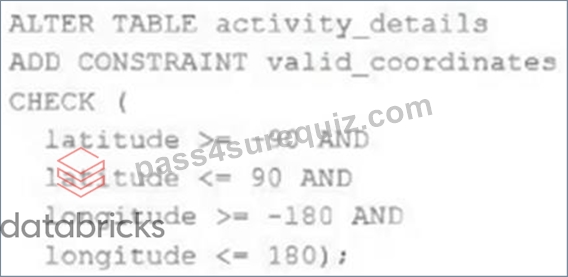
A senior engineer has confirmed the above logic is correct and the valid ranges for latitude and longitude are provided, but the code fails when executed.
Which statement explains the cause of this failure?
- A. The current table schema does not contain the field valid coordinates; schema evolution will need to be enabled before altering the table to add a constraint.
- B. Because another team uses this table to support a frequently running application, two-phase locking is preventing the operation from committing.
- C. The activity details table already contains records that violate the constraints; all existing data must pass CHECK constraints in order to add them to an existing table.
- D. The activity details table already contains records; CHECK constraints can only be added prior to inserting values into a table.
- E. The activity details table already exists; CHECK constraints can only be added during initial table creation.
Answer: C
Explanation:
Explanation
The failure is that the code to add CHECK constraints to the Delta Lake table fails when executed. The code uses ALTER TABLE ADD CONSTRAINT commands to add two CHECK constraints to a table named activity_details. The first constraint checks if the latitude value is between -90 and 90, and the second constraint checks if the longitude value is between -180 and 180. The cause of this failure is that the activity_details table already contains records that violate these constraints, meaning that they have invalid latitude or longitude values outside of these ranges. When adding CHECK constraints to an existing table, Delta Lake verifies that all existing data satisfies the constraints before adding them to the table. If any record violates the constraints, Delta Lake throws an exception and aborts the operation. Verified References:
[Databricks Certified Data Engineer Professional], under "Delta Lake" section; Databricks Documentation, under "Add a CHECK constraint to an existing table" section.
NEW QUESTION # 14
A data engineer has set up a notebook to automatically process using a Job. The data engineer's manager wants
to version control the schedule due to its complexity.
Which of the following approaches can the data engineer use to obtain a version-controllable con-figuration of
the Job's schedule?
- A. They can submit the Job once on an all-purpose cluster
- B. They can download the JSON description of the Job from the Job's page
- C. They can submit the Job once on a Job cluster
- D. They can link the Job to notebooks that are a part of a Databricks Repo
- E. They can download the XML description of the Job from the Job's page
Answer: B
NEW QUESTION # 15
How does a Delta Lake differ from a traditional data lake?
- A. Delta lake is an open storage format designed to replace flat files with additional capa-bilities that can provide reliability, security, and performance
- B. Delta lake is Datawarehouse service on top of data lake that can provide reliability, se-curity, and performance
- C. Delta lake is an open storage format like parquet with additional capabilities that can provide reliability, security, and performance
- D. Delta lake is a caching layer on top of data lake that can provide reliability, security, and performance
- E. Delta lake is proprietary software designed by Databricks that can provide reliability, security, and performance
Answer: C
Explanation:
Explanation
Answer is, Delta lake is an open storage format like parquet with additional capabilities that can provide reliability, security, and performance Delta lake is
* Open source
* Builds up on standard data format
* Optimized for cloud object storage
* Built for scalable metadata handling
Delta lake is not
* Proprietary technology
* Storage format
* Storage medium
* Database service or data warehouse
NEW QUESTION # 16
Which of the following is true of Delta Lake and the Lakehouse?
- A. Views in the Lakehouse maintain a valid cache of the most recent versions of source tables at all times.
- B. Primary and foreign key constraints can be leveraged to ensure duplicate values are never entered into a dimension table.
- C. Because Parquet compresses data row by row. strings will only be compressed when a character is repeated multiple times.
- D. Delta Lake automatically collects statistics on the first 32 columns of each table which are leveraged in data skipping based on query filters.
- E. Z-order can only be applied to numeric values stored in Delta Lake tables
Answer: D
Explanation:
https://docs.delta.io/2.0.0/table-properties.html
Delta Lake automatically collects statistics on the first 32 columns of each table, which are leveraged in data skipping based on query filters1. Data skipping is a performance optimization technique that aims to avoid reading irrelevant data from the storage layer1. By collecting statistics such as min/max values, null counts, and bloom filters, Delta Lake can efficiently prune unnecessary files or partitions from the query plan1. This can significantly improve the query performance and reduce the I/O cost.
The other options are false because:
* Parquet compresses data column by column, not row by row2. This allows for better compression ratios, especially for repeated or similar values within a column2.
* Views in the Lakehouse do not maintain a valid cache of the most recent versions of source tables at all times3. Views are logical constructs that are defined by a SQL query on one or more base tables3. Views are not materialized by default, which means they do not store any data, but only the query definition3. Therefore, views always reflect the latest state of the source tables when queried3.
However, views can be cached manually using the CACHE TABLE or CREATE TABLE AS SELECT commands.
* Primary and foreign key constraints can not be leveraged to ensure duplicate values are never entered into a dimension table. Delta Lake does not support enforcing primary and foreign key constraints on tables. Constraints are logical rules that define the integrity and validity of the data in a table. Delta Lake relies on the application logic or the user to ensure the data quality and consistency.
* Z-order can be applied to any values stored in Delta Lake tables, not only numeric values. Z-order is a technique to optimize the layout of the data files by sorting them on one or more columns. Z-order can improve the query performance by clustering related values together and enabling more efficient data skipping. Z-order can be applied to any column that has a defined ordering, such as numeric, string, date, or boolean values.
References: Data Skipping, Parquet Format, Views, [Caching], [Constraints], [Z-Ordering]
NEW QUESTION # 17
A DLT pipeline includes the following streaming tables:
Raw_lot ingest raw device measurement data from a heart rate tracking device.
Bgm_stats incrementally computes user statistics based on BPM measurements from raw_lot.
How can the data engineer configure this pipeline to be able to retain manually deleted or updated records in the raw_iot table while recomputing the downstream table when a pipeline update is run?
- A. Set the pipelines, reset, allowed property to false on bpm_stats
- B. Set the pipelines, reset, allowed property to false on raw_iot
- C. Set the skipChangeCommits flag to true on bpm_stats
- D. Set the SkipChangeCommits flag to true raw_lot
Answer: B
NEW QUESTION # 18
The data engineering team has configured a Databricks SQL query and alert to monitor the values in a Delta Lake table. The recent_sensor_recordings table contains an identifying sensor_id alongside the timestamp and temperature for the most recent 5 minutes of recordings.
The below query is used to create the alert:
The query is set to refresh each minute and always completes in less than 10 seconds. The alert is set to trigger when mean (temperature) > 120. Notifications are triggered to be sent at most every 1 minute.
If this alert raises notifications for 3 consecutive minutes and then stops, which statement must be true?
- A. The average temperature recordings for at least one sensor exceeded 120 on three consecutive executions of the query
- B. The maximum temperature recording for at least one sensor exceeded 120 on three consecutive executions of the query
- C. The recent_sensor_recordingstable was unresponsive for three consecutive runs of the query
- D. The source query failed to update properly for three consecutive minutes and then restarted
- E. The total average temperature across all sensors exceeded 120 on three consecutive executions of the query
Answer: A
Explanation:
This is the correct answer because the query is using a GROUP BY clause on the sensor_id column, which means it will calculate the mean temperature for each sensor separately. The alert will trigger when the mean temperature for any sensor is greater than 120, which means at least one sensor had an average temperature above 120 for three consecutive minutes. The alert will stop when the mean temperature for all sensors drops below 120. Verified References: [Databricks Certified Data Engineer Professional], under "SQL Analytics" section; Databricks Documentation, under "Alerts" section.
NEW QUESTION # 19
A distributed team of data analysts share computing resources on an interactive cluster with autoscaling configured. In order to better manage costs and query throughput, the workspace administrator is hoping to evaluate whether cluster upscaling is caused by many concurrent users or resource-intensive queries.
In which location can one review the timeline for cluster resizing events?
- A. Workspace audit logs
- B. Executor's log file
- C. Ganglia
- D. Driver's log file
- E. Cluster Event Log
Answer: E
NEW QUESTION # 20
A data engineer has created a Delta table as part of a data pipeline. Downstream data analysts now need
SELECT permission on the Delta table.
Assuming the data engineer is the Delta table owner, which part of the Databricks Lakehouse Plat-form can
the data engineer use to grant the data analysts the appropriate access?
- A. Jobs
B Dashboards - B. Data Explorer
- C. Databricks Filesystem
- D. Repos
Answer: D
NEW QUESTION # 21
Once a cluster is deleted, below additional actions need to performed by the administrator
- A. Remove logs
- B. Remove networking but Virtual machines and storage disks are automatically dropped
- C. Drop storage disks but Virtual machines and networking are automatically dropped
- D. Remove virtual machines but storage and networking are automatically dropped
- E. No action needs to be performed. All resources are automatically removed.
Answer: E
Explanation:
Explanation
What is Delta?
Delta lake is
* Open source
* Builds up on standard data format
* Optimized for cloud object storage
* Built for scalable metadata handling
Delta lake is not
* Proprietary technology
* Storage format
* Storage medium
* Database service or data warehouse
NEW QUESTION # 22
A data engineer, User A, has promoted a new pipeline to production by using the REST API to programmatically create several jobs. A DevOps engineer, User B, has configured an external orchestration tool to trigger job runs through the REST API. Both users authorized the REST API calls using their personal access tokens.
Which statement describes the contents of the workspace audit logs concerning these events?
- A. Because User B last configured the jobs, their identity will be associated with both the job creation events and the job run events.
- B. Because these events are managed separately, User A will have their identity associated with the job creation events and User B will have their identity associated with the job run events.
- C. Because the REST API was used for job creation and triggering runs, user identity will not be captured in the audit logs.
- D. Because the REST API was used for job creation and triggering runs, a Service Principal will be automatically used to identity these events.
- E. Because User A created the jobs, their identity will be associated with both the job creation events and the job run events.
Answer: B
Explanation:
The events are that a data engineer, User A, has promoted a new pipeline to production by using the REST API to programmatically create several jobs, and a DevOps engineer, User B, has configured an external orchestration tool to trigger job runs through the REST API. Both users authorized the REST API calls using their personal access tokens. The workspace audit logs are logs that record user activities in a Databricks workspace, such as creating, updating, or deleting objects like clusters, jobs, notebooks, or tables. The workspace audit logs also capture the identity of the user who performed each activity, as well as the time and details of the activity. Because these events are managed separately, User A will have their identity associated with the job creation events and User B will have their identity associated with the job run events in the workspace audit logs. Verified References: [Databricks Certified Data Engineer Professional], under
"Databricks Workspace" section; Databricks Documentation, under "Workspace audit logs" section.
NEW QUESTION # 23
A data engineer needs to create a database called customer360 at the loca-tion /customer/customer360. The
data engineer is unsure if one of their colleagues has already created the database.
Which of the following commands should the data engineer run to complete this task?
- A. CREATE DATABASE customer360 DELTA LOCATION '/customer/customer360';
- B. CREATE DATABASE customer360 LOCATION '/customer/customer360';
- C. CREATE DATABASE IF NOT EXISTS customer360;
- D. CREATE DATABASE IF NOT EXISTS customer360 DELTA LOCATION '/customer/customer360';
- E. CREATE DATABASE IF NOT EXISTS customer360 LOCATION '/customer/customer360';
Answer: E
NEW QUESTION # 24
A Data engineer wants to run unit's tests using common Python testing frameworks on python functions defined across several Databricks notebooks currently used in production.
How can the data engineer run unit tests against function that work with data in production?
- A. Define units test and functions within the same notebook
- B. Define and unit test functions using Files in Repos
- C. Run unit tests against non-production data that closely mirrors production
- D. Define and import unit test functions from a separate Databricks notebook
Answer: C
Explanation:
The best practice for running unit tests on functions that interact with data is to use a dataset that closely mirrors the production data. This approach allows data engineers to validate the logic of their functions without the risk of affecting the actual production data. It's important to have a representative sample of production data to catch edge cases and ensure the functions will work correctly when used in a production environment.
Reference:
Databricks Documentation on Testing: Testing and Validation of Data and Notebooks
NEW QUESTION # 25
Which of the following data workloads will utilize a Silver table as its source?
- A. A job that queries aggregated data that already feeds into a dashboard
- B. A job that ingests raw data from a streaming source into the Lakehouse
- C. A job that enriches data by parsing its timestamps into a human-readable format
- D. A job that cleans data by removing malformatted records
- E. A job that aggregates cleaned data to create standard summary statistics
Answer: E
NEW QUESTION # 26
You were asked to create or overwrite an existing delta table to store the below transaction data.
- A. 1.CREATE OR REPLACE TABLE IF EXISTS transactions (
2.transactionId int,
3.transactionDate timestamp,
4.unitsSold int)
5.FORMAT DELTA - B. 1.CREATE OR REPLACE DELTA TABLE transactions (
2.transactionId int,
3.transactionDate timestamp,
4.unitsSold int) - C. 1.CREATE IF EXSITS REPLACE TABLE transactions (
2.transactionId int,
3.transactionDate timestamp,
4.unitsSold int) - D. 1.CREATE OR REPLACE TABLE transactions (
2.transactionId int,
3.transactionDate timestamp,
4.unitsSold int)
Answer: D
Explanation:
Explanation
The answer is
1.CREATE OR REPLACE TABLE transactions (
2.transactionId int,
3.transactionDate timestamp,
4.unitsSold int)
When creating a table in Databricks by default the table is stored in DELTA format.
NEW QUESTION # 27
The marketing team is looking to share data in an aggregate table with the sales organization, but the field names used by the teams do not match, and a number of marketing specific fields have not been approval for the sales org.
Which of the following solutions addresses the situation while emphasizing simplicity?
- A. Add a parallel table write to the current production pipeline, updating a new sales table that varies as required from marketing table.
- B. Create a view on the marketing table selecting only these fields approved for the sales team alias the names of any fields that should be standardized to the sales naming conventions.
- C. Use a CTAS statement to create a derivative table from the marketing table configure a production jon to propagation changes.
- D. Create a new table with the required schema and use Delta Lake's DEEP CLONE functionality to sync up changes committed to one table to the corresponding table.
Answer: B
Explanation:
Creating a view is a straightforward solution that can address the need for field name standardization and selective field sharing between departments. A view allows for presenting a transformed version of the underlying data without duplicating it. In this scenario, the view would only include the approved fields for the sales team and rename any fields as per their naming conventions.
References:
* Databricks documentation on using SQL views in Delta Lake:
https://docs.databricks.com/delta/quick-start.html#sql-views
NEW QUESTION # 28
......
Sample Questions of Databricks-Certified-Professional-Data-Engineer Dumps With 100% Exam Passing Guarantee: https://www.pass4surequiz.com/Databricks-Certified-Professional-Data-Engineer-exam-quiz.html