

[Sep-2026] Study resources for the Valid Professional-Machine-Learning-Engineer Braindumps!
Updated Professional-Machine-Learning-Engineer Tests Engine pdf - All Free Dumps Guaranteed!
NEW QUESTION # 150
An interactive online dictionary wants to add a widget that displays words used in similar contexts. A Machine Learning Specialist is asked to provide word features for the downstream nearest neighbor model powering the widget.
What should the Specialist do to meet these requirements?
- A. Create word embedding vectors that store edit distance with every other word.
- B. Create one-hot word encoding vectors.
- C. Download word embeddings pre-trained on a large corpus.
- D. Produce a set of synonyms for every word using Amazon Mechanical Turk.
Answer: B
Explanation:
Explanation/Reference: https://aws.amazon.com/blogs/machine-learning/amazon-sagemaker-object2vec-adds-new- features-that-support-automatic-negative-sampling-and-speed-up-training/
NEW QUESTION # 151
During batch training of a neural network, you notice that there is an oscillation in the loss. How should you adjust your model to ensure that it converges?
- A. Increase the learning rate hyperparameter
- B. Decrease the size of the training batch
- C. Increase the size of the training batch
- D. Decrease the learning rate hyperparameter
Answer: A
Explanation:
https://developers.google.com/machine-learning/crash-course/introduction-to-neural-networks/playground-exercises
NEW QUESTION # 152
You work for a gaming company that has millions of customers around the world. All games offer a chat feature that allows players to communicate with each other in real time. Messages can be typed in more than 20 languages and are translated in real time using the Cloud Translation API. You have been asked to build an ML system to moderate the chat in real time while assuring that the performance is uniform across the various languages and without changing the serving infrastructure.
You trained your first model using an in-house word2vec model for embedding the chat messages translated by the Cloud Translation API. However, the model has significant differences in performance across the different languages. How should you improve it?
- A. Replace the in-house word2vec with GPT-3 or T5.
- B. Remove moderation for languages for which the false positive rate is too high.
- C. Add a regularization term such as the Min-Diff algorithm to the loss function.
- D. Train a classifier using the chat messages in their original language.
Answer: D
Explanation:
The problem with the current approach is that it relies on the Cloud Translation API to translate the chat messages into a common language before embedding them with the in-house word2vec model. This introduces two sources of error: the translation quality and the word2vec quality. The translation quality may vary across different languages, depending on the availability of data and the complexity of the grammar and vocabulary. The word2vec quality may also vary depending on the size and diversity of the corpus used to train it. These errors may affect the performance of the classifier that moderates the chat messages, resulting in significant differences across the languages.
A better approach would be to train a classifier using the chat messages in their original language, without relying on the Cloud Translation API or the in-house word2vec model. This way, the classifier can learn the nuances and subtleties of each language, and avoid the errors introduced by the translation and embedding processes. This would also reduce the latency and cost of the moderation system, as it would not need to invoke the Cloud Translation API for every message. To train a classifier using the chat messages in their original language, one could use a multilingual pre-trained model such as mBERT or XLM-R, which can handle multiple languages and domains. Alternatively, one could train a separate classifier for each language, using a monolingual pre-trained model such as BERT or a custom model tailored to the specific language and task.
Reference:
Professional ML Engineer Exam Guide
Preparing for Google Cloud Certification: Machine Learning Engineer Professional Certificate Google Cloud launches machine learning engineer certification
[mBERT: Bidirectional Encoder Representations from Transformers]
[XLM-R: Unsupervised Cross-lingual Representation Learning at Scale]
[BERT: Pre-training of Deep Bidirectional Transformers for Language Understanding]
NEW QUESTION # 153
You work with a data engineering team that has developed a pipeline to clean your dataset and save it in a Cloud Storage bucket. You have created an ML model and want to use the data to refresh your model as soon as new data is available. As part of your CI/CD workflow, you want to automatically run a Kubeflow Pipelines training job on Google Kubernetes Engine (GKE). How should you architect this workflow?
- A. Use App Engine to create a lightweight python client that continuously polls Cloud Storage for new files As soon as a file arrives, initiate the training job
- B. Configure your pipeline with Dataflow, which saves the files in Cloud Storage After the file is saved, start the training job on a GKE cluster
- C. Configure a Cloud Storage trigger to send a message to a Pub/Sub topic when a new file is available in a storage bucket. Use a Pub/Sub-triggered Cloud Function to start the training job on a GKE cluster
- D. Use Cloud Scheduler to schedule jobs at a regular interval. For the first step of the job. check the timestamp of objects in your Cloud Storage bucket If there are no new files since the last run, abort the job.
Answer: C
Explanation:
This option is the best way to architect the workflow, as it allows you to use event-driven and serverless components to automate the ML training process. Cloud Storage triggers are a feature that allows you to send notifications to a Pub/Sub topic when an object is created, deleted, or updated in a storage bucket. Pub/Sub is a service that allows you to publish and subscribe to messages on various topics. Pub/Sub-triggered Cloud Functions are a type of Cloud Functions that are invoked when a message is published to a specific Pub/Sub topic. Cloud Functions are a serverless platform that allows you to run code in response to events. By using these components, you can create a workflow that starts the training job on a GKE cluster as soon as a new file is available in the Cloud Storagebucket, without having to manage any servers or poll for changes. The other options are not as efficient or scalable as this option. Dataflow is a service that allows you to create and run data processing pipelines, but it is not designed to trigger ML training jobs on GKE. App Engine is a service that allows you to build and deploy web applications, but it is not suitable for polling Cloud Storage for new files, as it may incur unnecessary costs and latency. Cloud Scheduler is a service that allows you to schedule jobs at regular intervals, but it is not ideal for triggering ML training jobs based on data availability, as it may miss some files or run unnecessary jobs. References:
* Cloud Storage triggers documentation
* Pub/Sub documentation
* Pub/Sub-triggered Cloud Functions documentation
* Cloud Functions documentation
* Kubeflow Pipelines documentation
NEW QUESTION # 154
You work at a subscription-based company. You have trained an ensemble of trees and neural networks to predict customer churn, which is the likelihood that customers will not renew their yearly subscription. The average prediction is a 15% churn rate, but for a particular customer the model predicts that they are 70% likely to churn. The customer has a product usage history of 30%, is located in New York City, and became a customer in 1997. You need to explain the difference between the actual prediction, a 70% churn rate, and the average prediction. You want to use Vertex Explainable AI. What should you do?
- A. Configure integrated gradients explanations on Vertex Explainable AI.
- B. Configure sampled Shapley explanations on Vertex Explainable AI.
- C. Train local surrogate models to explain individual predictions.
- D. Measure the effect of each feature as the weight of the feature multiplied by the feature value.
Answer: B
Explanation:
Option A is incorrect because training local surrogate models to explain individual predictions is not a feature of Vertex Explainable AI, but rather a general technique for interpreting black-box models. Local surrogate models are simpler models that approximate the behavior of the original model around a specific input1.
Option B is correct because configuring sampled Shapley explanations on Vertex Explainable AI is a way to explain the difference between the actual prediction and the average prediction for a given input. Sampled Shapley explanations are based on the Shapley value, which is a game-theoretic concept that measures how much each feature contributes to the prediction2. Vertex Explainable AI supports sampled Shapley explanations for tabular data, such as customer churn3.
Option C is incorrect because configuring integrated gradients explanations on Vertex Explainable AI is not suitable for explaining the difference between the actual prediction and the average prediction for a given input. Integrated gradients explanations are based on the idea of computing the gradients of the prediction with respect to the input features along a path from a baseline input to the actual input4. Vertex Explainable AI supports integrated gradients explanations for image and text data, but not for tabular data3.
Option D is incorrect because measuring the effect of each feature as the weight of the feature multiplied by the feature value is not a valid way to explain the difference between the actual prediction and the average prediction for a given input. This method assumes that the model is linear and additive, which is not the case for an ensemble of trees and neural networks. Moreover, this method does not account for the interactions between features or the non-linearity of the model5.
Reference:
Local surrogate models
Shapley value
Vertex Explainable AI overview
Integrated gradients
Feature importance
NEW QUESTION # 155
You are training an ML model on a large dataset. You are using a TPU to accelerate the training process You notice that the training process is taking longer than expected. You discover that the TPU is not reaching its full capacity. What should you do?
- A. Decrease the learning rate
- B. Increase the batch size
- C. Increase the learning rate
- D. Increase the number of epochs
Answer: B
Explanation:
The best option for training an ML model on a large dataset, using a TPU to accelerate the training process, and discovering that the TPU is not reaching its full capacity, is to increase the batch size. This option allows you to leverage the power and simplicity of TPUs to train your model faster and more efficiently. A TPU is a custom-developed application-specific integrated circuit (ASIC) that can accelerate machine learning workloads. A TPU can provide high performance and scalability for various types of models, such as linear regression, logistic regression, k-means clustering, matrix factorization, and deep neural networks. A TPU can also support various tools and frameworks, such as TensorFlow, PyTorch, and JAX. A batch size is a parameter that specifies the number of training examples in one forward/backward pass. A batch size can affect the speed and accuracy of the training process. A larger batch size can help you utilize the parallel processing power of the TPU, and reduce the communication overhead between the TPU and the host CPU. A larger batch size can also help you avoid overfitting, as it can reduce the variance of the gradient updates. By increasing the batch size, you can train your model on a large dataset faster and more efficiently, and make full use of the TPU capacity1.
The other options are not as good as option D, for the following reasons:
* Option A: Increasing the learning rate would not help you utilize the parallel processing power of the TPU, and could cause errors or poor performance. A learning rate is a parameter that controls how much the model is updated in each iteration. A learning rate can affect the speed and accuracy of the training process. A larger learning rate can help you converge faster, but it can also cause instability, divergence, or oscillation. By increasing the learning rate, you may not be able to find the optimal solution, and your model may perform poorly on the validation or test data2.
* Option B: Increasing the number of epochs would not help you utilize the parallel processing power of the TPU, and could increase the complexity and cost of the training process. An epoch is a measure of the number of times all of the training examples are used once in the training process. An epoch can affect the speed and accuracy of the training process. A larger number of epochs can help you learn
* more from the data, but it can also cause overfitting, underfitting, or diminishing returns. By increasing the number of epochs, you may not be able to improve the model performance significantly, and your training process may take longer and consume more resources3.
* Option C: Decreasing the learning rate would not help you utilize the parallel processing power of the TPU, and could slow down the training process. A learning rate is a parameter that controls how much the model is updated in each iteration. A learning rate can affect the speed and accuracy of the training process. A smaller learning rate can help you find a more precise solution, but it can also cause slow convergence or local minima. By decreasing the learning rate, you may not be able to reach the optimal solution in a reasonable time, and your training process may take longer2.
References:
* Preparing for Google Cloud Certification: Machine Learning Engineer, Course 2: ML Models and Architectures, Week 1: Introduction to ML Models and Architectures
* Google Cloud Professional Machine Learning Engineer Exam Guide, Section 2: Architecting ML solutions, 2.1 Designing ML models
* Official Google Cloud Certified Professional Machine Learning Engineer Study Guide, Chapter 4: ML Models and Architectures, Section 4.1: Designing ML Models
* Use TPUs
* Triose phosphate utilization and beyond: from photosynthesis to end ...
* Cloud TPU performance guide
* Google TPU: Architecture and Performance Best Practices - Run
NEW QUESTION # 156
You are training an object detection model using a Cloud TPU v2. Training time is taking longer than expected. Based on this simplified trace obtained with a Cloud TPU profile, what action should you take to decrease training time in a cost-efficient way?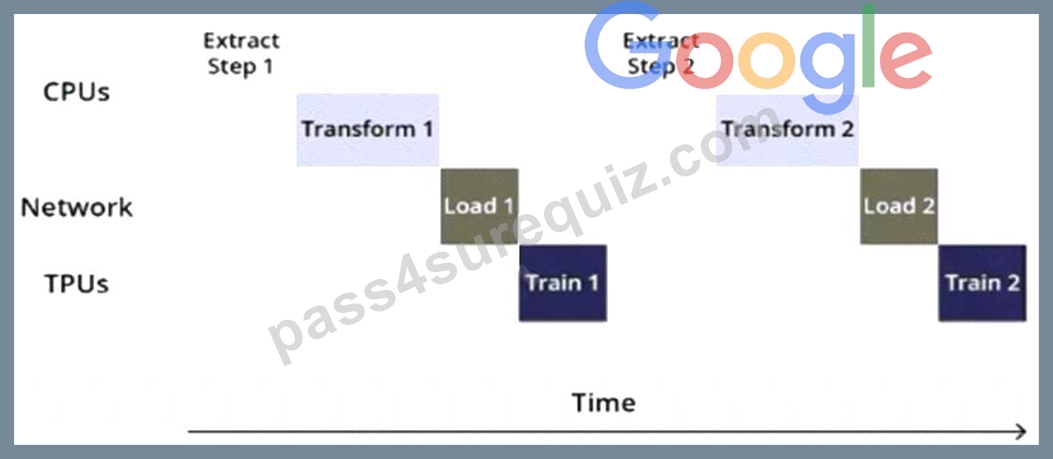
- A. Move from Cloud TPU v2 to 8 NVIDIA V100 GPUs and increase batch size.
- B. Move from Cloud TPU v2 to Cloud TPU v3 and increase batch size.
- C. Rewrite your input function using parallel reads, parallel processing, and prefetch.
- D. Rewrite your input function to resize and reshape the input images.
Answer: C
Explanation:
The trace in the question shows that the training time is taking longer than expected. This is likely due to the input function not being optimized. To decrease training time in a cost-efficient way, the best option is to rewrite the input function using parallel reads, parallel processing, and prefetch. This will allow the model to process the data more efficiently and decrease training time. References:
* [Cloud TPU Performance Guide]
* [Data input pipeline performance guide]
NEW QUESTION # 157
While performing exploratory data analysis on a dataset, you find that an important categorical feature has 5% null values. You want to minimize the bias that could result from the missing values. How should you handle the missing values?
- A. Remove the rows with missing values, and upsample your dataset by 5%.
- B. Replace the missing values with a placeholder category indicating a missing value.
- C. Replace the missing values with the feature's mean.
- D. Move the rows with missing values to your validation dataset.
Answer: C
NEW QUESTION # 158
Your company manages an ecommerce website. You developed an ML model that recommends additional products to users in near real time based on items currently in the user's cart. The workflow will include the following processes:
1. The website will send a Pub/Sub message with the relevant data and
then receive a message with the prediction from Pub/Sub
2. Predictions will be stored in BigQuery
3. The model will be stored in a Cloud Storage bucket and will be
updated frequently
You want to minimize prediction latency and the effort required to update the model. How should you reconfigure the architecture?
- A. Write a Cloud Function that loads the model into memory for prediction. Configure the function to be triggered when messages are sent to Pub/Sub.
- B. Expose the model as a Vertex AI endpoint. Write a custom DoFn in a Dataflow job that calls the endpoint for prediction.
- C. Create a pipeline in Vertex AI Pipelines that performs preprocessing, prediction, and postprocessing. Configure the pipeline to be triggered by a Cloud Function when messages are sent to Pub/Sub.
- D. Use the RunInference API with WatchFilePattern in a Dataflow job that wraps around the model and serves predictions.
Answer: A
NEW QUESTION # 159
You are developing an ML model to predict house prices. While preparing the data, you discover that an important predictor variable, distance from the closest school, is often missing and does not have high variance. Every instance (row) in your data is important. How should you handle the missing data?
- A. Delete the rows that have missing values.
- B. Apply feature crossing with another column that does not have missing values.
- C. Replace the missing values with zeros.
- D. Predict the missing values using linear regression.
Answer: D
Explanation:
The best option for handling missing data in this case is to predict the missing values using linear regression.
Linear regression is a supervised learning technique that can be used to estimate the relationship between a continuous target variable and one or more predictor variables. In this case, the target variable is the distance from the closest school, and the predictor variables are the other features in the dataset, such as house size, location, number of rooms, etc. By fitting a linear regression model on the data that has no missing values, we can then use the model to predict the missing values for the distance from the closest school feature. This way, we can preserve all the instances in the dataset and avoid introducing bias or reducing variance. The other options are not suitable for handling missing data in this case, because:
* Deleting the rows that have missing values would reduce the size of the dataset and potentially lose important information. Since every instance is important, we want to keep as much data as possible.
* Applying feature crossing with another column that does not have missing values would create a new feature that combines the values of two existing features. This might increase the complexity of the model and introduce noise or multicollinearity. It would not solve the problem of missing values, as the new feature would still have missing values whenever the distance from the closest school feature is missing.
* Replacing the missing values with zeros would distort the distribution of the feature and introduce bias.
It would also imply that the houses with missing values are located at the same distance from the closest school, which is unlikely to be true. A zero value might also be outside the range of the feature, as the distance from the closest school is unlikely to be exactly zero for any house. References:
* Linear Regression
* Imputation of missing values
* Google Cloud launches machine learning engineer certification
* Google Professional Machine Learning Engineer Certification
* Professional ML Engineer Exam Guide
* Preparing for Google Cloud Certification: Machine Learning Engineer Professional Certificate
NEW QUESTION # 160
You are building a model to predict daily temperatures. You split the data randomly and then transformed the training and test datasets. Temperature data for model training is uploaded hourly. During testing, your model performed with 97% accuracy; however, after deploying to production, the model ' s accuracy dropped to
66%. How can you make your production model more accurate?
- A. Split the training and test data based on time rather than a random split to avoid leakage
- B. Add more data to your test set to ensure that you have a fair distribution and sample for testing
- C. Normalize the data for the training, and test datasets as two separate steps.
- D. Apply data transformations before splitting, and cross-validate to make sure that the transformations are applied to both the training and test sets.
Answer: A
Explanation:
When building a model to predict daily temperatures, it is important to split the training and test data based on time rather than a random split. This is because temperature data is likely to have temporal dependencies and patterns, such as seasonality, trends, and cycles. If the data is split randomly, there is a risk of data leakage, which occurs when information from the future is used to train or validate the model. Data leakage can lead to overfitting and unrealistic performance estimates, as the model may learn from data that it should not have access to. By splitting the data based on time, such as using the most recent data as the test set and the older data as the training set, the model can be evaluated on how well it can forecast future temperatures based on past data, which is the realistic scenario in production. Therefore, splitting the data based on time rather than a random split is the best way to make the production model more accurate.
NEW QUESTION # 161
You work for a retail company. You have been tasked with building a model to determine the probability of churn for each customer. You need the predictions to be interpretable so the results can be used to develop marketing campaigns that target at-risk customers. What should you do?
- A. Build a random forest classification model in a Vertex Al Workbench notebook instance Configure the model to generate feature importance's after the model is trained.
- B. Build a random forest regression model in a Vertex Al Workbench notebook instance Configure the model to generate feature importance's after the model is trained.
- C. Build a custom TensorFlow neural network by using Vertex Al custom training Configure the model to generate explanations when it makes predictions.
- D. Build an AutoML tabular regression model Configure the model to generate explanations when it makes predictions.
Answer: A
Explanation:
A random forest is an ensemble learning method that consists of many decision trees. It can be used for both regression and classification tasks. A random forest classification model can predict the probability of churn for each customer by assigning them to different classes, such as high-risk, medium-risk, or low-risk. A random forest model can also generate feature importances, which measure how much each feature contributes to the prediction. Feature importances can help interpret the model and understand what factors influence customer churn. Vertex AI Workbench is an integrated development environment (IDE) that allows you to create and run Jupyter notebooks on Google Cloud. You can use Vertex AI Workbench to build a random forest classification model in Python, using libraries such as scikit-learn or TensorFlow. You can also configure the model to generate feature importances after the model is trained, and visualize them using plots or tables. This solution can help you build an interpretable model for customer churn prediction, and use the results to design marketing campaigns that target at-risk customers. Reference:
Random Forests | scikit-learn
Vertex AI Workbench | Google Cloud
Interpreting Random Forests | Towards Data Science
NEW QUESTION # 162
You are developing a training pipeline for a new XGBoost classification model based on tabular data The data is stored in a BigQuery table You need to complete the following steps
1. Randomly split the data into training and evaluation datasets in a 65/35 ratio
2. Conduct feature engineering
3 Obtain metrics for the evaluation dataset.
4 Compare models trained in different pipeline executions
How should you execute these steps'?
- A. 1 Using Vertex Al Pipelines, add a component to divide the data into training and evaluation sets, and add another component for feature engineering
2 Enable autologging of metrics in the training component
3 Compare models using the artifacts lineage in Vertex ML Metadata - B. 1 In BigQuery ML use the create model statement with boosted_tree_classifier as the model type, and use BigQuery to handle the data splits.
2 Use ml transform to specify the feature engineering transformations, and train the model using the data in the table
' 3. Compare the evaluation metrics of the models by using a SQL query with the ml. training_info statement. - C. 1 In BigQuery ML. use the create model statement with bocstzd_tree_classifier as the model type and use BigQuery to handle the data splits.
2 Use a SQL view to apply feature engineering and train the model using the data in that view
3. Compare the evaluation metrics of the models by using a SQL query with the ml. training_infc statement. - D. 1 Using Vertex Al Pipelines, add a component to divide the data into training and evaluation sets, and add another component for feature engineering
2. Enable auto logging of metrics in the training component.
3 Compare pipeline runs in Vertex Al Experiments
Answer: A
Explanation:
Vertex AI Pipelines is a service that allows you to create and run scalable and portable ML pipelines on Google Cloud. You can use Vertex AI Pipelines to add a component to divide the data into training and evaluation sets, and add another component for feature engineering. A component is a self-contained piece of code that performs a specific task in the pipeline. You can use the built-in components provided by Vertex AI Pipelines, or create your own custom components. By using Vertex AI Pipelines, you can orchestrate and automate your ML workflow, and track the provenance and lineage of your data and models. You can also enable autologging of metrics in the training component, which is a feature that automatically logs the metrics from your XGBoost model to Vertex AI Experiments. Vertex AI Experiments is a service that allows you to track, compare, and optimize your ML experiments on Google Cloud. You can use Vertex AI Experiments to monitor the training progress, visualize the metrics, and analyze the results of your model. You can also compare models using the artifacts lineage in Vertex ML Metadata. Vertex ML Metadata is a service that stores and manages the metadata of your ML artifacts, such as datasets, models, metrics, and executions. You can use Vertex ML Metadata to view the artifacts lineage, which is a graph that shows the relationships and dependencies among the artifacts. By using the artifacts lineage, you can compare the performance and quality of different models trained in different pipeline executions, and identify the best model for your use case. By using Vertex AI Pipelines, Vertex AI Experiments, and Vertex ML Metadata, you can execute the steps required for developing a training pipeline for a new XGBoost classification model based on tabular data stored in a BigQuery table. References:
* Vertex AI Pipelines documentation
* Vertex AI Experiments documentation
* Vertex ML Metadata documentation
* Preparing for Google Cloud Certification: Machine Learning Engineer Professional Certificate
NEW QUESTION # 163
You are an ML engineer at a large grocery retailer with stores in multiple regions. You have been asked to create an inventory prediction model. Your models features include region, location, historical demand, and seasonal popularity. You want the algorithm to learn from new inventory data on a daily basis. Which algorithms should you use to build the model?
- A. Reinforcement Learning
- B. Convolutional Neural Networks (CNN)
- C. Classification
- D. Recurrent Neural Networks (RNN)
Answer: A
Explanation:
Reinforcement learning is a machine learning technique that enables an agent to learn from its own actions and feedback in an environment. Reinforcement learning does not require labeled data or explicit rules, but rather relies on trial and error and reward and punishment mechanisms to optimize the agent's behavior and achieve a goal. Reinforcement learning can be used to solve complex and dynamic problems that involve sequential decision making and adaptation to changing situations1.
For the use case of creating an inventory prediction model for a large grocery retailer with stores in multiple regions, reinforcement learning is a suitable algorithm to use. This is because the problem involves multiple factors that affect the inventory demand, such as region, location, historical demand, and seasonal popularity, and the inventory manager needs to make optimal decisions on how much and when to order, store, and distribute the products. Reinforcement learning can help the inventory manager to learn from the new inventory data on a daily basis, and adjust the inventory policy accordingly. Reinforcement learning can also handle the uncertainty and variability of the inventory demand, and balance the trade-off between overstocking and understocking2.
The other options are not as suitable as option B, because they are not designed to handle sequential decision making and adaptation to changing situations. Option A, classification, is a machine learning technique that assigns a label to an input based on predefined categories. Classification can be used to predict the inventory demand for a single product or a single period, but it cannot optimize the inventory policy over multiple products and periods. Option C, recurrent neural networks (RNN), are a type of neural network that can process sequential data, such as text, speech, or time series. RNN can be used to model the temporal patterns and dependencies of the inventory demand, but they cannot learn from feedback and rewards. Option D, convolutional neural networks (CNN), are a type of neural network that can process spatial data, such as images, videos, or graphs. CNN can be used to extract features and patterns from the inventory data, but they cannot optimize the inventory policy over multiple actions and states. Therefore, option B, reinforcement learning, is the best answer for this question.
References:
* Reinforcement learning - Wikipedia
* Reinforcement Learning for Inventory Optimization
NEW QUESTION # 164
You work on a growing team of more than 50 data scientists who all use Al Platform. You are designing a strategy to organize your jobs, models, and versions in a clean and scalable way. Which strategy should you choose?
- A. Set up restrictive I AM permissions on the Al Platform notebooks so that only a single user or group can access a given instance.
- B. Set up a BigQuery sink for Cloud Logging logs that is appropriately filtered to capture information about Al Platform resource usage In BigQuery create a SQL view that maps users to the resources they are using.
- C. Use labels to organize resources into descriptive categories. Apply a label to each created resource so that users can filter the results by label when viewing or monitoring the resources
- D. Separate each data scientist's work into a different project to ensure that the jobs, models, and versions created by each data scientist are accessible only to that user.
Answer: C
Explanation:
Labels are key-value pairs that can be attached to any AI Platform resource, such as jobs, models, versions, or endpoints1. Labels can help you organize your resources into descriptive categories, such as project, team, environment, or purpose. You can use labels to filter the results when you list or monitor your resources, or to group them for billing or quota purposes2. Using labels is a simple and scalable way to manage your AI Platform resources without creating unnecessary complexity or overhead. Therefore, using labels to organize resources is the best strategy for this use case.
References:
* Using labels
* Filtering and grouping by labels
NEW QUESTION # 165
You are building a custom image classification model and plan to use Vertex Al Pipelines to implement the end-to-end training. Your dataset consists of images that need to be preprocessed before they can be used to train the model. The preprocessing steps include resizing the images, converting them to grayscale, and extracting features. You have already implemented some Python functions for the preprocessing tasks. Which components should you use in your pipeline ' ?
- A.

- B.

Answer: A
NEW QUESTION # 166
You are developing an ML model on Vertex AI that needs to meet specific interpretability requirements for regulatory compliance. You want to use a combination of model architectures and modeling techniques to maximize accuracy and interpretability. How should you create the model?
- A. Use a boosted decision tree-based model architecture, and use SHAP values for interpretability.
- B. Use a recurrent neural network (RNN)-based deep learning model architecture, and use integrated gradients for interpretability.
- C. Use a long short-term memory (LSTM)-based model architecture, and use local interpretable model-agnostic explanations (LIME) for interpretability.
- D. Use a convolutional neural network (CNN)-based deep learning model architecture, and use local interpretable model-agnostic explanations (LIME) for interpretability.
Answer: A
Explanation:
Boosted decision tree models (e.g., XGBoost) offer strong predictive performance while being more interpretable than deep learning models. SHAP values provide consistent, theoretically grounded explanations for model predictions, making this combination well-suited for meeting interpretability requirements in regulated environments.
NEW QUESTION # 167
You recently designed and built a custom neural network that uses critical dependencies specific to your organization's framework. You need to train the model using a managed training service on Google Cloud. However, the ML framework and related dependencies are not supported by AI Platform Training. Also, both your model and your data are too large to fit in memory on a single machine. Your ML framework of choice uses the scheduler, workers, and servers distribution structure. What should you do?
- A. Build your custom container to run jobs on AI Platform Training.
- B. Use a built-in model available on AI Platform Training.
- C. Build your custom containers to run distributed training jobs on AI Platform Training.
- D. Reconfigure your code to a ML framework with dependencies that are supported by AI Platform Training.
Answer: C
Explanation:
By running your machine learning (ML) training job in a custom container, you can use ML frameworks, non-ML dependencies, libraries, and binaries that are not otherwise supported on Vertex AI.
Model and your data are too large to fit in memory on a single machine hence distributed training jobs.
https://cloud.google.com/vertex-ai/docs/training/containers-overview
NEW QUESTION # 168
You have recently developed a custom model for image classification by using a neural network. You need to automatically identify the values for learning rate, number of layers, and kernel size. To do this, you plan to run multiple jobs in parallel to identify the parameters that optimize performance. You want to minimize custom code development and infrastructure management. What should you do?
- A. Create a Vertex Al hyperparameter tuning job.
- B. Create a custom training job that uses the Vertex Al Vizier SDK for parameter optimization.
- C. Create a Vertex Al pipeline that runs different model training jobs in parallel.
- D. Train an AutoML image classification model.
Answer: A
NEW QUESTION # 169
......
Professional-Machine-Learning-Engineer Dumps Updated Practice Test and 350 unique questions: https://www.pass4surequiz.com/Professional-Machine-Learning-Engineer-exam-quiz.html
Latest Google Cloud Certified Professional-Machine-Learning-Engineer Actual Free Exam Questions: https://drive.google.com/open?id=1zK3-MWits8bF3619Sb1tGBOz1HjpYY1R