

Exam Massachusetts-Real-Estate-Salesperson Realistic Dumps Verified Questions Free [Sep 12, 2025]
Valid Massachusetts-Real-Estate-Salesperson Dumps for Helping Passing Real Estate Exam!
NEW QUESTION # 41
A salesperson owns an apartment complex in Boston. The salesperson has decided to advertise the property for sale in a local newspaper and personally sell it. If the salesperson proceeds in this manner, the salesperson is
- A. Violating the law because the salesperson is not a broker and cannot advertise.
- B. Violating the law because a salesperson may not sell an income-producing property.
- C. Not violating the law because the salesperson has all the rights of a non-salesperson owner.
- D. Not violating the law because the broker-salesperson distinction does not apply to commercial properties.
Answer: C
Explanation:
A salesperson in Massachusetts, when selling their own property, has the same rights as a non-salesperson owner. The broker-salesperson distinction does not apply when an individual is selling their own property. A salesperson is not restricted from selling their own property, even if it is an income-producing property like an apartment complex.
The key distinction is that salespersons are prohibited from engaging in real estate activities for others without the supervision of a licensed broker. However, in this scenario, the salesperson is acting as an individual property owner and is free to advertise and sell the apartment complex without violating the law.
Therefore, the salesperson is not violating the law and has all the rights of a non-salesperson property owner.
Reference: M.G.L. c. 112, 87RR - Licensee Requirements; Massachusetts Real Estate Candidate Information Bulletin.
NEW QUESTION # 42
What type of relationship does NOT require confidentiality?
- A. Buyer agency
- B. Seller agency
- C. Facilitator
- D. Dual agency
Answer: C
Explanation:
In Massachusetts, real estate licensees may act as agents (seller's agent, buyer's agent, or dual agent) or as a facilitator (non-agent). Agency relationships impose fiduciary duties, including confidentiality, loyalty, and full disclosure.
A facilitator, however, does not represent either party as an agent. Instead, the facilitator assists both parties with paperwork and transaction logistics but owes no fiduciary duty of confidentiality or loyalty. The facilitator must treat all parties honestly and fairly but cannot favor one side over the other.
Therefore, confidentiality applies in seller, buyer, and dual agency, but not in facilitator relationships.
Reference: 254 CMR 3.00; Massachusetts Consumer Guide to Real Estate Agency Relationships.
NEW QUESTION # 43
The heir to a large estate will be of legal age within 30 days. The heir lists for sale with a broker one of the properties held by the estate. The broker knows of a buyer for the property and sells it within 24 hours of listing, with closing to be in 45 days. Both listing and sale contracts are
- A. executed.
- B. executory.
- C. fulfilled.
- D. voidable.
Answer: D
Explanation:
Comprehensive and Detailed Explanation (150-250 words):
Contracts entered into by a minor (a person not yet of legal age) are generally voidable at the option of the minor. In this case, the heir is still underage when signing both the listing and the sales contract. Although enforceable by the minor, they may be disaffirmed before reaching majority age or within a reasonable time thereafter.
Fulfilled (A) applies only once all terms have been performed.
Executed (B) means fully performed; here, the contracts are not.
Executory (D) means still in progress, which is true, but the critical legal issue is that the contracts are voidable due to minority.
Therefore, both contracts are voidable.
Reference: Massachusetts Real Estate Salesperson Candidate Handbook - Contracts; M.G.L. c.231 §85O (contracts with minors).
NEW QUESTION # 44
A buyer wants to purchase a home for $150,000 with a 30% down payment. The lender charges 1.75 points.
How much money does the buyer need up front to make the purchase?
- A. $45,788
- B. $46,838
- C. $47,625
- D. $45,000
Answer: C
Explanation:
45,000+1,837.50=46,837.50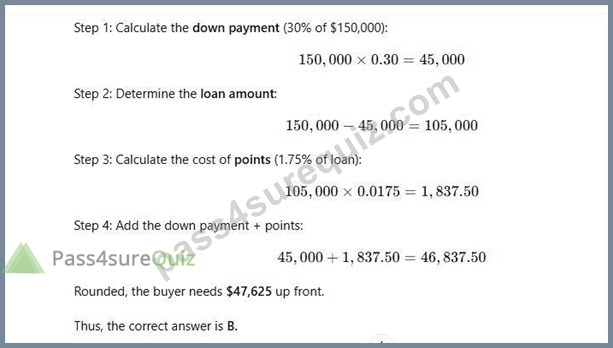
Rounded, the buyer needs $47,625 up front.
Thus, the correct answer is B.
Reference: Massachusetts Real Estate Salesperson Candidate Handbook - Financing & Math (Points, Down Payments, Loan Calculations).
NEW QUESTION # 45
A buyer receives a seller's property condition disclosure in which the buyer's agent believes the seller has misrepresented the condition of the property. The buyer's agent should
- A. call the listing agent and express this concern.
- B. point out this concern to the buyer and recommend further inspection or investigation before proceeding.
- C. recommend that the buyer withdraw from the transaction.
- D. remain silent as the agent does not know for certain that the seller has misrepresented the property.
Answer: B
Explanation:
Comprehensive and Detailed Explanation (150-250 words):
An agent owes a fiduciary duty of care, loyalty, and disclosure to their client. If a buyer's agent suspects misrepresentation in a seller disclosure, they cannot remain silent (A) because that fails fiduciary duty. They also cannot simply instruct withdrawal (B) without investigation. Communicating only with the listing agent (C) does not fulfill the duty to protect the buyer.
The proper action is to disclose the concern to the buyer and recommend further investigation, inspections, or professional evaluations before proceeding. This allows the buyer to make an informed decision and protects the agent from liability.
Correct answer: D.
Reference: Massachusetts Real Estate Salesperson Candidate Handbook - Agency Obligations; Seller Disclosure Laws.
NEW QUESTION # 46
The listing broker has been presented with multiple offers. The seller would accept only a cash offer on the home, so the broker will present
- A. all offers to the seller.
- B. the highest offer to the seller.
- C. the highest cash offer to the seller.
- D. only cash offers to the seller.
Answer: A
Explanation:
Comprehensive and Detailed Explanation (150-250 words):
Under license law and the broker's fiduciary duty of obedience and disclosure, the listing broker must present all offers to the seller promptly, regardless of terms, unless the seller gives prior written instructions to the contrary. The broker does not have discretion to screen offers or present only those that match the seller's preferences.
It is the seller's decision whether to reject, accept, or counter offers (including non-cash offers). By law, withholding offers could constitute a violation of fiduciary duty and possibly discrimination if done selectively.
Thus, the correct answer is D: all offers to the seller.
Reference: Massachusetts Real Estate Salesperson Candidate Handbook - Agency Duties; 254 CMR 3.00.
NEW QUESTION # 47
The Massachusetts Consumer Protection Act requires that
- A. The seller disclose all offers received.
- B. The broker disclose known material defects.
- C. The seller's information be kept confidential.
- D. The buyer be informed of all offers.
Answer: B
Explanation:
The Massachusetts Consumer Protection Act (M.G.L. c. 93A) prohibits unfair or deceptive practices in trade or commerce. In real estate, this means that a broker must disclose known material defects to prospective buyers. Failing to do so constitutes a deceptive act and can subject the broker to liability, including double or treble damages, attorney's fees, and court costs.
While sellers and buyers have their own disclosure obligations, the statute specifically imposes consumer protection responsibilities on businesses, including real estate brokers. Confidentiality of client information is a fiduciary duty under agency law, not a requirement of Chapter 93A. Offers themselves must always be presented to clients, but Chapter 93A focuses primarily on material misrepresentation and nondisclosure.
Reference: M.G.L. c. 93A; 254 CMR 3.00; Massachusetts Real Estate Candidate Information Bulletin - Consumer Protection Law.
NEW QUESTION # 48
Standard title insurance would protect a buyer
- A. in a purchase where the buyer had knowledge of a shed violating setback requirements.
- B. for the purchase of a property bought sight unseen where the buyer discovers a tenant living at the property.
- C. if after closing, the HOA placed a lien on the property for the previous owner's unpaid dues.
- D. when the seller has forged an ex-partner's signature on the deed.
Answer: D
Explanation:
Comprehensive and Detailed Explanation (150-250 words):
Standard title insurance protects against defects in title that existed prior to closing and were not discovered in the public record. Covered risks include:
Forged deeds or signatures.
Fraud in the chain of title.
Undisclosed heirs.
Mistakes in recording.
Therefore, if a seller forged a co-owner's (ex-partner's) signature on the deed, title insurance would cover the buyer.
B: Post-closing liens (such as new HOA liens) are not covered.
C: Known defects or issues (shed violating setbacks) are not covered.
D: Occupancy issues are outside the scope of standard title coverage.
Thus, the correct answer is A.
Reference: Massachusetts Real Estate Salesperson Candidate Handbook - Transfer of Title; Title Insurance.
NEW QUESTION # 49
Which of the following is true of a quitclaim deed?
- A. It cannot be recorded.
- B. It cannot be used to transfer a title held in fee simple.
- C. It has warranties similar to a special warranty deed.
- D. It can be used to remove a cloud on a title.
Answer: D
Explanation:
A quitclaim deed is commonly used in Massachusetts to transfer whatever interest the grantor may have in the property, without any warranties of title. The grantor does not guarantee that they own the property or that the title is clear; they are simply releasing ("quitting") any claim they might have.
This makes quitclaim deeds useful for curing defects or removing a cloud on title, such as correcting a name, releasing an interest, or resolving minor disputes. While Massachusetts typically uses quitclaim deeds even in regular sales transactions (where other states may prefer warranty deeds), their primary legal function is still to transfer without guarantees.
The other options are incorrect:
A: It can transfer fee simple interest.
B: It provides no warranties, unlike a special warranty deed.
D: It can be recorded.
Reference: Massachusetts Real Estate Salesperson Candidate Handbook - Transfer of Title; M.G.L. Chapter
183 (Conveyances of Land).
NEW QUESTION # 50
Under Housing and Urban Development guidelines, when an advertisement includes the phrase "walk to bus- stop," the advertisement is
- A. Discriminatory against individuals with disabilities.
- B. Only discriminatory if the statement is false.
- C. Only discriminatory against disabled individuals in some cases.
- D. Not discriminatory against disabled individuals.
Answer: D
Explanation:
HUD guidelines on advertising under the Fair Housing Act (42 U.S.C. §§ 3601-3619) prohibit language that expresses limitations, preferences, or discrimination based on a protected class (race, color, religion, sex, disability, familial status, or national origin). However, phrases describing the property's location or proximity to amenities (such as "walk to bus-stop" or "near shopping center") are not considered discriminatory under HUD's advertising rules.
HUD distinguishes between "steering language" and neutral descriptors. References to nearby services are acceptable because they do not discourage or exclude individuals with disabilities; they simply describe a geographic fact. HUD specifically lists "walk to transportation" as non-discriminatory advertising language in its Fair Housing Advertising Guidelines.
Reference: HUD Fair Housing Advertising Guidelines; Fair Housing Act (42 U.S.C. § 3604(c)).
NEW QUESTION # 51
Deposit money received by a salesperson must be turned over to the salesperson's broker
- A. Within three days.
- B. Immediately.
- C. At the date specified in the offer to purchase.
- D. At the signing of the purchase and sale agreement.
Answer: B
Explanation:
Under 254 CMR 3.10, all deposit money received by a salesperson must be immediately turned over to the salesperson's broker for deposit into the escrow account. It is the broker's responsibility to ensure that the funds are properly held and protected, not the salesperson's.
The rule is clear that the funds should be handed over immediately. Any delay in submitting the funds to the broker could violate escrow rules and could result in disciplinary action.
Reference: 254 CMR 3.10 - Handling of Client Funds; Massachusetts Real Estate Candidate Information Bulletin - Escrow Procedures.
NEW QUESTION # 52
Which of the following is used in the cost approach when estimating the value of improvements?
- A. The assessed value of the property including the land.
- B. The price per square foot of comparable properties.
- C. How much it would cost to build a similar building at today's cost.
- D. Location, available financing, and depreciation.
Answer: C
Explanation:
The cost approach to value is based on the principle of substitution, which states that a buyer will not pay more for a property than the cost to build a comparable one. In this method, the appraiser estimates the current cost of constructing the improvements using either the replacement cost (cost to build a similar building with modern materials and methods) or the reproduction cost (exact duplicate of the original).
The appraiser then subtracts depreciation (physical deterioration, functional obsolescence, or economic obsolescence) and adds the land value (determined separately). This approach is most often used for special- purpose properties (schools, churches, government buildings) where comparable sales are limited.
The other options are incorrect:
Assessed value (A) is for taxation, not appraisal.
Price per square foot (C) is a sales comparison method.
Location/financing (D) are factors but not a direct step in the cost approach.
Reference: Massachusetts Real Estate Salesperson Candidate Handbook - Appraisal Methods; USPAP Standards.
NEW QUESTION # 53
A broker has been engaged to locate a property for a buyer. The broker has determined that a suitable property for the buyer is for sale and is owned by the broker's cousin. The broker has not informed the buyer of the broker's relationship with the owner. If the buyer purchases the property under these circumstances, the broker is
- A. Not violating the license law because the broker in this situation has no duty of disclosure.
- B. Violating the license law because a relative's interest shall be made known to all parties.
- C. Violating the license law because it is illegal to purchase family property for a principal.
- D. Not violating the license law because a relative's interest is an exception to the fiduciary duty rule.
Answer: B
Explanation:
Under Massachusetts real estate license law, a broker must disclose any personal interest, or the interest of an immediate family member, in a transaction to all parties. This is a matter of fiduciary duty and is explicitly required under 254 CMR 3.00.
Failing to disclose that the seller is the broker's cousin constitutes a conflict of interest and violates the duty of loyalty, disclosure, and honesty to the client (the buyer). While it is not illegal to buy or sell property involving relatives, the relationship must always be made known to avoid misrepresentation or concealment of material facts.
Therefore, the broker is in violation because the familial relationship was not disclosed.
Reference: 254 CMR 3.00 - Duties of Licensees; M.G.L. c. 112, § 87AAA; Massachusetts Real Estate Candidate Information Bulletin - Agency & Disclosure.
NEW QUESTION # 54
A licensee whose license has been suspended is required to
- A. Do nothing; no action is required.
- B. Appeal the decision within 14 days.
- C. Stop working, but may still make referrals.
- D. Surrender the license to the Board of Registration.
Answer: D
Explanation:
When a real estate license is suspended in Massachusetts, the licensee must surrender their license to the Board of Registration immediately. Suspension means the licensee is temporarily prohibited from engaging in real estate activities.
The licensee cannot continue to work, make referrals, or conduct any real estate transactions during the suspension period. They must follow the suspension terms set by the Board, and the license will be reinstated after the suspension period has ended, provided they comply with any further requirements. The licensee may appeal the decision, but this must be done separately from the immediate surrender requirement.
Reference: M.G.L. c. 112, § 87FF; 254 CMR 5.00 - Disciplinary Action.
NEW QUESTION # 55
To avoid triggering full disclosure under TILA when advertising financing availability on a listed property, which of the following statements must a real estate licensee avoid using?
- A. FHA and VA financing available
- B. owner willing to finance
- C. assumable loan
- D. buy for less than $650 per month
Answer: D
Explanation:
The Truth in Lending Act (TILA, Regulation Z) regulates advertising of credit terms. If an advertisement contains a triggering term such as the amount of down payment, monthly payment, interest rate, or repayment period, then full disclosure of all financing terms must be provided.
"Buy for less than $650 per month" (D) is a triggering term because it states a specific monthly payment. This requires full disclosure of the APR, down payment, term, and total cost of financing.
"Assumable loan" (A), "owner willing to finance" (B), and "FHA and VA financing available" (C) are general financing terms that do not trigger mandatory disclosure.
Thus, the correct answer is D.
Reference: Federal TILA (Regulation Z), 12 C.F.R.1026; Massachusetts Real Estate Salesperson Candidate Handbook - Financing.
NEW QUESTION # 56
Under an option to buy, the ownership of land will change when the
- A. option is signed by the parties.
- B. optionee exercises the option.
- C. specified time has expired.
- D. optionor does not fulfill the obligation.
Answer: B
Explanation:
Comprehensive and Detailed Explanation (150-250 words):
An option to buy is a unilateral contract where the seller (optionor) gives the buyer (optionee) the exclusive right to purchase property within a set period at agreed terms. Ownership does not transfer when the option is signed - only when the optionee exercises the option and a purchase contract is completed.
A: The option itself does not transfer ownership.
B: Optionor has no further obligations beyond honoring the option.
D: Expiration ends the option with no transfer.
Thus, title passes only after the optionee exercises the option and proceeds with purchase.
Reference: Massachusetts Real Estate Salesperson Candidate Handbook - Contracts; Options in Real Estate.
NEW QUESTION # 57
If a lender has granted a VA-guaranteed loan to a veteran, the veteran
- A. cannot apply for another VA loan in the veteran's lifetime.
- B. cannot prepay any of the principal amount of the loan.
- C. makes the down payment directly to the VA.
- D. may sell the property to another veteran who assumes the loan.
Answer: D
Explanation:
Comprehensive and Detailed Explanation (150-250 words):
A VA-guaranteed loan allows veterans to purchase with little or no down payment. Once the loan is made, the veteran deals directly with the lender - not the VA. The VA guarantees repayment to the lender if default occurs.
A: Down payments, if required, are paid to the lender, not the VA.
B: Veterans may obtain multiple VA loans in a lifetime, depending on eligibility and entitlement.
C: VA loans allow prepayment without penalty.
D: VA loans are assumable, meaning another veteran (or even non-veteran, with lender approval) may assume the existing financing, often a benefit if the loan has a favorable interest rate.
Correct answer: D.
Reference: VA Lender's Handbook; Massachusetts Real Estate Salesperson Candidate Handbook - Financing
/VA Loans.
NEW QUESTION # 58
Which of the following statements concerning a security deposit is correct?
- A. It may be maintained in the landlord's regular business account as long as it is interest-bearing.
- B. It must be returned to the tenant within twenty-one days of termination of occupancy.
- C. It may not exceed the first month's rent.
- D. It must be transferred to the tenant when the building is sold.
Answer: B
Explanation:
Under M.G.L. c. 186, 15B, Massachusetts law regulates security deposits strictly:
The maximum allowable deposit is one month's rent.
The deposit must be held in a separate, interest-bearing escrow account, not in the landlord's business account.
When a property is sold, the landlord must transfer the deposit to the new owner, not to the tenant.
Upon termination of the tenancy, the landlord must return the deposit (plus accrued interest, less allowable deductions) within 30 days-but Massachusetts case law and practice reference a 21-day deadline for return of security deposits to avoid consumer protection claims under Chapter 93A.
Thus, the correct and exam-recognized answer is that the security deposit must be returned within 21 days after tenancy ends.
Reference: M.G.L. c. 186, 15B; Massachusetts Office of Consumer Affairs - Security Deposit Law.
NEW QUESTION # 59
According to the CAN-SPAM Act, every email advertisement for real estate services must do all of the following EXCEPT
- A. allow a method for the recipient to opt out and not receive future emails.
- B. inform the recipient of the name and location of the brokerage firm.
- C. clearly indicate the nature of the content of the email.
- D. advise the recipient that it will take 180 days to remove the recipient's name from this email list.
Answer: D
Explanation:
Comprehensive and Detailed Explanation (150-250 words):
The CAN-SPAM Act of 2003 governs commercial email. Key requirements include:
Emails must not use misleading subject lines (A).
Must include the sender's valid physical postal address (B).
Must provide a clear, simple way to opt out of future emails (C).
Opt-out requests must be honored within 10 business days, not 180 days.
Thus, advising that it will take 180 days to remove an email address is not compliant.
Correct answer: D.
Reference: CAN-SPAM Act (15 U.S.C. 7704); Massachusetts Real Estate Salesperson Candidate Handbook
- Advertising Compliance.
NEW QUESTION # 60
A buyer and a seller have a purchase agreement that contains a home inspection contingency. The buyer has applied for a VA mortgage. After the home inspection is completed, the buyer writes an addendum requesting that the seller pay to repair several items found by the home inspector. The seller counters the addendum by requiring that the buyer agree that the repairs will be made, but that no further expenses will be incurred by the seller. The VA appraisal inspection has not been conducted. Under these circumstances, which of the following is correct?
- A. There is no longer a valid contract.
- B. The original contract is still in effect.
- C. The VA inspection is not necessary because the buyer's home inspection report will be sent to the mortgage company.
- D. The licensee should encourage the seller to place the home back on the market.
Answer: B
Explanation:
Comprehensive and Detailed Explanation (150-250 words):
In this scenario, the parties have entered into a binding purchase agreement with a home inspection contingency. The buyer submitted an addendum requesting seller repairs, but the seller countered. Since the buyer has not yet accepted, the counter is not binding - therefore, the original contract remains in effect until both parties agree to a modification.
Additionally, because the financing is a VA loan, the VA still requires a VA appraisal (separate from the buyer's home inspection) to determine value and minimum property requirements. The VA inspection cannot be waived by substituting the home inspector's report.
Thus, the correct answer is B: the original contract is still in effect.
Reference: Massachusetts Real Estate Salesperson Candidate Handbook - Contracts; VA Loan Program Guidelines.
NEW QUESTION # 61
What is the difference between a license to use property and an easement?
- A. There must be consideration paid for a license.
- B. An easement can be cancelled by the issuer.
- C. A license can be cancelled by the issuer.
- D. There must be consideration paid for an easement.
Answer: C
Explanation:
A license is a personal, revocable privilege to enter or use another person's land for a specific purpose (e.g., a ticket to a sporting event). A license does not create an interest in land and may be revoked at any time by the issuer.
An easement, however, is a non-possessory interest in land that grants a legal right to use the property of another (e.g., a right-of-way). Easements are generally permanent, run with the land, and cannot simply be canceled by the property owner at will.
Massachusetts law distinguishes between the two: easements are formal property interests that usually require a written grant and may only be terminated by agreement, expiration, or court action, while licenses are informal, temporary, and revocable.
Thus, the correct answer is A: A license can be cancelled by the issuer.
Reference: Massachusetts Real Estate Salesperson Candidate Handbook - Property Interests and Rights; M.G.
L. c. 183.
NEW QUESTION # 62
The two clauses in a mortgage which allow the lender to proceed with a foreclosure sale are which of the following?
- A. foreclosure clause and alienation clause
- B. acceleration clause and power of sale clause
- C. escalation clause and alienation clause
- D. escalation clause and power of sale clause
Answer: B
Explanation:
Comprehensive and Detailed Explanation (150-250 words):
Two key clauses permit a lender to enforce foreclosure:
Acceleration clause - allows the lender to declare the entire debt immediately due and payable if the borrower defaults. Without this clause, the lender could only sue for past-due installments.
Power of sale clause - common in Massachusetts "title theory" mortgages, it authorizes the lender to sell the property at public auction without going through full judicial foreclosure.
The alienation clause (also called a "due-on-sale" clause) allows the lender to demand payoff when the property is transferred, not for foreclosure. The escalation clause allows interest rate or payment adjustments, not foreclosure.
Therefore, the correct pair that authorizes foreclosure is D: acceleration clause and power of sale clause.
Reference: Massachusetts Real Estate Salesperson Candidate Handbook - Financing Instruments; M.G.L. c.
183 21 (Power of Sale Foreclosure).
NEW QUESTION # 63
......
Massachusetts-Real-Estate-Salesperson Exam Dumps For Certification Exam Preparation: https://www.pass4surequiz.com/Massachusetts-Real-Estate-Salesperson-exam-quiz.html
Download Free Real Estate Massachusetts-Real-Estate-Salesperson Exam Questions & Answer : https://drive.google.com/open?id=1oF45E8R41FOi6Qse8o3a_E-7AJUDH0DO