

Updated May-2026 Massachusetts-Real-Estate-Salesperson Exam Practice Test Questions
Verified Massachusetts-Real-Estate-Salesperson dumps Q&As 100% Pass in First Attempt Guaranteed Updated Dump
NEW QUESTION # 62
What kind of lease would require the lessee to pay the taxes, insurance, repairs, and other operating expenses of the premises in addition to the regular rental payment?
- A. gross lease
- B. percentage lease
- C. net lease
- D. graduated lease
Answer: C
Explanation:
In a net lease, the tenant (lessee) is responsible not only for the base rent but also for additional property expenses such as real estate taxes, insurance, maintenance, and sometimes repairs. This is common in commercial leasing, particularly for office buildings and retail space.
A gross lease (B) means the landlord pays all expenses, while the tenant pays only rent. A percentage lease (A) bases rent partly on tenant sales (common in retail malls). A graduated lease (C) allows rent increases at set intervals.
Because the question describes a tenant paying rent plus taxes, insurance, and operating expenses, this is a net lease.
Reference: Massachusetts Real Estate Salesperson Candidate Handbook - Leasing & Property Management; Commercial Leasing Practices.
NEW QUESTION # 63
According to the Massachusetts Fair Housing Law, it is unlawful to ask prospective tenants questions about their
- A. Income.
- B. Place of birth.
- C. Occupation.
- D. Criminal history.
Answer: B
Explanation:
The Massachusetts Fair Housing Law (M.G.L. c. 151B) prohibits discrimination in housing based on race, color, religion, sex, sexual orientation, gender identity, national origin, age, ancestry, veteran status, familial status, disability, or receipt of public assistance. Asking about a tenant's place of birth could reveal information about national origin or ancestry, which are protected classes under both state and federal fair housing law.
By contrast, landlords and brokers are legally permitted to verify income and occupation to determine financial qualifications, and Massachusetts law also permits certain criminal history checks in compliance with state and federal guidelines. However, questioning applicants about their place of birth is directly discriminatory and unlawful.
Reference: M.G.L. c. 151B, 4; HUD Fair Housing Act Guidelines.
NEW QUESTION # 64
An offer of $569,000 is verbally accepted by a seller. Two hours later an offer of $589,000 is presented to the seller, which the seller accepts in writing. Based on the above situation the first buyer is
- A. Entitled to an additional offer.
- B. Entitled to purchase the property.
- C. Not entitled to the status as a backup offer.
- D. Not entitled to purchase the property.
Answer: D
Explanation:
Under Massachusetts law and the Statute of Frauds (M.G.L. c. 259), all contracts for the sale of real property must be in writing and signed to be enforceable. A verbal acceptance of an offer does not create a binding real estate contract. Therefore, when the seller verbally accepted the first offer of $569,000, no enforceable agreement was formed.
Later, when the seller accepted the $589,000 offer in writing, that acceptance created the first legally binding contract because it was in writing and signed. The first buyer cannot compel the seller to sell to them, as there was no enforceable written agreement.
Thus, the first buyer is not entitled to purchase the property. Only the second, written offer created enforceable contractual rights.
Reference: Massachusetts General Laws Chapter 259 (Statute of Frauds); Massachusetts Real Estate Candidate Information Bulletin, Section: Contracts.
NEW QUESTION # 65
A prospective tenant wishes to rent an apartment and is told by the owner that the owner does not want to rent to anyone with children because of the lead paint. The prospective tenant, who has children ages four, six, and nine years old, is not concerned about lead paint and wants to rent the apartment for six months. The owner agrees to lease them the unit. Concerning the lead paint, the owner must
- A. Wait to de-lead until the owner has sufficient funds.
- B. Not de-lead because this is only a six-month lease.
- C. De-lead or make lead-safe whether the tenant requires it or not.
- D. Write into the lease that the tenant has agreed that de-leading is not necessary.
Answer: C
Explanation:
Under the Massachusetts Lead Law (M.G.L. c. 111, 189A-199B), the presence of lead paint in any residential property built before 1978 where children under six will be residing requires that the property be either deleaded or brought into interim control (made lead-safe). The law does not exempt short-term leases, and the landlord must comply regardless of the lease term (even for a six-month rental).
Since the tenant has children ages four, six, and nine, the landlord must take appropriate action to either de- lead or make the property lead-safe. The tenant's lack of concern does not exempt the owner from the obligation to comply with the law.
Reference: M.G.L. c. 111, 189A-199B; Massachusetts Lead Poisoning Prevention and Control Law.
NEW QUESTION # 66
A prescriptive easement is proven by a
- A. title policy.
- B. recorded abstract.
- C. quiet title action.
- D. previous recorded deed.
Answer: C
Explanation:
A prescriptive easement is established through open, notorious, continuous, and adverse use of another's land for a statutory period (in Massachusetts, typically 20 years).
To legally recognize and establish the easement, the claimant must usually bring a quiet title action in court.
This court proceeding clarifies ownership rights and confirms the existence of the easement.
A (deed): not applicable since prescriptive easements arise without written agreements.
C (abstract): summarizes recorded documents but would not establish prescriptive rights.
D (title policy): insures title, does not prove an easement.
Thus, the correct answer is B: quiet title action.
Reference: Massachusetts Real Estate Salesperson Candidate Handbook - Easements & Rights; M.G.L. c.
187, §2.
NEW QUESTION # 67
Which of the following will NOT be considered relevant if HUD investigates a prospective home buyer's allegation of discriminatory treatment by a licensee in a brokerage office?
- A. whether or not the HUD Equal Housing Opportunity poster is displayed in the office
- B. records of the houses shown and properties suggested to the prospective buyer
- C. whether the licensee believed they were acting in the best interests of the prospective buyer
- D. the reports of undercover testers who visited the office
Answer: C
Explanation:
Comprehensive and Detailed Explanation (150-250 words):
HUD enforces the Fair Housing Act, investigating allegations of discrimination in housing. Relevant evidence in such investigations includes objective records such as listings shown, properties suggested, office policies, whether the HUD Fair Housing poster is displayed, and even reports from undercover testers.
The licensee's personal belief or intent (C) is irrelevant. The law focuses on the effect of the action, not the subjective intent of the broker. Even if the broker believes they were "acting in the client's best interest," if the conduct results in steering, blockbusting, or other discriminatory practices, it is still a violation.
Therefore, the only irrelevant factor is the licensee's personal belief, making C the correct answer.
Reference: Fair Housing Act, 42 U.S.C. 3600; HUD Fair Housing Investigative Procedures; Massachusetts Real Estate Salesperson Candidate Handbook - Fair Housing.
NEW QUESTION # 68
A broker lists a property abutting a pond. A potential buyer is interested in the property but plans to build an addition onto a boathouse. The buyer will need
- A. Approval from the State Sanitary Commission.
- B. A certificate of compliance.
- C. Approval from the local conservation commission.
- D. A letter of interim control.
Answer: C
Explanation:
If a property abuts a pond, the potential construction of any addition, especially near water, may require approval from the local conservation commission. This is because Massachusetts law, under the Massachusetts Wetlands Protection Act (M.G.L. c. 131, § 40), regulates activities near water bodies, wetlands, and other protected areas to preserve the environment and control construction near these sensitive areas.
The local conservation commission is responsible for approving construction projects that could affect the pond or surrounding wetlands. If the buyer intends to build near the pond, especially on land that may fall under these regulations, they must seek the approval of the local conservation commission before proceeding with construction.
Reference: M.G.L. c. 131, § 40 - Wetlands Protection Act; Massachusetts Real Estate Candidate Information Bulletin - Environmental Issues.
NEW QUESTION # 69
A veteran has applied for a VA loan to purchase a house with a sale price of $90,000. The Department of Veterans Affairs (VA) appraised the house at $85,000. In this situation, the veteran
- A. may buy the property with the VA loan only if the seller agrees to take back a second mortgage for
$5,000. - B. may use the VA loan to buy the house after making a down payment of $5,000.
- C. cannot secure a VA loan because such loans are limited to a maximum of $75,000.
- D. may buy the property with the VA loan only if the price is reduced to $85,000.
Answer: B
Explanation:
Comprehensive and Detailed Explanation (150-250 words):
The VA loan program guarantees part of the loan, but it is always based on the VA's Notice of Value (NOV), which is capped at the appraised value ($85,000 in this case). The veteran may still purchase at the higher price ($90,000), but must make up the difference in cash:
90
,
000
#
85
,
000
=
5
,
000
90,000#85,000=5,000
Thus, the veteran can proceed with a $5,000 down payment plus the VA-guaranteed loan of $85,000.
B: Incorrect; VA loans are not capped at $75,000.
C: The seller does not have to lower the price, though they may.
D: VA loans do not allow secondary financing to cover the appraisal gap.
Correct answer: A.
Reference: VA Lender's Handbook (Chapter 3 - The Appraisal Process); Massachusetts Real Estate Salesperson Candidate Handbook - Financing/VA Loans.
NEW QUESTION # 70
An appraisal made by a certified appraiser is required
- A. before real property can transfer from one owner to another.
- B. before any property settlement in a divorce.
- C. when heirs receive property.
- D. when the buyer is using an FHA loan to purchase.
Answer: D
Explanation:
Comprehensive and Detailed Explanation (150-250 words):
Federal law (FIRREA, 1989) and HUD regulations require that FHA and VA loans be supported by an appraisal from a state-licensed or certified appraiser. The purpose is to determine whether the property meets minimum standards and supports the loan amount.
A: Appraisals are not required for all property transfers, only certain financed ones.
B: Inheritances may require valuations for estate tax purposes, but not necessarily certified appraisals.
D: Divorce settlements may require appraisals for division of assets, but this is not federally mandated.
Thus, the correct answer is C.
Reference: HUD Handbook 4000.1; Massachusetts Real Estate Salesperson Candidate Handbook - Appraisal
/Financing.
NEW QUESTION # 71
A buyer wants to purchase a home for $150,000 with a 30% down payment. The lender charges 1.75 points.
How much money does the buyer need up front to make the purchase?
- A. $45,000
- B. $46,838
- C. $47,625
- D. $45,788
Answer: C
Explanation:
45,000+1,837.50=46,837.50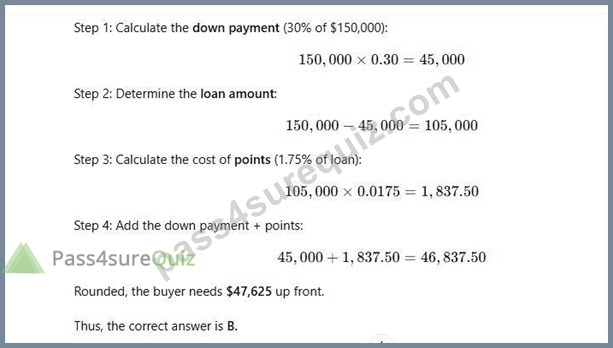
Rounded, the buyer needs $47,625 up front.
Thus, the correct answer is B.
Reference: Massachusetts Real Estate Salesperson Candidate Handbook - Financing & Math (Points, Down Payments, Loan Calculations).
NEW QUESTION # 72
A buyer is considering a property in one of the subdivisions of a Planned Unit Development (PUD). The buyer noticed nearby properties having detached garages and workshops. The buyer mentions to their agent that they want to build a detached building on the back of the lot for a home business. There is an HOA for this subdivision. Additionally, there are overarching covenants, conditions, and restrictions (CC&Rs) for the PUD. What actions, if any, should be taken by the broker to assure the buyer can use the property as they wish?
- A. Take no action because other properties have detached buildings.
- B. Recommend the buyer obtain the current CC&Rs and all current HOA documents.
- C. Recommend the buyer determine if architectural review requirements exist for the subdivision.
- D. Determine if home business use is allowed in the subdivision.
Answer: B
Explanation:
In a Planned Unit Development (PUD), buyers are subject to both subdivision-level rules (via HOAs) and overarching covenants, conditions, and restrictions (CC&Rs) that govern the entire development. Even if other neighbors have similar structures, this does not guarantee that new construction or business use will be allowed.
The broker's role is to protect the buyer's interests by ensuring they review all current CC&Rs and HOA governing documents. These documents will reveal architectural review requirements, use restrictions (including home businesses), and other limitations. The broker should not assume permissibility based on observation alone.
Thus, the best and legally correct advice is D.
Reference: Massachusetts Real Estate Salesperson Candidate Handbook - Property Ownership & PUDs; Restrictive Covenants.
NEW QUESTION # 73
A first-year licensee without either a degree in finance, or a strong background in real estate investment should generally refrain from
- A. representing a first time home buyer.
- B. representing an owner who wants to sell raw land to a developer.
- C. acting as the seller's agent in selling an oceanfront lot to a retiree.
- D. listing commercial income property.
Answer: D
Explanation:
Comprehensive and Detailed Explanation (150-250 words):
Commercial income property brokerage requires specialized competencies: analyzing rent rolls, operating statements, cap rates, cash flow, expense recoveries, lease structures (NNN, modified gross), and investment metrics (IRR, NOI, debt coverage). A first-year licensee lacking finance/investment background typically does not yet possess these skills. Massachusetts licensing materials stress competence and reasonable care
/diligence as fiduciary duties; taking assignments beyond one's expertise can breach those duties. While raw land or unique residential properties can also be complex, the exam recognizes commercial income listings as particularly finance-heavy and analysis-driven. New licensees should seek mentorship, co-list with experienced commercial practitioners, or refer such opportunities until competency is established.
Representation of first-time homebuyers (C) is a common early-career practice area, provided the agent understands agency, disclosures, financing basics, and transaction timelines. Therefore, the prudent, exam- correct choice is to refrain from listing commercial income property without appropriate background.
References: Massachusetts Real Estate Salesperson Candidate Handbook - Agency/Fiduciary Duties; Real Estate Brokerage Practice sections on competence and scope of services.
NEW QUESTION # 74
The Massachusetts Sanitary Code requires landlords to
- A. Notify a tenant 24 hours prior to entering a property.
- B. Provide a statement of condition within 30 days of the lease.
- C. Maintain their properties in a safe and habitable condition.
- D. Inspect the property every six months.
Answer: C
Explanation:
The Massachusetts State Sanitary Code (105 CMR 410) establishes minimum standards for human habitation.
Landlords are required to ensure that rental units are kept in a safe, sanitary, and habitable condition at all times. This includes maintaining heating systems, hot water, structural integrity, pest control, and ensuring compliance with health and safety standards.
While landlords may provide a statement of condition when collecting a security deposit (per M.G.L. c. 186,
§ 15B), this is not part of the Sanitary Code itself. Similarly, no law requires inspections every six months or a
24-hour notice of entry (although reasonable notice is considered best practice and is recommended in case law).
The essential legal requirement is habitability. Tenants have the right to withhold rent or seek remedies if the landlord fails to maintain the property in compliance with the Sanitary Code. Local boards of health enforce these regulations.
Reference: Massachusetts Sanitary Code, 105 CMR 410; M.G.L. c. 186, § 14; Massachusetts Real Estate Salesperson Study Guide - Landlord/Tenant Law.
NEW QUESTION # 75
A broker may withdraw money from the broker's escrow account
- A. To cover the broker's commission.
- B. When the transaction has been consummated.
- C. To pay for advertising expenses related to the sale.
- D. When ordered by the seller's attorney.
Answer: B
Explanation:
Escrow accounts are regulated under 254 CMR 3.10 and Massachusetts licensing law. All deposits, such as earnest money, must be kept in a separate escrow account maintained by the broker. These funds remain the property of the client until the transaction is consummated (closed) or otherwise terminated by mutual agreement or legal judgment.
A broker may only withdraw money when the transaction has been completed or when the parties have agreed in writing how the funds should be disbursed. Brokers cannot use escrow funds to pay commissions, marketing expenses, or other business costs until the closing. Misuse or commingling of escrow funds is a serious violation and can result in license suspension or revocation.
Reference: 254 CMR 3.10 - Handling of Client Funds; M.G.L. c. 112, 87AAA-87DDD.
NEW QUESTION # 76
Which of the following groups are protected under the Massachusetts Fair Housing Laws?
- A. Public assistance recipients
- B. Smokers
- C. Sex offenders
- D. Students
Answer: A
Explanation:
The Massachusetts Fair Housing Law (M.G.L. c. 151B) prohibits discrimination based on race, color, religion, sex, sexual orientation, gender identity, national origin, familial status, disability, and receipt of public assistance.
This includes protection for individuals who are recipients of public assistance (e.g., Section 8 housing voucher recipients). Sex offenders, students, and smokers are not protected classes under the law. While landlords can regulate smoking and may have policies on students or criminal history, they cannot discriminate based on receipt of public assistance, which is a specifically protected category under Massachusetts law.
Reference: M.G.L. c. 151B; Massachusetts Fair Housing Guidelines.
NEW QUESTION # 77
When lending standards are tightened, lenders typically require
- A. a higher loan-to-value ratio.
- B. a lower loan-to-value ratio.
- C. a waiver of the Equal Credit Opportunity Act.
- D. a balloon payment after 5 years.
Answer: B
Explanation:
The loan-to-value ratio (LTV) is the loan amount compared to the property's value or purchase price.
A lower LTV ratio means that the borrower must make a larger down payment, reducing the lender's risk.
A higher LTV ratio (A) increases risk and is more common in loose lending markets.
C (balloon payments) is a loan feature, not directly related to tightening standards.
D (waiving ECOA) is illegal; lenders cannot require waiving anti-discrimination protections.
Thus, in tighter credit markets, lenders protect themselves by requiring lower LTV ratios.
Reference: Massachusetts Real Estate Salesperson Candidate Handbook - Financing; Federal Reserve Lending Guidelines.
NEW QUESTION # 78
A real estate licensee is a partial owner of a local inspection company. It is permissible for the licensee to tell all clients to use this company when
- A. the licensee does not know any of the other title companies in the area.
- B. the client does not ask for other recommendations.
- C. it is in the best interest of the client.
- D. the licensee discloses the interest in the company to the client.
Answer: D
Explanation:
Under Massachusetts law and federal RESPA (Real Estate Settlement Procedures Act, Section 8), real estate professionals may have an ownership interest in related businesses (such as inspection, title, or mortgage companies), but they must provide full disclosure of this interest to clients in writing.
Steering clients exclusively to a business in which the agent has a financial interest - without disclosure - is a conflict of interest and a violation of fiduciary duties. However, once the relationship is disclosed, the client may freely choose whether to use that company or not.
The other options are incorrect because:
"Best interest" (A) doesn't override disclosure requirements.
Lack of knowledge of competitors (B) is not an excuse.
Failing to disclose simply because the client doesn't ask (C) is a violation.
Thus, the only permissible action is disclosure (D).
Reference: Massachusetts Real Estate Salesperson Candidate Handbook - Agency & Disclosure; RESPA, 12
U.S.C. §2607.
NEW QUESTION # 79
A seller informs the listing broker that the wind chime on the back door is broken and the roof leaks when it rains. The listing broker is required to disclose
- A. The wind chime.
- B. Both the wind chime and the leaky roof.
- C. The leaky roof.
- D. Nothing.
Answer: C
Explanation:
Massachusetts law requires real estate licensees to disclose material defects of which they are aware. A material defect is any condition that would significantly affect the health, safety, or value of the property. In this case, a leaky roof is considered a material defect because it can cause substantial property damage, affect habitability, and impact property value.
On the other hand, a broken wind chime is a minor cosmetic defect that does not materially affect the property's value or use. Licensees are not required to disclose trivial issues but must disclose known material defects even if instructed by the seller to remain silent. Failure to disclose material defects constitutes misrepresentation and may result in disciplinary action.
Reference: 254 CMR 3.00 - Duties of Licensees; Massachusetts Real Estate Salesperson Candidate Information Bulletin - Agency & Disclosure.
NEW QUESTION # 80
A broker has been engaged to locate a property for a buyer. The broker has determined that a suitable property for the buyer is for sale and is owned by the broker's cousin. The broker has not informed the buyer of the broker's relationship with the owner. If the buyer purchases the property under these circumstances, the broker is
- A. Violating the license law because a relative's interest shall be made known to all parties.
- B. Not violating the license law because the broker in this situation has no duty of disclosure.
- C. Violating the license law because it is illegal to purchase family property for a principal.
- D. Not violating the license law because a relative's interest is an exception to the fiduciary duty rule.
Answer: A
Explanation:
Under Massachusetts real estate license law, a broker must disclose any personal interest, or the interest of an immediate family member, in a transaction to all parties. This is a matter of fiduciary duty and is explicitly required under 254 CMR 3.00.
Failing to disclose that the seller is the broker's cousin constitutes a conflict of interest and violates the duty of loyalty, disclosure, and honesty to the client (the buyer). While it is not illegal to buy or sell property involving relatives, the relationship must always be made known to avoid misrepresentation or concealment of material facts.
Therefore, the broker is in violation because the familial relationship was not disclosed.
Reference: 254 CMR 3.00 - Duties of Licensees; M.G.L. c. 112, § 87AAA; Massachusetts Real Estate Candidate Information Bulletin - Agency & Disclosure.
NEW QUESTION # 81
Which of the following is used in the cost approach when estimating the value of improvements?
- A. The assessed value of the property including the land.
- B. The price per square foot of comparable properties.
- C. Location, available financing, and depreciation.
- D. How much it would cost to build a similar building at today's cost.
Answer: D
Explanation:
The cost approach to value is based on the principle of substitution, which states that a buyer will not pay more for a property than the cost to build a comparable one. In this method, the appraiser estimates the current cost of constructing the improvements using either the replacement cost (cost to build a similar building with modern materials and methods) or the reproduction cost (exact duplicate of the original).
The appraiser then subtracts depreciation (physical deterioration, functional obsolescence, or economic obsolescence) and adds the land value (determined separately). This approach is most often used for special- purpose properties (schools, churches, government buildings) where comparable sales are limited.
The other options are incorrect:
Assessed value (A) is for taxation, not appraisal.
Price per square foot (C) is a sales comparison method.
Location/financing (D) are factors but not a direct step in the cost approach.
Reference: Massachusetts Real Estate Salesperson Candidate Handbook - Appraisal Methods; USPAP Standards.
NEW QUESTION # 82
Based on the common law of agency, which of the following would always be an agent's duty?
- A. disclosing that the reason a client is selling is an impending divorce
- B. placing the interests of the principal above all others, including the agent's own interests
- C. hiring a contractor to repair a listing with a leaky roof
- D. analyzing the preliminary title report and advising the buyer regarding exceptions listed
Answer: B
Explanation:
The common law of agency requires real estate licensees to act in the best interests of their principal (the client). The six fiduciary duties are: obedience, loyalty, disclosure, confidentiality, accounting, and reasonable care/diligence.
The most fundamental of these is loyalty - meaning the agent must always place the client's interests above all others, including their own.
Hiring a contractor (A) goes beyond the agent's authority unless authorized.
Disclosing divorce (B) would breach confidentiality, not fulfill a duty.
Analyzing legal title exceptions (C) constitutes unauthorized legal practice.
Thus, the correct answer is D: placing the principal's interests first.
Reference: Massachusetts Real Estate Salesperson Candidate Handbook - Agency Law; Common Law Fiduciary Duties.
NEW QUESTION # 83
A seller has entered into an exclusive right to sell agreement with a broker. The buyer presents the seller with an offer to purchase which is 20% less than the list price. Which of the following is appropriate?
- A. The seller is obligated to pay the buyer a commission or the offer price if the seller rejects the offer.
- B. The seller is under no obligation to accept the offer or make a counteroffer.
- C. The seller is obligated to make a counteroffer to the buyer if the offer is unacceptable.
- D. The seller has 72 hours to submit a counteroffer or else the offer is considered to be accepted.
Answer: B
Explanation:
Comprehensive and Detailed Explanation (150-250 words):
A listing agreement gives the broker the right to market the property and earn a commission if a ready, willing, and able buyer is found, but it does not obligate the seller to accept any offer. Even if the offer is below asking price, the seller can accept, reject, or counteroffer. The seller has full discretion to decide, and no automatic acceptance or commission liability arises just because the offer is refused.
A: Incorrect, seller never owes buyer a commission.
C: There is no automatic "72-hour" acceptance rule unless specifically written into the offer.
D: Seller is not required to counter.
Thus, the correct answer is B.
Reference: Massachusetts Real Estate Salesperson Candidate Handbook - Brokerage Agreements; Agency Duties.
NEW QUESTION # 84
Which of the following activities may result in a fine from the Massachusetts Commission Against Discrimination (MCAD) against a licensee?
- A. Blockbusting
- B. Failing to give both the buyer and the seller a copy of the purchase and sales agreement
- C. Acting in the dual capacity of broker and undisclosed principal in the same transaction
- D. Knowingly making any substantial misrepresentation
Answer: A
Explanation:
The Massachusetts Commission Against Discrimination (MCAD) is the state agency responsible for enforcing the Massachusetts Fair Housing Law (M.G.L. c. 151B). Blockbusting is the illegal practice of inducing homeowners to sell by suggesting that protected classes of people (such as minorities, families with children, or people receiving public assistance) are moving into the neighborhood, often suggesting declining property values.
This practice is explicitly prohibited under both federal law (Fair Housing Act) and Massachusetts General Law. MCAD has the authority to investigate complaints of housing discrimination and levy fines against licensees found guilty of such violations.
While misrepresentation or undisclosed dual capacity may lead to disciplinary action by the Massachusetts Board of Registration of Real Estate Brokers and Salespersons, only violations of fair housing law, such as blockbusting, steering, or refusing to deal with members of protected classes, fall under the jurisdiction of MCAD.
Reference: Massachusetts General Laws c. 151B; MCAD Fair Housing Guidelines; 254 CMR 3.00.
NEW QUESTION # 85
Inactive salespersons are permitted to perform which of the following activities?
- A. Refer potential buyers to an active salesperson in exchange for a fee from the salesperson.
- B. Refer potential listings to an active broker in exchange for a fee from the active broker.
- C. List homes by telephone.
- D. Affiliate with inactive brokers.
Answer: B
Explanation:
An inactive salesperson in Massachusetts holds a license that is not active for brokerage activities (buying, selling, leasing). They may not list homes, show property, or handle transactions.
However, under M.G.L. c. 112, an inactive licensee may receive a referral fee from an active broker for referring potential business. This is because the inactive license keeps the person legally affiliated with the licensing system, even though they cannot directly engage in brokerage.
They may not be paid directly by other salespersons, nor may they affiliate with inactive brokers. Referrals and fee-sharing must always flow through an active broker.
Reference: M.G.L. c. 112, 87RR, 87SS; 254 CMR 2.00.
NEW QUESTION # 86
An example of modular construction is
- A. an apartment building.
- B. a log cabin.
- C. prefabricated housing.
- D. a home used as a model.
Answer: C
Explanation:
In real estate and construction terminology, modular construction refers to a building method where sections of the home are manufactured in a factory setting, transported to the building site, and then assembled on a permanent foundation. This is a form of prefabricated housing, but different from mobile homes because modular homes are considered real property once placed on their permanent foundation.
Massachusetts licensing materials classify modular homes under prefabricated housing because they are built off-site to precise specifications and then joined together at the location. This method provides greater efficiency, lower cost, and adherence to state and local building codes. By contrast, apartment buildings (B) are traditionally built on-site, a model home (C) is only a sales demonstration, and a log cabin (D) may be site- built but not considered modular unless pre-manufactured in sections.
Therefore, the correct answer is A: prefabricated housing.
Reference: Massachusetts Real Estate Salesperson Candidate Handbook - Property Ownership and Land Use Controls section; Modern Real Estate Practice, 20th Edition, Construction Methods.
NEW QUESTION # 87
......
Ultimate Guide to Prepare Free Massachusetts-Real-Estate-Salesperson Exam Questions and Answer: https://drive.google.com/open?id=1oF45E8R41FOi6Qse8o3a_E-7AJUDH0DO
Pass Massachusetts Real Estate Massachusetts-Real-Estate-Salesperson Exam With 139 Questions: https://www.pass4surequiz.com/Massachusetts-Real-Estate-Salesperson-exam-quiz.html